Aspen Tree Care in Sparks: A Practical Guide to Healthier Trees
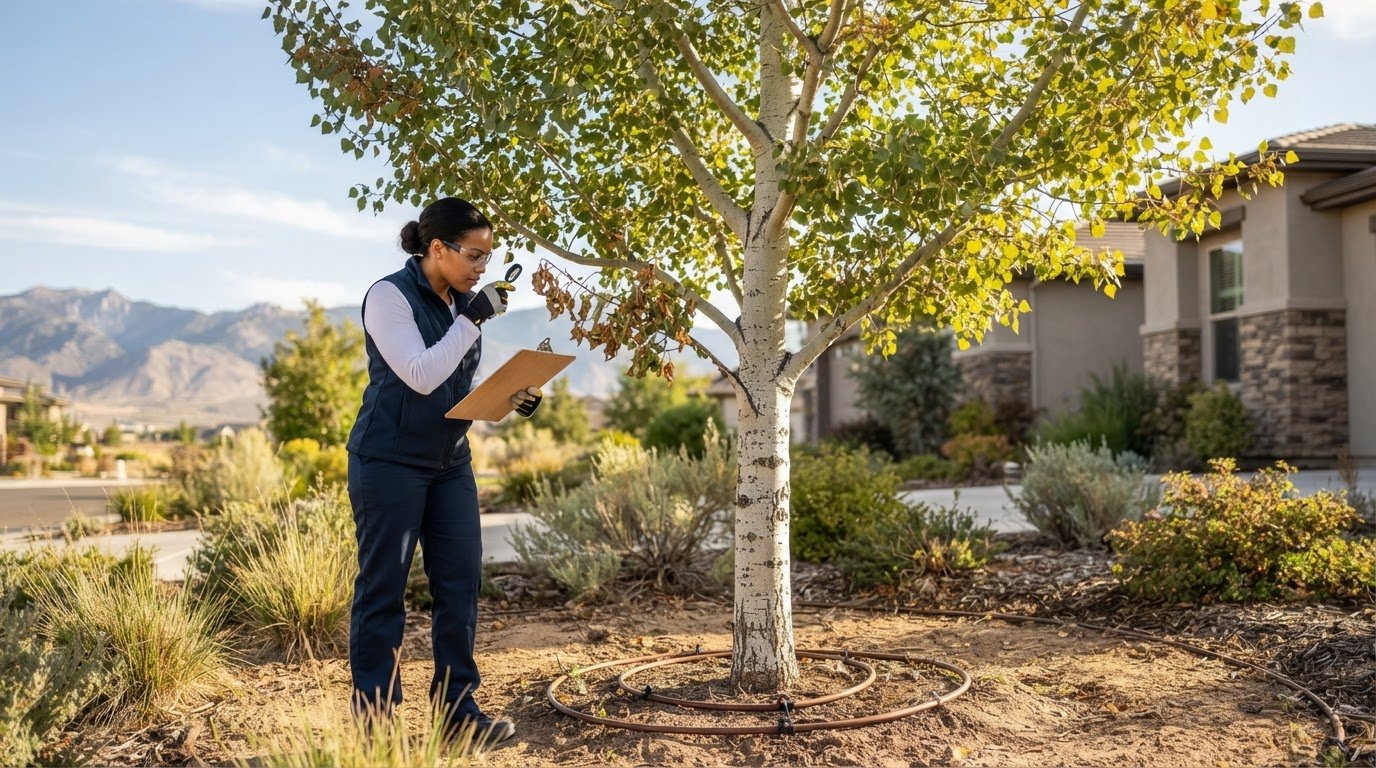
What if a few yellowing leaves or a bare branch don’t tell the whole story of your aspen? In Sparks, heat, dry conditions, watering patterns, pests, and disease can all affect tree health. If you’re searching for “aspen tree care Sparks,” start by looking at the tree and its growing site together. A change may be part of the normal cycle, or it may be a sign that your tree needs attention.
This guide covers practical aspen care for local conditions, common signs of stress, and when a closer assessment can help. You’ll learn how to track changes, consider watering and pruning, and avoid assuming that one symptom points to a specific problem. Battle Born Pest Control’s certified arborists provide tree health assessments and tailored recommendations, connecting visible changes with site conditions to help you choose a measured next step for the tree and your property.
Key Takeaways
- Use changes in leaves, branches, and trunks as clues to observe, not as a diagnosis on their own.
- Consider the tree’s overall condition and growing site when deciding what care may help.
- Compare observation, an arborist assessment, pruning, and pest or disease management to choose a response suited to the concern.
- Keep a simple record of symptoms, timing, and recent site changes to make your next care decision more grounded.
- Certified arborists can connect what you notice with tailored recommendations, including removal when appropriate for tree and property safety.
Aspen Tree Care in Sparks: What Healthy Growth Looks Like
Good aspen care starts with observation, not an immediate treatment. Look at the tree as a whole, consider the conditions around it, and match any care to what the evidence suggests. A yellow leaf, thinning patch, or dead branch is worth noting, but one symptom alone doesn’t identify its cause or show what action is needed. Similar signs can have different explanations, so look for patterns before drawing conclusions.
Many local homeowners are familiar with Quaking aspen (Populus tremuloides), a deciduous tree whose foliage changes through the growing year. In fall, leaf color and leaf drop can be part of the seasonal cycle, so color by itself isn’t a reliable measure of health. Individual leaves and branches may also vary. Assess the canopy and new growth alongside any unusual spots or bare areas.
How to recognize normal aspen growth
A canopy with foliage distributed across its branches and visible new growth may look reassuring, but neither feature proves that a tree is healthy. Compare the whole tree with your earlier observations, if available. Note when a change first appears, which part of the canopy it affects, and whether it stays localized or spreads. This simple record can help distinguish a passing change from a developing pattern.
Notice whether leaf changes affect the whole tree or a limited area, and whether bare branches appear during a seasonal transition or remain bare as other parts produce foliage. These are clues, not diagnoses. Avoid removing branches or applying treatments based on a single visual sign. Identifying the likely cause first can help prevent care that doesn’t address the tree’s needs.
Why the Sparks site matters to an aspen
An aspen’s surroundings influence how it grows and responds to stress. Consider how much sun reaches the canopy, how and when the tree receives water, and whether the soil drains or stays wet. Recent construction, changes to nearby irrigation, or disturbance around the roots may also be relevant. Local weather and the conditions in an individual yard can interact, so consider both rather than assuming every aspen faces the same pressures.
Site context matters because the same symptom can point to different concerns depending on a tree’s growing conditions. To guide aspen tree care, Sparks homeowners can note site conditions alongside visible changes. If symptoms persist, spread, or raise concerns about people or property, an arborist-led tree health assessment can connect those observations with the site and help determine a measured next step.
How to Assess Aspen Leaves, Branches, and Trunks Before Choosing Care
Start your inspection from the ground, at a safe distance. Look across the canopy, then note visible changes to leaves, branches, and trunk without climbing, pulling at bark, or standing beneath an unstable limb. The goal is to describe what you see, not diagnose the cause. Similar-looking symptoms can result from different conditions, so a careful record is more useful than a quick guess.
What changing leaves may tell you, and what they cannot
Discoloration, spots, wilting, or leaves dropping earlier than expected are observations, not diagnoses. Compare affected areas with parts of the canopy that look unchanged. Are symptoms limited to one branch, or are several areas involved? Note when the change began and whether it appears to be spreading. Utah State University Extension describes common problems affecting ornamental aspens, but a photo or leaf symptom alone can’t confirm a specific pest or disease in your tree.
Record what you can see before deciding on treatment. A short dated note or photo can show whether a symptom is new, recurring, or becoming more widespread. Avoid applying a treatment or removing growth solely because of leaf appearance. Identifying the likely cause helps guide a more suitable response.
When branch or trunk changes deserve closer attention
From a safe position, look for dead or broken branches, visible trunk damage, or changes that seem to be getting worse. Don’t touch or try to remove a limb that appears unstable. A concern near a walkway, structure, or place where people gather deserves timely professional attention. The tree’s condition and the potential impact of a falling branch both matter.
An arborist’s assessment brings together multiple symptoms, their timing, and the tree’s site history to guide a suitable next step. To help with an assessment, note recent watering changes, construction or other disturbance near the tree, and which areas appear affected. These details are more useful than trying to identify the problem from a single symptom.
If decline is spreading or recurring, or a branch or trunk concern is near people or property, arrange a tree health assessment with Battle Born Pest Control. Certified arborists evaluate observed changes in context and recommend care based on the tree’s needs.
Aspen Care Options in Sparks: Match the Response to the Cause
A practical response depends on what’s changing, the tree’s structure, and what’s happening around it. A stable, minor leaf change may call for observation, while a spreading decline or a branch concern near a walkway deserves a closer look. Aspen tree care in Sparks starts with choosing the next step based on the pattern and likely cause, rather than on one symptom alone.
| Care option | When it may fit | What it helps determine or address |
|---|---|---|
| Continued observation | A minor change appears stable, with no apparent safety concern. | Tracking its location, timing, and progression can show whether the pattern changes. |
| Tree health assessment | Symptoms are recurring, spreading, unclear, or accompanied by structural concerns. | An arborist considers the tree’s condition, site conditions, and structure together. |
| Pruning | Specific branches need attention for tree condition, structure, or property needs. | Targeted branch work may address the identified concern; it doesn’t explain decline by itself. |
| Pest or disease management | An assessment indicates a pest or disease is contributing to the symptoms. | Management can be selected to address the identified cause rather than applied as a general fix. |
Observation, assessment, and targeted management
If a change is small and stable, continue observing it and keep notes or dated photos. If it spreads, returns, or appears alongside other changes, a tree health assessment can help connect the symptoms with watering patterns, soil or other site conditions, and the tree’s overall structure. A reference such as the Common Insects & Diseases of Aspen can introduce possible concerns, but it can’t diagnose an individual tree from a description or photo. Pest and disease management should follow an informed assessment, not a one-size-fits-all assumption.
When pruning or removal enters the discussion
Pruning should have a clear purpose, such as addressing a branch-related concern or a property need. It isn’t a substitute for finding out why an aspen is declining. Removal is a separate decision, considered when an evaluation indicates it’s appropriate for the tree and the safety of people or property. One symptom alone doesn’t establish that removal is necessary.
For more detail on how symptoms and causes inform care, read this guide to tree disease management in Sparks, NV. A certified arborist assessment can help match the response to the condition observed, whether that means continued monitoring, pruning, or targeted pest and disease management.
A Practical Aspen Care Checklist for Sparks Homeowners
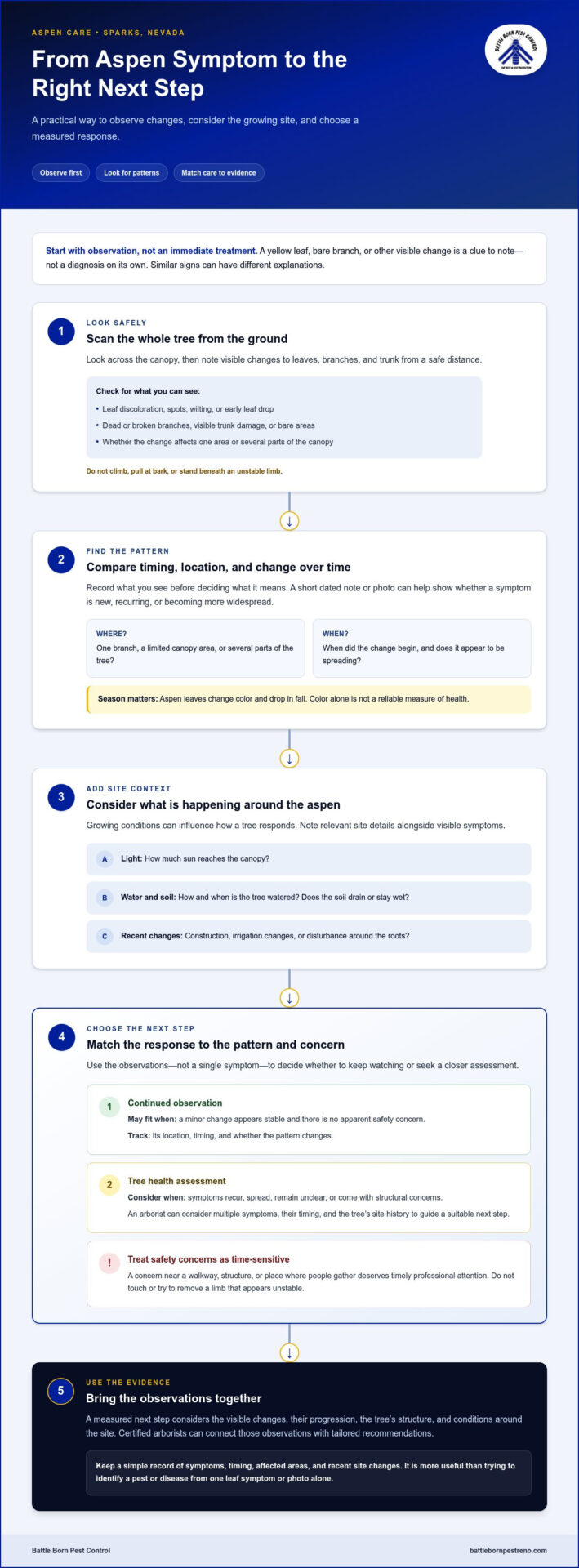
Consistent observations can make it easier to understand how an aspen is changing and give an arborist useful context if you need an assessment. Use this checklist to gather details without climbing, cutting limbs, or trying to diagnose the tree yourself.
- Observe the whole tree from a safe spot. Look at the canopy, branches, and trunk, and note which areas appear different. Use the same viewing points over time to compare changes.
- Photograph what you notice. Take clear photos of the whole tree and affected areas from the ground. Treat them as a record, not a complete health diagnosis.
- Note when changes appear. Record when you first saw discoloration, thinning, or branch dieback, and whether it has stayed stable, returned, or spread.
- Review recent site changes. Write down adjustments to irrigation, nearby construction, soil disturbance, or other changes around the tree that may help explain the timing.
- Keep watering consistent and appropriate. Consider the tree’s site and current conditions rather than following a universal schedule or quantity. Note major changes in watering so they can be considered alongside other observations.
What to monitor between seasons
Compare canopy condition and branch dieback from the same safe viewing points as the seasons change. Keep a simple record of irrigation adjustments, construction, or soil disturbance near the tree, including when each occurred. A single photo or brief look offers only a snapshot. Patterns over time provide better context for understanding whether a change is persistent or progressing.
When an arborist assessment is the sensible next step
Arrange an assessment if symptoms worsen, decline keeps returning, the tree raises a structural concern, or you can’t tell what may be causing the changes. Share your notes and photos, along with the timing of watering or site changes. A certified arborist can evaluate tree health and structure in context, then discuss care options suited to the findings.
Battle Born Pest Control’s certified arborists provide tree health assessments in Sparks. If your observations leave you unsure about your aspen’s condition, discuss your tree health concern with Battle Born Pest Control.
How Battle Born Pest Control Approaches Aspen Tree Care in Sparks
A change in an aspen’s leaves or branches is a reason to pay attention, but it doesn’t automatically point to a specific treatment. Battle Born Pest Control’s certified arborists start with your observations and consider them alongside the tree’s condition, structure, and site. This connects what you’ve noticed with factors that may be affecting the tree, rather than defaulting to a predetermined fix.
From observed symptoms to a tailored care plan
Photos and notes about when a change began, where it appears, and whether it has progressed can provide useful context. Site details, such as watering changes or disturbance near the tree, can also inform a tree health assessment. The assessment guides recommendations. Depending on the findings, suitable care may involve pruning, pest or disease management, or another response. These options aren’t automatic remedies. The tree’s needs and the property around it shape the next step.
Recommendations also take safety into account. A branch concern near a structure or walkway calls for attention to both the tree and the people or property nearby. If an evaluation indicates removal is appropriate, it can be considered as a separate care decision, not an assumption based on one symptom.
Local arborist support for Sparks properties
Battle Born Pest Control serves Sparks, Reno, Carson City, Dayton, and surrounding Northern Nevada communities. Its certified arborists provide tree health assessments, pruning, pest and disease management, and tree removal. For homeowners planning aspen tree care in Sparks, an arborist-led evaluation can clarify which option fits the observed condition and site, with attention to the tree and property safety.
Bring your observations and questions to the discussion. You don’t need to identify the cause on your own. For an informed next step, discuss aspen tree care with Battle Born Pest Control.
Take a Measured Next Step for Your Aspen
Changes in leaves, branches, or trunks are useful clues, but a single symptom doesn’t explain what’s causing it or which care is right. Track when changes appear, whether they spread, and what has shifted around the tree. This gives an assessment more context and helps avoid a rushed response. A measured approach to aspen tree care in Sparks connects visible symptoms with site conditions and the tree’s overall structure.
When concerns persist or affect nearby people and property, Battle Born Pest Control’s certified arborists can assess the tree and recommend care suited to its condition and setting. Depending on the findings, options may include pruning, pest and disease management, or tree removal. The team serves Sparks and Northern Nevada, with attention to the tree, property, and people nearby.
If you’re unsure what your aspen needs, schedule a tree health assessment with Battle Born Pest Control. Get a clear assessment and choose a practical next step for your tree.
Frequently Asked Questions
Is an aspen tree a good fit for a yard in Sparks?
An aspen may suit a Sparks yard, but its fit depends on the specific site rather than a blanket rule. Consider available space, soil, water access, and sun and wind exposure, then assess the tree’s current growth and condition. For an established aspen with health or growth concerns, an arborist can evaluate how its setting may be affecting it and discuss practical care options tailored to the property.
Why are the leaves on my aspen tree turning brown?
Brown leaves on an aspen can have several possible causes, including environmental stress, site conditions, pests, or disease. Color alone can’t identify which one is involved. Note when browning began, whether it affects one branch or several canopy areas, and whether it’s spreading. If the change worsens, returns, or appears with branch or trunk concerns, a tree health assessment can help clarify what may be happening.
How often should I water an aspen tree in Sparks?
There isn’t one watering schedule or amount that fits every aspen in Sparks. Needs depend on the tree, soil, weather, and irrigation setup, so monitor the soil and the tree’s condition while accounting for recent weather. Don’t rely only on dry soil at the surface to decide whether more water is needed. If symptoms persist or irrigation conditions are unclear, include those details in a professional tree health assessment.
When should an aspen tree be pruned?
The right timing and extent for pruning depend on the tree’s condition, the reason for the work, and local conditions. Avoid removing large limbs yourself or pruning simply because leaves look unhealthy, since leaf symptoms alone don’t establish that pruning is needed. A certified arborist can assess the tree and recommend whether pruning is appropriate. For a particular season or timing, seek guidance based on the tree and conditions at the time.
Can pests or disease affect aspens in Sparks?
Yes, pests and diseases can affect aspen health, but visible symptoms don’t identify a specific cause on their own. Note which parts of the tree are affected, what the symptoms look like, and whether they change or spread over time. Avoid applying treatment based on a guess. A professional tree health assessment can help determine whether pest or disease management is suitable for the condition observed.
How can I tell whether my aspen needs an arborist assessment?
Arrange an assessment if symptoms spread or recur, or if you notice dead branches, visible damage, or a structural concern near a walkway, home, or other target. An arborist evaluates the whole tree and its site rather than relying on one sign. Photograph changes, note when they began, and share recent site disturbances. Battle Born Pest Control’s certified arborists serve Sparks, Reno, Carson City, and Dayton.
Should I remove an aspen with thinning leaves?
Thinning leaves alone don’t show that removal is necessary. The cause and extent of decline, the tree’s structure, and nearby property all matter when deciding what care may be appropriate. A professional assessment can clarify the condition before you make a removal decision. Depending on the findings, options may include continued observation, pruning, or targeted pest and disease management, but no single response is right for every tree.