Tree Care in Northern Nevada: A Practical Guide for 2026
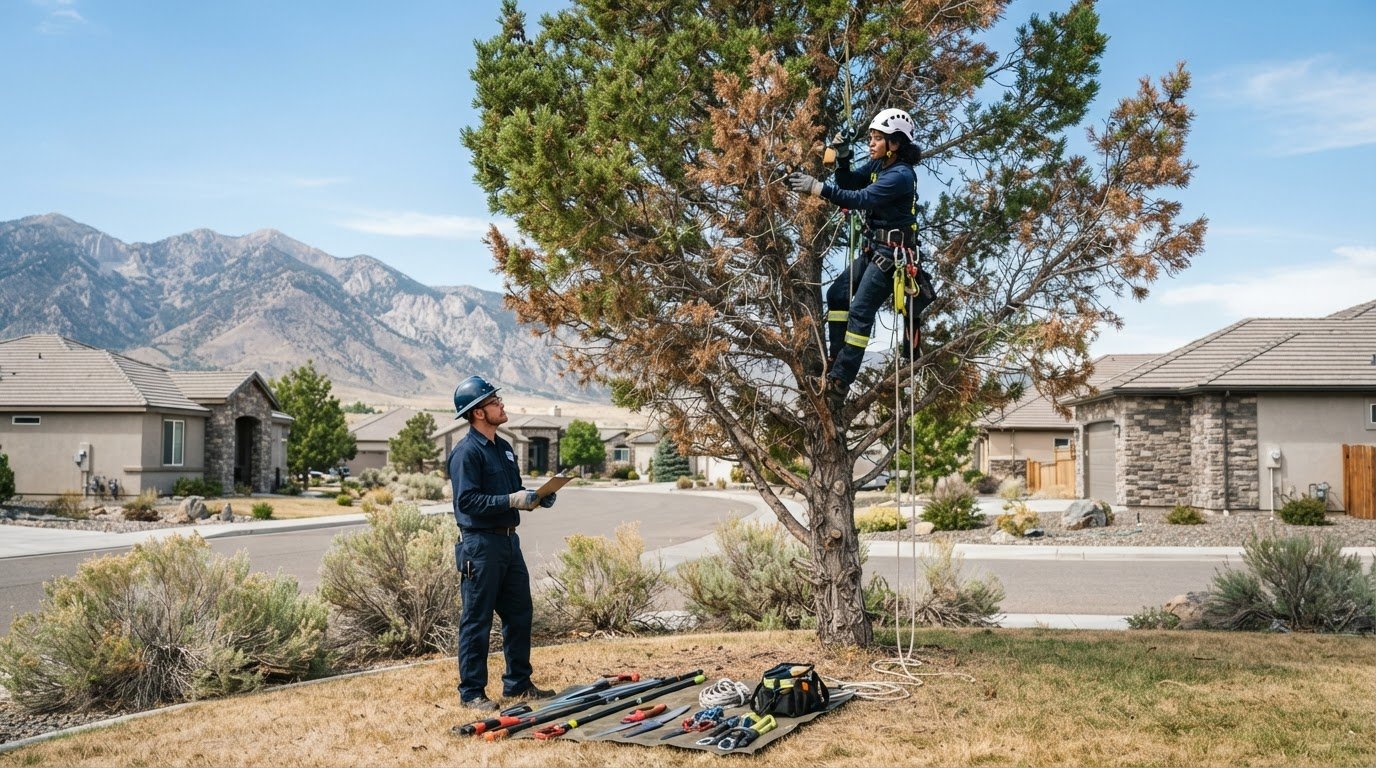
What if a tree that looks unhealthy is responding to the season, while a less obvious change signals a problem worth assessing? In Northern Nevada, dry air, limited moisture, and sharp temperature shifts can all influence how trees grow and recover. That makes tree care Northern Nevada property owners can rely on a year-round, site-specific responsibility.
It’s understandable to wonder whether browning leaves, thinning branches, or storm damage call for monitoring, pruning, or more involved care. A single sign doesn’t always reveal the cause. Guessing can lead to unnecessary work or leave risks near your home unaddressed.
This guide explains how local conditions affect tree health, which changes deserve closer attention, and when an arborist’s assessment can help clarify the next step. You’ll learn what routine care may involve, how pest and disease concerns fit in, and when pruning or removal may be appropriate. Battle Born Pest Control’s certified arborists provide tree health assessments, pruning, pest and disease management, and removal to support informed decisions about your trees and property.
Key Takeaways
- Tree care Northern Nevada works best when ongoing maintenance is tailored to each tree’s site, water access, and surroundings.
- Changes in a tree can have several causes, so a visible symptom alone can’t confirm a pest, disease, or structural issue.
- Track canopy and branch changes over time, and avoid climbing or cutting to investigate concerns yourself.
- When symptoms persist or worsen, an assessment can help clarify whether pruning, treatment, or another response is appropriate.
- Certified arborists can tailor pruning, health assessments, pest and disease management, or removal to the tree and property.
What does tree care in Northern Nevada involve?
Northern Nevada tree care means observing trees over time, choosing appropriate maintenance, and arranging timely assessments as their condition and surroundings change. It isn’t a one-time task or a standard treatment applied to every tree. Effective care starts with understanding what a particular tree is experiencing and what’s around it.
Notice changes in the canopy, branches, or trunk, then decide whether routine monitoring is enough or a closer assessment is warranted. Preventive care can address maintenance needs before they become more disruptive. Visible damage, declining health, or a possible safety concern calls for a response based on the tree’s actual condition. A symptom can raise a question, but it doesn’t confirm its cause.
Tree care is part of Arboriculture, the cultivation and management of trees. In practice, that means balancing tree health with the needs of the property, including nearby homes, paths, and other structures.
How Northern Nevada’s setting can influence tree health
High-desert and elevation-related conditions make local context important, but properties don’t all experience them in the same way. Sun exposure, available water, soil, wind, and winter weather may affect a tree differently depending on its location and surroundings.
A tree beside a building, for example, may have different exposure and space constraints from one in an open area. Conditions also vary among Reno, Sparks, Carson City, Dayton, and nearby communities. Weather-related stress is one possibility, not a diagnosis. Persistent or worsening changes deserve closer assessment.
What a complete tree-care plan can include
A suitable plan may involve pruning, a tree health assessment, or pest and disease management. These are distinct responses: pruning addresses selected branches, an assessment helps clarify the tree’s condition, and management focuses on identified pest or disease concerns.
The tree’s condition and site context guide the next step. Not every tree needs treatment, and care doesn’t have to follow a fixed schedule. An arborist-led assessment can help determine whether observation is appropriate or whether a more specific response may support tree health and property safety.
Tree Care Factors in Reno, Sparks, and Carson City
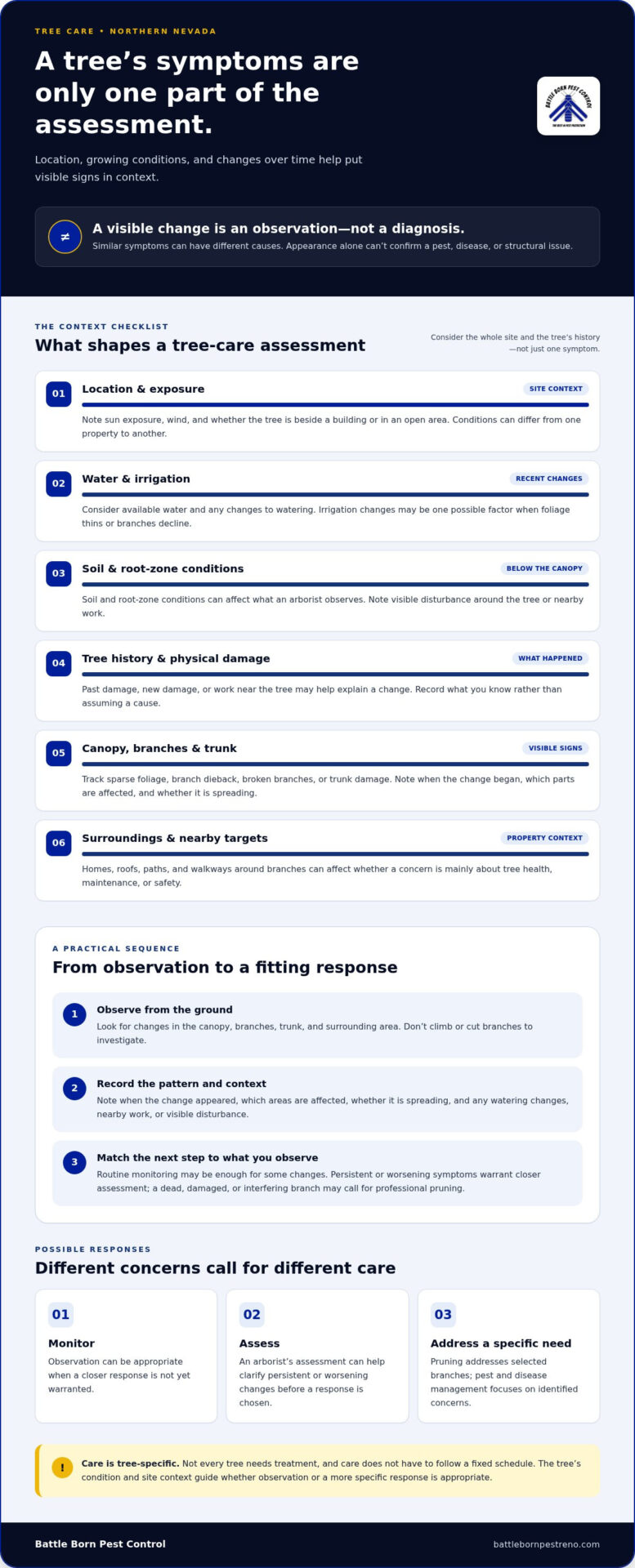
Two trees with similar symptoms may need different responses because they don’t share the same growing conditions. A tree’s location and history matter alongside its visible symptoms. Exposure, irrigation, soil, and past damage can all shape what an arborist observes. This is a useful starting point for tailoring care to a property instead of relying on a one-size-fits-all schedule.
Why the same tree symptom can have different causes
Sparse foliage or branch dieback is an observation, not a diagnosis. Possible factors include changes in irrigation, root-zone conditions, physical damage, pests, or other sources of stress. Weather may also play a role, but appearance alone can’t establish the cause.
Keep a simple record: note when the change first appeared, which parts of the tree are affected, and whether the pattern is spreading. Also note nearby work, changes to watering, or visible disturbance around the tree. If symptoms persist or worsen, a tree health assessment can help clarify what’s happening before you choose a response.
What property owners should observe through the seasons
Check from the ground for changes in the canopy, branches, trunk, and surrounding area. Winter damage may be one consideration if you notice new broken branches afterward, but trees and properties don’t all face the same conditions. Don’t climb or cut branches to investigate. Record what you can safely see.
A sheltered residential yard in Sparks may differ from an exposed tree beside a driveway in Carson City. In Reno or Dayton, trees near roofs, walkways, and shared commercial spaces may also have more potential targets beneath or around their branches. These surroundings help determine whether a change is mainly a health concern, a maintenance need, or a safety issue.
For broader background on tree selection, planting, watering, and pruning, consult UNR Extension’s guide to healthy trees. Local guidance can complement careful observation, while persistent concerns may call for a closer assessment. Battle Born Pest Control’s certified arborists provide tailored tree health assessments to help property owners understand a tree’s condition and consider an appropriate next step.
How can you tell whether a tree needs pruning, assessment, or treatment?
A change in a tree is a reason to observe more closely, not a diagnosis. Sparse foliage, dead branches, or trunk damage can have different explanations, so the next step should match the concern rather than assume the tree needs removal. Start by separating what’s visible from what still needs assessment.
| Observation | Possible concern | Reasonable next step |
|---|---|---|
| A branch is dead, damaged, or interfering with nearby space | A maintenance need or a branch that warrants closer review | Consider professional pruning, especially if the branch is high or near a structure. |
| Foliage is thinning or the canopy is changing | Several possible sources of stress, including site conditions or pests | Record when the change began and seek a health assessment if it persists or spreads. |
| New trunk damage or a major crack is visible | A potential structural concern that can’t be judged from appearance alone | Arrange a professional assessment; keep people clear if the tree appears to pose an immediate hazard. |
| Signs suggest a pest or disease concern | An issue that may require identification before management is chosen | Have the tree assessed so any pest and disease management is based on the observed condition. |
When is pruning different from a tree health assessment?
Pruning is targeted care for branches and canopy. Its purpose depends on the tree and its setting, such as addressing selected damaged or interfering branches. A tree health assessment is broader: it considers the tree’s overall condition and potential concerns to help determine what response, if any, is appropriate. Avoid climbing or cutting branches yourself, particularly at height or near structures.
Some concerns may call for treatment rather than pruning, but pest or disease management should follow an informed assessment, not a guess based on one symptom. Declining or damaged trees don’t automatically need removal. An assessment can help clarify whether tailored maintenance, management, or another course of action is suitable.
Which signs deserve prompt professional attention?
Major new cracks, hanging limbs, sudden canopy changes, and visible trunk damage warrant professional attention, especially when the tree is close to a home, driveway, walkway, or shared space. If there appears to be an immediate hazard, keep people away from the area while arranging appropriate professional help. Don’t try to inspect or remove a hazardous limb yourself.
Certified arborists can assess the tree and explain whether pruning, a health assessment, pest and disease management, or removal is the proportionate next step. The goal is to understand the concern and choose a response suited to both the tree and the property.
What tree-care steps can Northern Nevada property owners take year-round?
A steady routine helps you spot changes early without turning ordinary observation into guesswork. For tree care you can manage safely, use four steps: observe what’s visible, record changes, protect the tree’s growing area, and arrange an assessment if a concern persists or worsens.
A simple seasonal observation routine
At different points in the year, look from the ground for changes in leaves or needles, canopy density, branches, and trunk. After severe weather, check from a safe distance for newly broken or hanging branches. Don’t climb the tree or try to remove limbs yourself.
Brief, dated notes or photographs can make it easier to explain a change during an assessment. Record what you see, when you first noticed it, and whether it appears to be spreading. Your record doesn’t need to identify a cause; it simply gives an arborist useful context.
- Routine observation: Note gradual or isolated changes you can monitor safely, and revisit them over time.
- Arrange an assessment: Seek arborist input if changes persist, worsen, appear suddenly, or include hanging limbs, trunk damage, or other apparent hazards.
- Protect the site: Keep people clear of an area beneath a potentially hazardous branch while arranging appropriate professional help.
How to protect trees without causing avoidable stress
Take care around the trunk and root area during mowing, landscaping, or construction. Equipment and site work can cause physical damage, so avoid striking the trunk or disturbing the ground around it unnecessarily. Watering needs also depend on the tree, soil, irrigation, and current conditions. A blanket quantity may not suit every site.
Avoid heavy pruning or applying treatments based only on an online diagnosis. Similar-looking symptoms can have different causes, and the right response depends on the tree and its setting. For additional background on planting, watering, and pruning, see UNR Extension’s backyard tree health guide.
If a tree’s condition remains unclear, a professional assessment can help turn your observations into a proportionate care plan. Schedule a tree health assessment with Battle Born Pest Control’s certified arborists to understand the concern and determine an appropriate next step.
How can an arborist support tree care in Northern Nevada?
An arborist can help turn a concern into a clear, proportionate next step. Battle Born Pest Control’s certified arborists provide tree pruning, health assessments, pest and disease management, and tree removal across Reno, Sparks, Carson City, Dayton, and surrounding Northern Nevada communities. The right response depends on the tree’s condition, its location, and the concern observed, not on a single symptom or a default assumption that removal is needed.
What to expect from an arborist-led assessment
An assessment considers the tree’s visible condition alongside relevant site context, such as nearby structures and the reported history of changes. The findings can help clarify whether monitoring, pruning, pest or disease management, or another form of care may be appropriate. If disease is a concern, Battle Born Pest Control’s tree disease management guide can offer more background, while an assessment helps connect observations to the tree’s specific circumstances.
This process supports informed decisions without promising that a particular treatment will resolve every problem. Recommendations are tailored to the tree and property, with attention to tree health and the safety of people, pets, and nearby structures. Removal may be appropriate in some cases, but it is one possible outcome, not the automatic answer to decline or damage.
Choosing a practical next step for your property
If branches need attention or are interfering with the property, learn more in Battle Born Pest Control’s tree pruning services guide. A potentially hazardous tree calls for a different response; the Carson City hazardous tree removal guide offers information about that situation. For any concern, avoid climbing or attempting risky cutting, and keep people clear of an apparent immediate hazard while arranging professional help.
To approach tree care with confidence, start with what you’ve observed and share when changes began or whether they’re getting worse. That context can help an arborist understand the concern and recommend a suitable next step, whether that involves pruning, assessment, management, or removal.
Battle Born Pest Control provides tailored tree care in its Northern Nevada service area. Contact the team to discuss a tree concern and explore an appropriate path forward for your property.
Take a Thoughtful Next Step for Your Trees
Good tree care is ongoing and site-specific. Exposure, water, soil, and nearby structures all shape what a tree may need, while a visible symptom alone rarely tells the whole story. Keep track of changes you can safely observe, and seek an assessment when concerns persist, worsen, or raise a safety question.
Pruning, health assessments, pest and disease management, and removal each serve a different purpose. Battle Born Pest Control’s certified arborists tailor recommendations to the tree, its condition, and the property, helping you understand the options before choosing a response. The team serves Reno, Sparks, Carson City, Dayton, and surrounding Northern Nevada communities.
Explore tree care services for Northern Nevada properties and take a considered step toward supporting tree health and protecting the places around it. With attentive observation and the right guidance, you can make confident choices for your property.
Frequently Asked Questions
What does tree care in Northern Nevada include?
Tree care in Northern Nevada includes observing trees over time, maintaining them appropriately, and arranging an assessment when conditions change. Depending on the tree and property, care may involve pruning, a health assessment, pest and disease management, or removal. Sun exposure, available water, soil, irrigation, and nearby structures all influence what’s suitable. A tailored approach helps property owners in Reno, Sparks, Carson City, and Dayton make informed decisions.
When should I call an arborist about a tree?
Call an arborist when a tree’s condition changes suddenly, symptoms persist or worsen, or you’re concerned about safety. Major new cracks, hanging limbs, visible trunk damage, and sudden canopy changes deserve attention, especially near a home, driveway, or walkway. Don’t climb the tree or attempt risky cutting to investigate. If a tree or branch appears to pose an immediate hazard, keep people clear of the area while arranging professional help.
Can dry weather cause tree problems in Northern Nevada?
Yes, dry weather can contribute to tree stress, but it doesn’t prove that dryness is the cause of a particular symptom. Sparse foliage or branch dieback may have several possible explanations, including irrigation patterns, soil conditions, physical damage, or pests. Watering needs vary with the tree, soil, irrigation, and current conditions, so avoid relying on a universal amount. If changes persist or worsen, a health assessment can help clarify the concern.
How often should trees be inspected in Northern Nevada?
There isn’t one inspection interval that fits every tree and property. Observe trees regularly throughout the year, noting changes in the canopy, branches, trunk, and surrounding ground. A tree near a roof or walkway may raise different concerns from one in an open part of a yard. Arrange an arborist assessment if symptoms persist, worsen, appear suddenly, or follow severe weather, rather than waiting for a routine date.
Does a damaged or diseased tree always need to be removed?
No. Damage or suspected disease doesn’t automatically mean a tree needs removal. An arborist can assess its condition and the property context, then determine whether pruning, pest and disease management, or another response may be appropriate. Removal is one possible outcome, particularly when there’s a safety concern, but it shouldn’t be assumed from a single visible symptom. An assessment helps guide a proportionate decision without promising a particular treatment will save the tree.
What should I do after a storm damages a tree?
After a storm, look from a safe distance for newly broken or hanging branches, trunk damage, or a sudden change in the canopy. Keep people away from an area beneath a branch that appears hazardous, and don’t climb or try to cut it down yourself. Note what changed and when you noticed it. If damage is concerning or close to a structure or walkway, arrange an arborist assessment to understand the next step.
Can an arborist help with tree pests and disease?
Yes. An arborist can assess a tree when you notice signs that may indicate pests or disease, then recommend whether pest and disease management is appropriate. Visible symptoms alone don’t confirm a cause, so avoid applying treatments based only on an online identification. Battle Born Pest Control’s certified arborists provide tree health assessments and pest and disease management for properties in Reno, Sparks, Carson City, Dayton, and surrounding communities.