Carpenter Ant Treatment in Reno: Signs, Solutions, and What to Expect
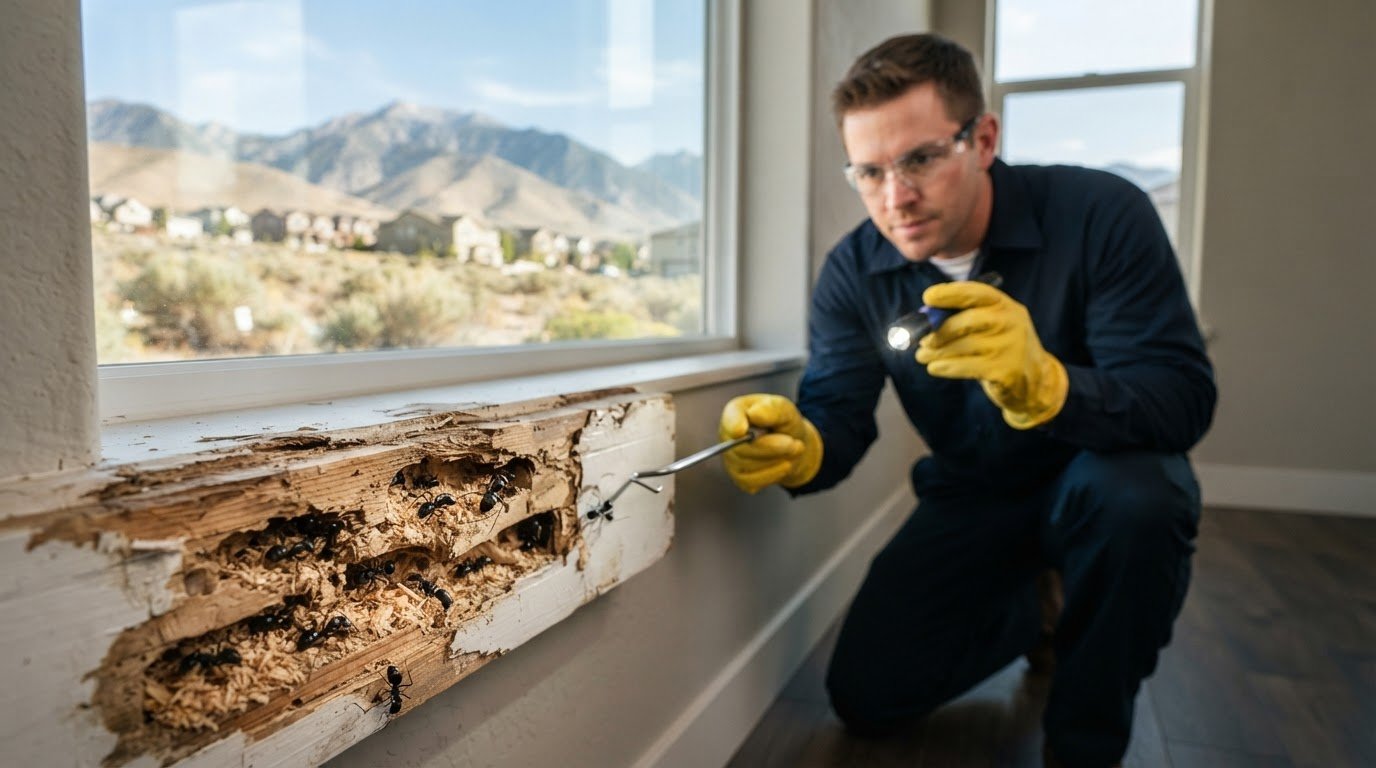
What if the ants you see are only a small sign of a nest nearby? If you’re searching for carpenter ant treatment reno, it’s understandable to wonder whether the insects are carpenter ants and whether they point to damage inside your home. Carpenter ants excavate wood to create nests rather than eating it, and small wood shavings near an opening can be a clue. Moisture-damaged wood may also make a property more inviting to them.
Visible ants alone don’t show where a colony is established or which treatment will suit the property. The next step depends on identifying the ant activity, considering likely nesting areas, and noting conditions such as moisture or wood damage. A careful assessment helps replace guesswork with a property-specific plan while prioritizing the safety of your family, pets, and property.
In this guide, you’ll learn which signs merit closer attention, how carpenter ants differ from termites, why finding the nest matters, and what to expect from a local assessment in Reno, Sparks, Carson City, and nearby communities.
Key Takeaways
- Use body shape and the single-node waist as identification clues, since different ant species may call for different treatment approaches.
- Carpenter ant treatment reno should account for likely nesting areas and property conditions, not just the ants that are easy to see.
- Note recurring activity and moisture concerns; these observations can help clarify whether further assessment is needed.
- Keep DIY steps focused on observation and property maintenance, and don’t assume they’ll resolve a colony that remains hidden.
- Battle Born Pest Control tailors ant control to the property, with one-time and ongoing pest-management options and a safety-conscious approach.
Carpenter ant treatment in Reno starts with recognizing the signs
Carpenter ants excavate wood to create nesting galleries; they don’t eat wood as food. Correct identification matters because other ants can look similar, and different pests may need different treatment approaches. A large, dark ant is a useful clue, but appearance alone can’t confirm a carpenter ant or reveal its nest. For an overview of their nesting habits and the damage they can cause, see the Carpenter Ant Overview.
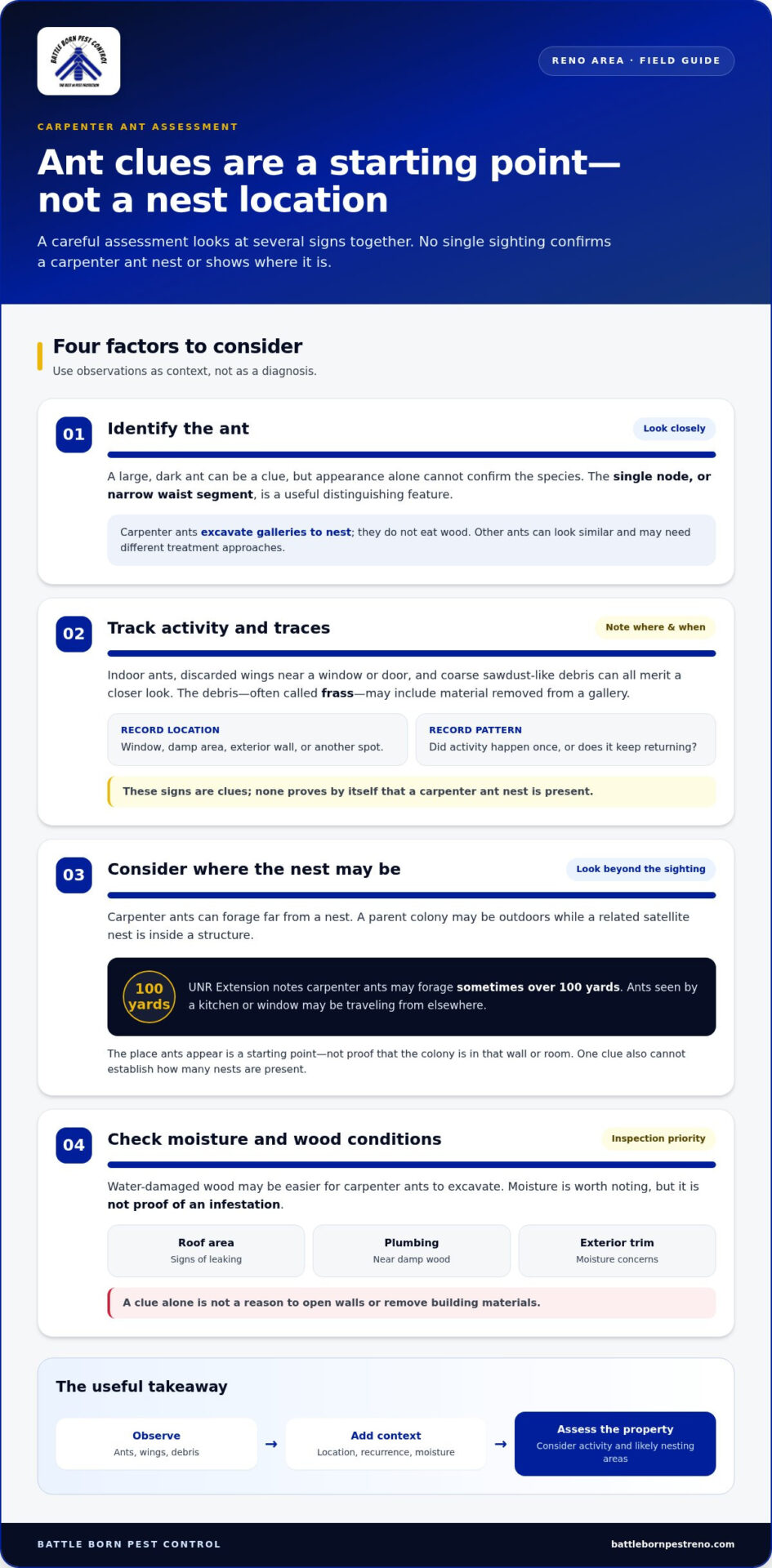
Carpenter ants vary in size, and winged swarmers can look different from worker ants. Compare several features rather than relying on color or size alone. UNR Extension identifies the single node, or narrow waist segment, between the thorax and abdomen as a useful distinguishing feature and describes the ants’ body shape. This waist detail can help distinguish carpenter ants from species with more than one visible node.
Which signs can point to carpenter ant activity?
Ants indoors, discarded wings near a window or door, and coarse sawdust-like debris can all merit a closer look, but none proves by itself that a carpenter ant nest is present. The debris, often called frass, may contain wood fragments and other material removed from a gallery. Carpenter ants also don’t build the characteristic soil mounds associated with some ant species, so the absence of a mound doesn’t rule them out.
Make your observations more useful by noting where ants or debris appear and when you see them. Record whether activity is near a window, damp area, or exterior wall, and whether it happens once or keeps returning. These details provide useful context without turning a clue into a diagnosis.
Does seeing carpenter ants mean the main nest is indoors?
No single sighting establishes where a colony is nesting. UNR Extension distinguishes a parent colony, which contains the queen, from satellite nests that may develop nearby. A satellite nest can be inside a structure even when the parent colony is outdoors, so ants in a room don’t necessarily mean the main colony is inside the home.
Visible ants may also be traveling between a food or water source and a nest that’s out of sight. Don’t assume every ant you see belongs to one nest or that a particular wall contains a colony. For carpenter ant treatment reno, identifying the species and understanding the activity pattern are more useful starting points than reacting to one insect or patch of debris.
If activity recurs, or you find wings or sawdust-like material, keep notes about the location and arrange an assessment. A closer look can help distinguish carpenter ant clues from other ant activity and guide next steps based on the property, without presuming that wood damage or an indoor nest is present.
How carpenter ant behavior and wood damage shape treatment
Carpenter ants make nests by excavating galleries inside wood, pushing out bits of material as they expand or maintain those spaces. They don’t consume wood for food. UNR Extension distinguishes carpenter ants from wood-eating pests by this behavior: carpenter ants excavate wood for nesting rather than eating it.
That difference matters during an assessment. The presence of ants doesn’t automatically mean a home has structural damage, and wood damage alone doesn’t identify the pest responsible. The goal is to understand where ants are traveling, whether there are signs of nesting, and which conditions around the property may be relevant. Guidance on locating and treating carpenter ant nests likewise emphasizes investigating nesting areas rather than focusing only on visible insects.
Why moisture-damaged wood deserves attention
UNR Extension notes an association between carpenter ants and water-damaged wood, which can be easier for them to excavate. That makes moisture a sensible inspection priority, not proof of an infestation. Examples to note include a roof area with signs of leaking, plumbing near damp wood, or moisture affecting exterior trim. These are conditions to observe, not proof of what caused ant activity.
Look for patterns that may help explain where ants are moving, such as activity near a damp area or recurring sightings along a wall. Don’t open walls or remove building materials based on a clue alone. A careful assessment can consider moisture conditions alongside ant activity and other evidence, avoiding conclusions based on one sign.
What satellite nests mean for a home assessment
A satellite nest is an offshoot nest associated with a larger parent colony. UNR Extension explains that carpenter ants may forage far from their nest, sometimes over 100 yards, so ants near a kitchen or window may be traveling from elsewhere. Conversely, a satellite nest may be inside a structure even if the parent colony is outdoors.
For that reason, the spot where ants appear is a starting point, not necessarily the colony’s location. An assessment can consider the route ants may be using, potential nesting areas, moisture concerns, and whether activity has appeared in more than one place. No single clue establishes how many nests are present; the right response depends on the property.
For carpenter ant treatment reno, this behavior is why a tailored assessment can be more useful than reacting only to foraging ants. Battle Born Pest Control provides ant control with plans shaped around each property, using an eco-conscious approach that prioritizes family, pets, and property. If sightings continue or you’re unsure what the signs mean, request an assessment for ant activity and share what you’ve observed.
DIY steps versus professional carpenter ant treatment in Reno
Homeowners can take useful first steps without trying to identify or reach a hidden nest. Observe where ants appear, note whether sightings return, and address obvious moisture problems through ordinary property maintenance. These actions can clarify what’s happening, but they aren’t a substitute for treatment when activity persists or the nesting location remains uncertain.
Killing the ants you can see doesn’t necessarily resolve an unseen colony. Foragers may be traveling from a nest elsewhere, and a structure may have a satellite nest separate from the parent colony. A temporary drop in visible activity doesn’t, by itself, show that the source has been addressed.
What homeowners can do before deciding on treatment
Keep simple notes about the activity, including the room or exterior area, approximate time, apparent route, and whether the ants return. Look for moisture concerns or coarse debris in accessible areas, but don’t open walls or disturb suspected nesting sites. Dated observations can help show whether activity is isolated or recurring.
Basic moisture correction, such as addressing a known leak through appropriate home maintenance, may improve conditions around the property, but it doesn’t confirm or eliminate a carpenter ant nest. Keep your notes and observations available if you arrange an assessment; they can help focus attention on relevant locations.
When a tailored professional assessment may help
An assessment is a practical next step if sightings recur, appear in multiple areas, or coincide with possible wood or moisture concerns. It can also help when you can’t tell whether the ants are carpenter ants or where they may be nesting. Rather than treating one visible spot as the whole problem, the assessment considers activity and conditions across the property.
The appropriate response depends on what the assessment finds, including the pattern of ant activity, potential nesting areas, and property conditions. No single treatment approach fits every situation, and an assessment shouldn’t be taken as a promise that every nest will be located or eliminated.
Battle Born Pest Control provides ant control in Reno, Sparks, Carson City, Dayton, and surrounding Northern Nevada communities, with one-time and ongoing pest-management options tailored to each property. Its eco-conscious approach prioritizes the safety of families, pets, and property. If the evidence remains unclear or activity continues, carpenter ant treatment reno can begin with a property-specific assessment and practical recommendations, rather than guesswork or repeated attempts to remove ants one at a time.
What to do before and after a carpenter ant assessment
A little preparation can make an assessment more useful without disturbing the area or making assumptions about what the signs mean. Keep a simple record, note moisture concerns, arrange an assessment if activity warrants a closer look, and follow guidance tailored to the property. You don’t need a long monitoring period or a perfect identification; clear, dated observations can help show where and when activity occurs.
How to document activity without disturbing a suspected nest
Record the room or exterior area, nearby entry points or wood, and the time you noticed ants. Note whether you saw them once or again in the same location, and describe visible debris without deciding that it proves a nest. If practical, take a photo from a safe distance. A clear record of what you observed is more useful than a confident species label based on an unclear image.
Leave suspected nesting sites undisturbed. Don’t pull apart wood, open walls, or move debris to investigate, since this can obscure the original signs and won’t establish where the colony is located. Include moisture concerns, such as a damp area or a known leak, as observations rather than assumed causes.
What to discuss during a Reno-area assessment
Share your location notes, photographs, recurring sightings, visible debris, and any moisture concerns. Explain what you’ve tried and whether activity changed afterward. This context can help connect observations across the property. For broader ant-control context, the existing Effective Ant Control Reno: Professional Kitchen Protection Guide may also be useful.
Ask the assessor to explain the property-specific plan and any safety guidance relevant to your household. Battle Born Pest Control tailors ant control to each property and prioritizes families, pets, and property. The recommended approach depends on the observed activity and conditions, so application details and follow-up steps should come from the treating professional rather than a general checklist.
Think of the process as a straightforward sequence:
- Document where and when you notice ants, wings, or debris.
- Note moisture concerns and nearby areas without disturbing suspected nests.
- Arrange an assessment if activity recurs, appears in different locations, or leaves you unsure what the signs mean.
- Review the tailored recommendations and follow the treating professional’s guidance after the assessment.
Afterward, keep noting new activity and its location, especially if it differs from what you observed before the visit. Follow the specific instructions provided for your property, including any directions about preparation, access, or household safety. Avoid adding your own pesticide applications unless the treating professional advises you to do so, since uncoordinated steps may complicate a tailored plan.
If recurring signs have you unsure what to do next, request a carpenter ant assessment in Reno and share the observations you’ve gathered.
How Battle Born Pest Control approaches carpenter ant treatment in Reno
Carpenter ant treatment reno is most useful when it responds to the conditions at the property rather than treating every sighting the same way. Battle Born Pest Control is a locally owned, licensed company serving Reno, Sparks, Carson City, Dayton, and surrounding Northern Nevada communities. The company provides ant control, with one-time treatment and ongoing pest-management options tailored to each property.
A treatment conversation starts with what you’ve observed and what matters in your home. Recurring activity, locations where ants appear, visible debris, and moisture concerns can all help inform the discussion. The goal is to understand the situation before recommending a property-specific plan, rather than assuming that a single sign tells the whole story.
A property-specific plan with safety in mind
Properties differ in their layout, activity patterns, and household needs, so recommendations are tailored to the situation and budget. Battle Born Pest Control uses eco-conscious, proven methods and prioritizes the safety of families, pets, and property when planning treatment. Recommendations are based on the property rather than a one-size-fits-all formula.
If you have questions about household safety, raise them during the conversation. The treating professional can explain the plan and provide guidance relevant to your situation. Application details and instructions for your home depend on the treatment plan, so follow the specific guidance provided rather than relying on general assumptions.
Requesting a free estimate in Reno
Battle Born Pest Control offers free estimates and consultations. To make the conversation more useful, share where you’ve noticed activity, whether it has returned, and any concerns about nearby wood or moisture. You can also mention what you’ve already observed or tried. These details connect your concerns to the conditions at your property and support a tailored discussion of ant control options.
There’s no need to arrive with a confirmed species identification or a conclusion about where a nest is located. Describe what you’ve seen as accurately as you can, and let the assessment help clarify what the evidence may indicate. If activity has appeared in several places, include those locations; a broader picture can be more helpful than focusing on one sighting.
Whether you’re considering a one-time treatment or ongoing pest management, the next step is a conversation about your property’s needs. Battle Born Pest Control’s locally grounded, eco-conscious approach provides clear recommendations while keeping household and property safety in view. Request a free estimate to discuss the ant activity you’ve noticed and explore a plan suited to your Reno property.
Take the next step with confidence
You don’t need to solve the mystery on your own before seeking guidance. A clear account of what you’ve noticed can help turn uncertainty into a practical conversation about your home, including which concerns deserve attention and what a reasonable next step may be.
For carpenter ant treatment reno, focus on advice that fits the property rather than making a quick decision based on one clue. Battle Born Pest Control offers free estimates and consultations, with recommendations tailored to the situation and an eco-conscious approach that prioritizes family, pets, and property.
If you’re ready to discuss what you’ve observed, request a free estimate for carpenter ant treatment in Reno. A calm, informed next step can help you feel more confident about caring for your home.
Frequently Asked Questions
Is seeing carpenter ants indoors proof that a nest is inside my home?
No, indoor sightings don’t prove the nest is inside the home. Ants may enter while foraging, and a satellite nest can be separate from the parent colony. For example, ants near a pantry could be following food from an outdoor nesting area. Note where they appear and whether activity repeats, then share those details during an assessment instead of assuming the nest is behind the nearest wall.
Can carpenter ants return after treatment?
Yes, carpenter ants may be seen again if activity persists or ants enter from another nesting area. A later sighting doesn’t automatically mean the same nest remains, since the source and route can vary. Keep track of where and when new ants appear, and follow the treating professional’s guidance about what to watch for. If activity continues, those observations can help inform the next conversation about your property.
How much does carpenter ant treatment cost in Reno?
The cost depends on the property and the treatment plan recommended for its conditions, so a general price may not reflect your situation. Battle Born Pest Control offers free estimates and consultations. Describe the activity you’ve noticed, where it appears, and any property concerns to get a tailored estimate for carpenter ant treatment in Reno, rather than relying on a national average that may not fit your home.
Is carpenter ant treatment safe for pets?
Safety depends on the treatment plan and how it applies to your household, so don’t assume every product or application has identical precautions. Battle Born Pest Control prioritizes family, pet, and property safety when planning treatment. Tell the team what pets live in the home and ask for the instructions that apply to your specific plan, including any guidance to follow before or after treatment.
What happens if I find carpenter ants near a tree or firewood?
Ants near a tree or firewood may be foraging or nesting nearby, but their location alone doesn’t confirm a colony in your home. Note whether activity is also present on the house, and avoid carrying potentially infested wood indoors. Keep firewood observations separate from indoor sightings when describing the situation, since the locations can help an assessment consider whether the activity appears connected.
Can carpenter ants live in dry wood?
They can nest in wood that isn’t visibly damp, so dry-looking wood doesn’t rule out carpenter ant activity. Moisture-damaged wood is a useful inspection concern, but it isn’t the only possible nesting material. If you notice ants around dry trim, a beam, or stored lumber, record the exact location and other signs rather than treating the wood’s appearance as a definitive answer.
Does Battle Born Pest Control offer ongoing ant prevention?
Yes, Battle Born Pest Control offers ongoing pest-management options as well as one-time treatment for ant concerns. The right option depends on your property’s needs and the activity you report, so discuss what you’ve observed and what kind of support you’re seeking. The company serves Reno and surrounding Northern Nevada communities, including Sparks, Carson City, and Dayton.