Dead Tree Removal Northern Nevada: A Homeowner’s Guide to Safety and Fire Prevention
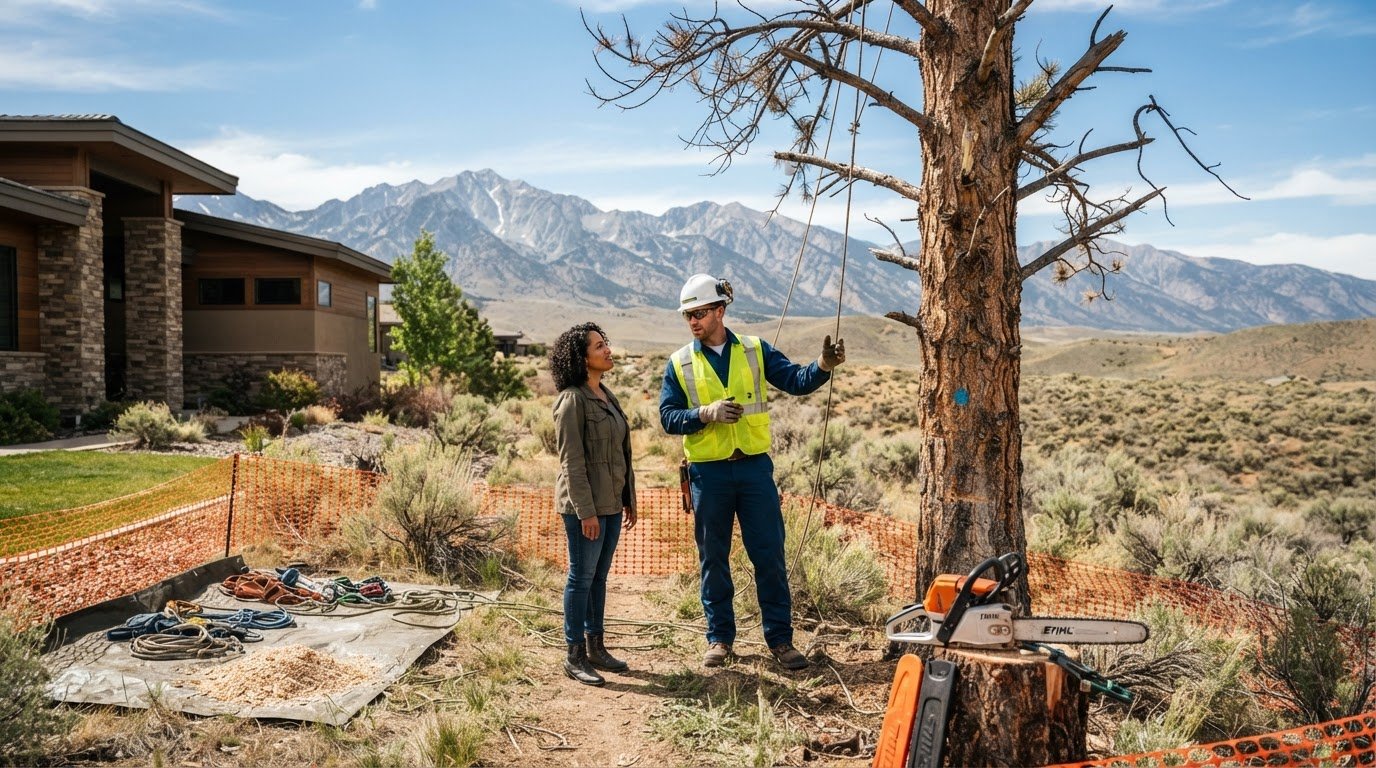
A dead tree is more than an eyesore. In Northern Nevada, it can add fuel for wildfire and become a hazard when strong Washoe Zephyr winds arrive. If you’re unsure whether a tree is dead or simply dormant in the high desert, consider what its condition could mean for your home and defensible space. Dead tree removal Northern Nevada homeowners can approach with confidence starts with understanding the tree’s condition and the risks around it.
This guide covers signs of declining tree health, how drought stress and bark beetles can affect local trees, and what to consider when planning removal. You’ll also learn where to find current fire-safety guidance, how to evaluate an arborist, and why a professional assessment can help distinguish a dormant tree from a hazardous one. A careful plan can help protect your property and support a safer landscape.
Key Takeaways
- Use the scratch test and other visible clues to assess whether a tree may be dead, but keep clear of trees that may be unstable.
- Understand how Northern Nevada’s drought, heat, and tree pests can contribute to decline before a hazard becomes obvious.
- Dead wood can behave unpredictably during cutting, so hazardous trees are safer to leave to trained professionals.
- Dead trees can add fuel near your home. Follow current local defensible-space guidance for your property.
- An arborist-led assessment can help guide a safe, property-conscious plan for dead tree removal Northern Nevada homeowners may need.
Identifying Dead Trees and Assessing Immediate Safety Risks
A bare tree in Northern Nevada isn’t necessarily dead. Some deciduous trees lose their leaves seasonally, and drought-stressed trees may look sparse before their condition becomes clear. Look for several signs together rather than relying on appearance alone, especially if the tree is near a home, driveway, or gathering area.
For a basic scratch test, use a fingernail or clean tool to gently scrape a small spot on a young twig. Green, moist tissue just beneath the bark suggests that the twig is alive; dry, brown tissue may indicate it’s dead. Check more than one small branch, since a single dead twig doesn’t establish the condition of the whole tree. Don’t cut into the trunk or climb to test higher branches.
Other warning signs include brittle branches that snap easily, widespread loss of needles or leaves during the growing season, and fungal growth near the base. Fungi can signal decay, but they don’t prove by themselves that a tree is dead. Deep trunk cracks, a worsening lean, raised or shifting soil near the roots, and dead branches suspended above a walkway all deserve attention. These hanging limbs, often called “widow-makers,” can fall without warning. A standing dead or dying tree is also known as a snag (ecology), a term that recognizes its role in nature as well as the hazards it may pose near homes.
The Hazards of Dead Trees in Northern Nevada
Wind can change the risk quickly. During a Washoe Zephyr, gusts can catch a brittle crown or hanging limb, causing it to break or fall toward a structure. Dry, sandy soil can also make root support less reliable, particularly when roots are compromised or the ground around the tree has shifted. A tree that appears stable on a calm day may behave differently under wind loading.
If a homeowner knows a tree is hazardous and it damages neighboring property, liability may become a concern. The details depend on the circumstances and applicable law. Documenting warning signs and arranging a professional assessment can help you make a timely, informed decision rather than waiting for a failure.
When to Call a Certified Arborist
Arrange an assessment when major limbs are dead, the trunk is cracked, the tree is leaning, or its condition is unclear. A tree risk assessment Reno NV is a professional evaluation of a tree’s health, structural condition, and potential to harm people or property.
People sometimes use the “50% rule” as a rough warning that losing about half a tree’s canopy may indicate serious decline, but it isn’t a universal diagnosis or automatic removal threshold. Species, season, and the location of the damage matter. Trees leaning toward power lines or structures need professional attention. Keep people clear of the fall area and don’t attempt to prune or remove them yourself. For dead tree removal Northern Nevada homeowners can approach with greater confidence, an assessment can help distinguish dormancy from decline and identify the safest next step.
Why Trees Die in the High Desert: Specific Northern Nevada Threats
Tree decline in Reno and Sparks often reflects several stresses building over time. Prolonged drought can leave trees short of the moisture they need, while intense summer heat increases water loss. In developed areas, pavement and buildings absorb and radiate heat, creating urban heat islands that can add stress for mature trees. A tree weakened by these conditions may be less able to withstand pests or recover from damage.
Soil and watering patterns matter, too. In the Truckee Meadows, alkaline soil can make some nutrients less available to roots, even when those nutrients are present. Roadside trees in Reno and Carson City may also be exposed to winter de-icing salts, which can stress roots and foliage. Irrigation can be difficult to balance: too little water compounds drought stress, while frequent shallow watering or persistently saturated soil can impair root health. Browning, thinning foliage, or dieback can have several causes, so a health assessment can help distinguish environmental stress from pest activity.
Bark Beetles and Pine Tree Mortality
Stressed pines may be more vulnerable to bark beetles, including Ips beetles and Mountain Pine Beetles. Look for reddish boring dust, pitch tubes, and small round holes in the bark. These are clues, not a reliable way to identify the beetle species on their own. The Nevada Division of Forestry’s 2025 report identified Mountain Pine Beetle as the most common pest in its accounting of damaged acres, underscoring why pine decline deserves careful attention.
Some beetles can reproduce in suitable dead or weakened wood, so a dead pine may become a brood tree and contribute to risk for nearby susceptible trees. That doesn’t mean every dead pine will spread an infestation or that removal alone resolves the cause. Timely diagnosis and appropriate handling of affected material can be part of a broader response. For practical prevention guidance, explore pine tree disease management in Reno.
Soil and Environmental Stressors
Before assuming a tree is beyond recovery, consider its setting. Compacted soil, limited rooting space, heat reflected from hard surfaces, and inconsistent irrigation can all contribute to decline. Salt exposure may be more relevant to trees near treated roads or sidewalks than to those farther from traffic. These pressures can overlap: a tree already stressed by drought or poor growing conditions may be less resilient when pests arrive.
Removing a confirmed dead tree can reduce one potential source of pest habitat and make it easier to assess nearby trees, though it won’t guarantee that pests or disease won’t affect the landscape. Battle Born Pest Control provides tree health assessments and pest and disease management to help homeowners understand what’s affecting their trees and plan a considered response. If signs of decline are appearing across your property, schedule a professional tree health assessment to guide the next step in dead tree removal Northern Nevada properties may need.
Professional Removal vs. DIY: Understanding the Complexity
A dead tree can be harder to predict than a healthy one. As wood dries, it may become brittle and break apart under a saw rather than fall cleanly, sending limbs or sections in unexpected directions. A leaning tree adds another complication: internal forces called tension and compression can cause the trunk or limbs to shift suddenly as a cut changes how the weight is supported. The direction of a lean alone doesn’t reveal where the tree will move.
A chainsaw is only one part of a removal plan. Work near a home, fence, or other obstacle may require ropes, rigging equipment, and an aerial lift or trained climbing techniques to manage the tree in sections. Improvised ropes or cutting from a ladder can increase the chance of a fall, an uncontrolled limb, or damage to nearby property. Homeowner insurance may not cover every injury or damage connected with DIY work, and coverage depends on the policy and circumstances. Review your policy rather than assuming you’re protected.
The Professional Removal Process
Arborist-led removal is planned around the tree’s condition, its position, and what lies below it. Depending on the site, the crew may:
- Plan the rigging and sectional removal. The tree is assessed so branches or trunk sections can be removed in a controlled sequence, using climbing or bucket work where appropriate.
- Lower heavy timber carefully. Ropes and rigging can help guide sections away from structures and landscaping instead of allowing them to fall freely.
- Complete the agreed cleanup. The scope should describe how cut material and debris will be handled. Tree removal and stump grinding are separate work; removal covers the tree and agreed debris handling, not stump grinding.
These steps are tailored to the site, not applied identically to every tree. A confined yard, sloped ground, or dead limbs over a roof can all affect the approach.
Evaluating Arborist Credentials
ISA certification indicates that an arborist has demonstrated knowledge of tree care through the International Society of Arboriculture’s credentialing program. It’s especially relevant when assessing a hazardous tree, because sound decisions depend on understanding tree structure, condition, and removal practices. Battle Born Pest Control has certified arborists on staff and is licensed in Northern Nevada, serving Reno, Sparks, and Carson City.
Clear documentation helps prevent misunderstandings. A written estimate can describe which tree will be removed, the planned work area, and how debris will be handled, so you know what the scope includes. Licensing and insurance are distinct considerations; insurance coverage varies, so make sure responsibilities are clear before work begins. For homeowners considering safe hazardous tree removal in Carson City, an arborist-led plan can help protect both the property and the people nearby.

Fire Safety and Defensible Space in Northern Nevada
Defensible space is the maintained area around a home that can help reduce wildfire exposure and give firefighters room to work. A common planning framework considers the area from the structure out to 100 feet, but the right treatment depends on the property, vegetation, slope, and local fire guidance. Dead tree removal Northern Nevada homeowners consider as part of this work can reduce one source of combustible material, though no single action can make a home fireproof.
Start close to the house. The first five feet, often called the Home Ignition Zone, deserve particular attention because embers and easily ignited material near the structure can create vulnerabilities. Keep this area clear of dead vegetation and other combustible debris, and follow local guidance for plants and materials. A dead tree farther from the house can also matter: low branches or nearby shrubs may let flames move from ground-level fuels into a tree’s canopy, creating what fire professionals call “ladder fuels.”
Defensible Space Zones and Sloped Properties
As a general organizing tool, homeowners can think of the area from five to 30 feet as a place to keep vegetation maintained and separated, and the area from 30 to 100 feet as a place to reduce excess fuel and avoid dense, continuous clusters. These distances describe a widely used framework, not a substitute for local requirements. On sloped properties, including parts of West Reno and Caughlin Ranch, fire behavior and vegetation placement can make site-specific guidance especially important.
Truckee Meadows Fire Protection District states that property owners in areas designated as having Moderate, High, or Extreme fire hazards are required to maintain defensible space. Requirements and guidance can vary by jurisdiction and property, so Reno and Carson City homeowners should consult their local fire authority for current rules, inspection options, and any applicable code enforcement process. A general zone diagram doesn’t determine what applies to your address.
Local Guidance, Inspections, and Practical Next Steps
Before cutting vegetation or arranging removal, contact the fire agency serving your address to find current defensible-space guidance and learn whether it provides property inspections. Programs can change, so confirm current dates and eligibility with the relevant agency before relying on a chipping event or assistance program. If you receive an inspection notice, read its instructions and deadlines carefully, then prioritize the identified hazards.
A professional assessment can help determine whether a dead tree needs removal and how its location affects a fire-safety plan. On sloped land, tree placement and surrounding vegetation matter alongside distance from the house. Plan removal so the work itself doesn’t create new hazards or leave unmanaged debris. Addressing a hazardous tree can contribute to a more manageable landscape and improve a home’s prospects during a wildfire, but it cannot guarantee protection.
For arborist-led tree removal and health assessments in Reno, Sparks, and Carson City, get help planning tree removal as part of your property’s fire-safety work.
Safe Tree Removal Services with Battle Born Pest Control
Removing a dead or declining tree is a decision about the health and safety of the whole property, not just the tree itself. Battle Born Pest Control provides arborist-led tree removal and health assessments shaped around Northern Nevada’s conditions. The goal is to explain what the tree needs and why, then carry out the work with care for the surrounding landscape.
Tree decline can involve more than one cause. Drought stress, insects, and disease may all contribute, so removing a tree without considering its condition and nearby trees can leave important questions unanswered. Our tree care services include pest and disease management to help identify concerns that may affect the rest of your landscape. We serve Reno, Sparks, Carson City, and Dayton, with local knowledge of the area’s trees and growing conditions.
Our Health-First Assessment
Assessment comes before a recommendation. A tree health assessment in Reno, NV considers visible signs of decline, the tree’s structure, and possible pest or disease issues. Not every troubled tree must be removed; depending on its condition, pruning or appropriate disease management may help address the problem. If removal is the safer course, an arborist can explain the reasons for that recommendation.
Recommendations should be clear and tied to what’s observed on your property. An estimate can outline the planned removal and work scope, giving you a practical basis for understanding the project before it begins. A straightforward conversation helps you make an informed choice without pressure or guesswork.
Booking Your Removal or Assessment
To get started, share your location, describe what you’ve noticed, and provide details about the tree’s position and nearby structures. That context helps shape an estimate around the site rather than a one-size-fits-all assumption. If the tree is close to a home, fence, or other feature, mention it so the work can be planned with the property in mind.
Before service, the work plan should clarify which tree or trees are included and how the work area and debris will be handled. During removal, the crew focuses on controlled work and care for nearby landscaping. Afterward, the agreed cleanup is completed. Tree removal does not include stump grinding.
For dead tree removal Northern Nevada homeowners can approach with confidence, choose a team that considers both the tree and the landscape around it. Protect your property and family by scheduling a tree assessment with Battle Born Pest Control.
Make a Confident Next Move for Your Trees
You don’t have to decide on removal based on a few bare branches or a troubling change in the canopy. A professional evaluation can give you a clearer picture of the tree’s condition and help you choose a next step that fits your property. Acting on uncertainty with sound information can bring greater peace of mind and help you care for the landscape with purpose.
For dead tree removal Northern Nevada homeowners can approach with confidence, Battle Born Pest Control brings certified arborists, local ownership, Nevada licensing, and knowledge of high desert tree care to the work. Recommendations are based on the tree’s condition, not pressure to remove it.
Schedule a professional tree health assessment and removal estimate with Battle Born Pest Control to take a thoughtful step toward a safer, healthier property. A clear plan starts with understanding what your trees need.
Frequently Asked Questions
How much does dead tree removal cost in Northern Nevada?
There isn’t one fixed price for dead tree removal Northern Nevada homeowners can use for every project. An estimate depends on factors such as tree size, access to the work area, condition, and nearby structures or landscaping. A tree in an open yard may require a different plan than one over a roof or enclosed by a fence. Request a project-specific estimate that spells out the removal scope and debris handling.
Do I need a permit to remove a dead tree in Reno or Sparks?
Reno doesn’t require a permit to remove a tree on private property, but work on trees in the city right-of-way requires a permit. Washoe County says a building permit isn’t required for private-property tree removal. For a Sparks address, review the City of Sparks’ current requirements, since local rules can differ. Confirm the tree’s location first, especially if it may be near a sidewalk or public right-of-way.
Can I leave a dead tree standing for wildlife?
Possibly, if the tree is stable and located where a falling limb or trunk won’t endanger people, buildings, roads, or utility lines. Standing dead trees can provide habitat, but their wildlife value doesn’t outweigh a serious safety or fire concern. Consider having the tree assessed and whether a lower-risk portion can remain. Local defensible-space guidance may also affect what’s appropriate on your property.
What is the best time of year to remove a dead tree in Nevada?
There isn’t one best season for every dead tree. The tree’s stability, location, access, and immediate risks matter more than choosing a particular month. If it’s near a structure or has large broken limbs, don’t delay an assessment just to wait for a preferred season. For a tree that isn’t an urgent concern, an arborist can help plan work around site conditions and your property’s needs.
Will my homeowners insurance pay for dead tree removal?
Homeowners insurance typically covers removal when a tree has fallen on a covered structure, while policies usually don’t cover removing a standing dead or hazardous tree as preventive maintenance. Coverage depends on your policy and the circumstances, so review the relevant exclusions and contact your insurer before assuming removal will be reimbursed. If a tree has already fallen, take photos of the damage and follow your insurer’s claim instructions.
Is a dead tree a fire hazard if it is far from my house?
It can still contribute to wildfire fuel even if it isn’t close to your home. Its significance depends on the tree’s location, surrounding vegetation, slope, and local fire guidance. A dead tree in a dense cluster or near other dry vegetation may warrant attention as part of the broader property plan. Check defensible-space recommendations for your address rather than relying on distance from the house alone.
What should I do if my neighbor has a dead tree that looks like it might fall on my house?
Start with a calm conversation, describe the specific concern, and share photographs taken from a safe location. Avoid entering the neighbor’s property or trimming the tree yourself. If the tree appears to pose an immediate danger, keep people away from the likely fall area and contact the appropriate local authority for guidance. For an ongoing concern, keep a record of communications and consider consulting your insurer about your options.
Does Battle Born Pest Control offer stump grinding after removal?
No. Battle Born Pest Control provides tree removal, but stump grinding isn’t part of the service. Before work begins, make sure you understand what the removal scope includes, including how cut tree material and debris will be handled. Stump grinding is separate from the tree removal service.