Deer Mice Removal in Reno: Identification, Safe Cleanup, and Control
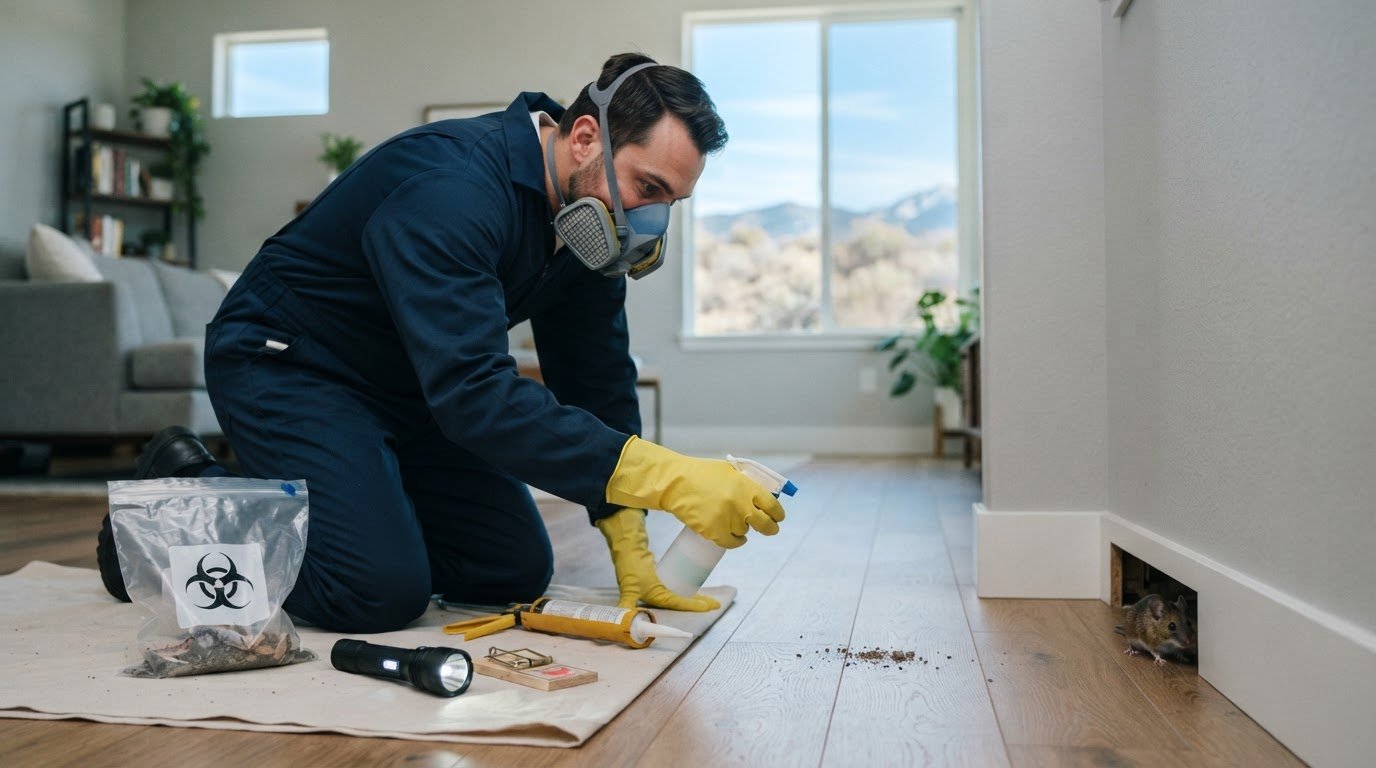
The safest first step may be to avoid handling a mouse rather than trying to identify it up close. Deer mice and house mice can look similar, and a brief sighting or a few droppings may not tell you which one is inside. Still, signs of activity deserve a careful response, especially when cleanup could stir contaminated dust. A practical approach to deer mice removal reno homeowners can follow starts with observation, not guesswork.
It’s understandable to worry about possible exposure, where mice are hiding, and whether traps alone will solve the problem. Deer mice can carry hantavirus. The CDC advises against sweeping or vacuuming dry droppings and recommends wetting them with disinfectant before cleanup. Keeping your distance and following current cleanup guidance can help reduce unnecessary exposure.
This guide explains how to recognize possible deer mouse activity without touching the animal, respond safely to droppings or nesting material, and look for gaps and sheltered areas that may support repeat activity. You’ll also learn how trapping, exclusion, and tailored rodent control fit together, so you can choose a sensible next step for your Reno property.
Key Takeaways
- Learn which visible traits and activity patterns may suggest deer mice, while keeping a safe distance from any live mouse.
- Understand why suspected rodent waste calls for careful cleanup and where to find current public-health guidance.
- See how exclusion, sanitation, trapping, and professional control serve different purposes in a deer mice removal reno plan.
- Use a practical response checklist to document signs, limit access to the affected area, and reduce conditions that attract rodents.
- Find out when recurring or hard-to-reach activity may make tailored rodent control from Battle Born Pest Control a sensible next step.
Deer Mice in Reno: How to Recognize Activity Without Guessing
Finding droppings in a garage or spotting a mouse near stored boxes can be unsettling, but it doesn’t identify the species. Observe what you can from a safe distance, and treat each clue as a reason to investigate carefully, not as proof that the mouse is a deer mouse. Accurate identification can help guide the next steps in deer mice removal reno homeowners may be considering.
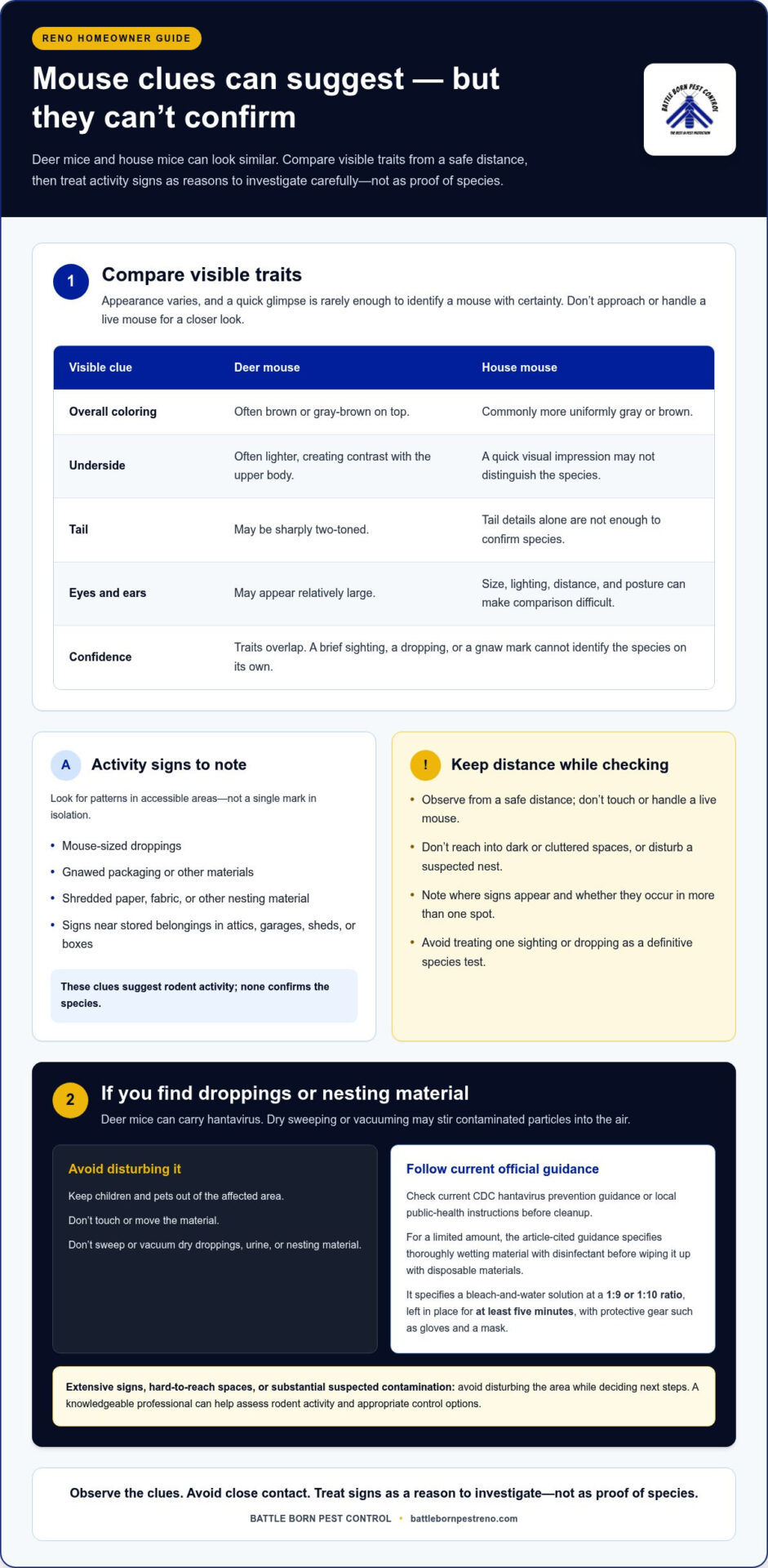
A deer mouse is a small wild rodent that may enter buildings in search of shelter. Deer mice are generally described as having brown or gray-brown fur on top, a lighter underside, and a tail that may be sharply two-toned. The deer mouse reference provides general background, but appearance varies and can be difficult to assess during a quick sighting. Don’t approach or handle a live mouse to get a better look.
What signs can suggest deer-mouse activity?
Look for patterns instead of relying on one mark or dropping. Mouse-sized droppings, gnawed packaging or materials, and shredded paper, fabric, or other nesting material can all suggest rodent activity. A sighting may add context, but a brief glimpse often reveals little detail. These signs indicate that a rodent may be present; none confirms the species on its own.
Check accessible areas where activity might go unnoticed, such as attics, garages, sheds, and boxes or stored items left undisturbed. Look for evidence in more than one spot, such as droppings near damaged packaging or nesting material beside stored belongings. Avoid reaching into dark or cluttered spaces, and don’t disturb a suspected nest to inspect it. Note where signs appear without making close contact.
How are deer mice different from house mice?
General appearance can offer clues. Deer mice often have a lighter belly and a distinct contrast between their upper body and underside, while house mice are commonly more uniformly gray or brown. Deer mice may also have relatively large eyes and ears, but size, lighting, distance, and posture can make those traits hard to judge. A quick look through a doorway is rarely enough to be certain.
Location can add context, especially when you consider where the mouse was seen and whether there are signs nearby. Activity around a quiet shed, attic, or stored belongings may be useful to note, but it doesn’t establish the species. House mice can also shelter indoors, and signs can overlap. Don’t use a single dropping, gnaw mark, or visual impression as a definitive test. If signs continue, an assessment can help determine an appropriate rodent-control response without relying on guesswork.
Deer Mice and Health Concerns: What Reno Residents Should Know
Droppings or nesting material can raise understandable health concerns, but there’s no need to assume the worst or handle a mouse to identify it. Deer mice are the primary reservoir for the Sin Nombre virus, which can cause hantavirus pulmonary syndrome. People may be exposed by breathing in particles stirred into the air from infected rodent urine, droppings, or saliva. North American hantavirus is not known to spread from person to person.
If you find suspected rodent waste, keep away and follow current public-health cleanup instructions before disturbing it. Dry sweeping or vacuuming can stir contaminated particles into the air. An article or description of a mouse cannot confirm the species or determine whether anyone has been exposed.
What should you do if you find droppings or nesting material?
Keep children and pets out of the affected area, and avoid touching or moving the material. Check the CDC’s current hantavirus prevention guidance or local public-health instructions before cleaning. Health authorities advise against sweeping or vacuuming dry droppings, urine, or nesting material because this may disperse particles into the air.
For a limited amount of material, CDC guidance calls for wetting it thoroughly with an appropriate disinfectant before wiping it up with disposable materials. The recommendations provided for this article specify a bleach-and-water solution at a 1:9 or 1:10 ratio, left in place for at least five minutes, with protective gear such as gloves and a mask. Follow current official instructions for preparation, application, and disposal rather than relying on memory or improvising a cleanup method.
If signs are extensive, in a difficult-to-reach space, or involve a substantial amount of suspected contamination, avoid disturbing the area while deciding on next steps. A knowledgeable professional can help assess rodent activity and appropriate control options. Careful cleanup matters, and so does preventing further activity in the home.
When does a possible exposure need medical advice?
Discuss personal exposure concerns with a healthcare professional or public-health authority, especially if you think you may have disturbed rodent waste or nesting material. Don’t use an online article to assess your individual risk or interpret symptoms. A professional can consider your circumstances and provide appropriate guidance without relying on a guess about the mouse species.
For homeowners weighing deer mice removal reno options, separate two questions: how to avoid disturbing possible contamination, and how to address ongoing rodent activity. Battle Born Pest Control provides tailored rodent control recommendations that consider household members, pets, and property when signs persist or access points are difficult to address. Learn about tailored rodent control as a practical step toward addressing activity safely.
Deer Mouse Removal in Reno: Comparing Prevention and Control Options
No single trap or treatment can keep mice from returning if they can still enter and find shelter or food. Match the response to the evidence: prevention reduces what attracts rodents and blocks access, while trapping or professional control may address activity already underway. UNR Extension’s non-chemical guidance emphasizes sanitation and exclusion, and notes that traps can be preferable to poison in many situations. The right approach still depends on the property and activity.
- Exclusion focuses on closing gaps and other access points. It can reduce future entry, but a trap won’t seal an opening, and a repair may not address mice already inside.
- Sanitation reduces access to food and shelter. Secure stored food and clear unnecessary clutter, while remembering that cleanliness alone won’t stop entry through an open gap.
- Trapping can help control rodents already present. Placement and regular checks matter, and traps should be positioned and used in ways that protect children and pets.
- Poison bait may control rodents, but it has trade-offs. Accessible bait or a poisoned rodent may expose a non-target animal, and rodents may die in inaccessible spaces.
- Professional control can help when activity persists, entry points are difficult to find, or signs recur. A property-specific plan can account for the home, its occupants, and the pattern of activity.
When do exclusion and sanitation make sense?
Look for ways a rodent could get inside, then consider what might provide food or cover indoors. Gaps around doors, pipes, or utility openings may need attention. Secure stored food and reduce clutter or exterior debris where practical. These measures work together, but they don’t replace safe management of active rodent signs. For broader context on choosing a response, see the rodent control services guide for Carson City.
When might trapping or professional control be appropriate?
Trapping may be a reasonable part of the response when activity is limited and the trap can be placed out of reach of children and pets. Follow the product instructions and check the trap regularly; it won’t prevent another mouse from entering. Poison also requires careful consideration because of possible non-target exposure, and inaccessible areas can make ongoing activity harder to locate.
Repeated signs, suspected activity behind walls or in other hard-to-reach spaces, or continued entry after repairs can make a do-it-yourself response more complicated. Battle Born Pest Control tailors rodent-control plans to each property, with recommendations that consider household members, pets, and the building. For deer mice removal reno, combining prevention with an appropriate control response is more useful than expecting one device or treatment to solve every part of the problem.
A Reno Homeowner’s Deer-Mouse Prevention and Response Checklist
A clear sequence can help you respond without disturbing possible contamination or rushing to identify the rodent. Record what you see from a safe distance, follow current public-health cleanup instructions, then reduce access and conditions that may support further activity.
- Keep your distance. Don’t approach or handle a live mouse, droppings, or nesting material. Keep children and pets away from the area while you decide what to do next.
- Document what you observe. Note the location and time of a sighting, and record where droppings, gnaw marks, or nesting material appear. Take photos from a safe distance if you can do so without disturbing anything.
- Limit access to the area. Close off the room or avoid using the affected part of a garage, shed, or storage space. Don’t move boxes or suspected nesting material to get a closer look.
- Check official cleanup guidance. Before handling suspected rodent waste, review current CDC or local public-health instructions. Don’t sweep or vacuum dry droppings or nesting material.
- Reduce opportunities for future activity. Secure food, reduce unnecessary clutter, and inspect accessible entry points when it’s safe. Prevention works best as an ongoing habit, not a one-time check.
How can you reduce the chance of mice entering?
Inspect accessible gaps around doors, vents, pipes, and utility openings, and note spots that may need repair or closer attention. Keep food in secure containers and clear clutter that could conceal rodent activity. Check garages, sheds, and stored belongings periodically, but don’t disturb suspected nesting material. These habits can make it easier to notice changes and address conditions that may attract rodents.
Keep inspections safe and manageable. You don’t need to reach behind heavy objects, enter a confined space, or touch anything to document a concern. If an area is difficult to access, note its location and leave it undisturbed rather than risking contact.
What information helps assess an ongoing problem?
A brief record can show whether signs are isolated or recurring. Note dates, rooms or outbuildings, and whether evidence appears near a door, stored belongings, or a particular wall or utility opening. Record repeated sightings and visible gnaw marks without touching the animal or waste. These details help explain the pattern to a pest professional and guide a property-specific assessment.
If activity continues or likely entry points are difficult to address, Battle Born Pest Control provides tailored rodent-control recommendations that consider the property, household members, and pets. For a practical next step, explore tailored rodent control in Reno and use your notes to describe what you’ve observed.
Professional Deer Mice Removal in Reno with Battle Born Pest Control
A professional assessment may be useful when rodent signs keep appearing, return after prevention efforts, or are concentrated in places that are difficult to reach safely. Repeated activity can point to entry points or shelter areas that aren’t easy to identify at a glance. You don’t need to determine the exact species before describing what you’ve found; the location and pattern of activity are useful starting points.
Battle Born Pest Control provides tailored rodent control for homes and businesses in Reno, Sparks, Carson City, Dayton, and surrounding Northern Nevada communities. Recommendations take the property and reported concern into account, along with household members, pets, and the building. This offers a considered alternative to relying on a single trap or treatment without addressing the conditions around it.
What can a tailored rodent-control plan address?
A plan can account for where signs appear, whether they recur, and whether suspected access points are difficult to reach. For example, activity in a garage may call for different considerations than signs in an attic or near stored belongings. Sharing those details helps shape recommendations around the property instead of assuming every rodent concern is the same.
Battle Born Pest Control offers one-time treatment for active rodent problems, along with recurring inspections and prevention plans. The appropriate approach depends on the reported activity and the property. Recommendations take family and pet safety and protection of the home into account, without presenting any one method as a guaranteed fix. A tailored plan can address current signs and steps that may help reduce continued activity.
How to take the next step in Reno
Before requesting help, note where and when you’ve seen signs, whether they’ve appeared more than once, and any suspected access areas. Don’t handle a live rodent or disturb droppings or nesting material to gather details. Clear observations can help explain the concern and focus a rodent-control assessment on the areas that matter.
Battle Born Pest Control serves Reno, Sparks, Carson City, Dayton, and surrounding Northern Nevada communities. If signs are persistent, recurring, or difficult to access, a property-specific assessment can help clarify practical control and prevention options. A calm, documented response is a useful place to start.
For deer mice removal reno homeowners can approach with a tailored control plan, request help with rodent control in Reno.
Choose a Steady Next Step for Your Property
When rodent signs keep returning, you don’t have to solve every part of the problem alone. A clear record of what you’ve noticed can help turn uncertainty into a practical conversation about the property and an appropriate control approach. For deer mice removal reno homeowners can pursue with confidence, tailored recommendations can account for the needs of the household and building.
Battle Born Pest Control is locally owned and licensed in Northern Nevada, providing rodent control for residential and commercial properties. Its plans are tailored to each property, with care for families, pets, and belongings. This local, considered approach provides a practical starting point for addressing active rodent concerns.
Request help with rodent control in Reno and take an informed step toward a better-protected property.
Frequently Asked Questions
Are deer mice common in Reno, Nevada?
Deer mice may be encountered in Reno, but a sighting at one property can’t tell you how common they are across the city. A mouse indoors may also be another species, and droppings alone don’t settle the question. In Reno, Sparks, Carson City, and Dayton, focus on the evidence at your property, such as repeated activity or signs in a storage area, rather than assuming a citywide pattern.
Can deer mice get into a house through a small opening?
Yes. A deer mouse can squeeze through an opening about the size of a nickel, so small gaps can matter. Check accessible areas around doors, pipes, vents, and utility openings for spaces that may allow entry. Don’t assume a gap is being used just because it’s present; look for other signs nearby and note where activity appears. Addressing entry opportunities is one part of reducing future access.
How can I tell deer mice apart from house mice?
Deer mice often have a noticeably lighter underside and a sharper contrast between the back and belly, while house mice may look more uniformly gray or brown. These are general clues, not a reliable identification test, especially after a brief sighting or in poor light. Don’t try to catch or approach a mouse for a closer look. Treat signs as rodent activity until a more reliable assessment is possible.
What should I do if I accidentally disturb mouse droppings?
Stop disturbing the area and don’t sweep or vacuum the material. Keep people and pets away, then check current CDC or local public-health cleanup guidance before deciding what to do next. Dry rodent waste can release particles into the air when disturbed, so avoid creating more dust. If you’re worried you may have been exposed, contact a healthcare professional or public-health authority for advice about your situation.
Can deer mice live in an attic, garage, or shed?
Yes, deer mice may shelter in buildings, including attics, garages, and sheds, particularly in quiet spaces with stored belongings. A mouse or nesting material in one of these places doesn’t confirm the species. Note the location and any nearby signs without reaching into boxes or disturbing suspected nesting material. Repeated evidence in the same area can help show where activity is concentrated and what may need further attention.
Does seeing one mouse mean there is an infestation?
No, one sighting by itself doesn’t establish an infestation or show how long a mouse has been present. It does give you a reason to watch for additional evidence, such as new droppings, gnaw marks, or repeat sightings. Record where and when you noticed the mouse, and avoid handling any signs you find. If activity appears again or evidence builds in several areas, a property assessment can help clarify the scope.
Can pets be affected by deer mice or contaminated areas?
Keep pets away from live rodents, droppings, and nesting material, since contact could expose them to contamination or lead them to disturb the area. Restrict access to a room, cupboard, or part of a garage where signs are present, and follow public-health instructions before cleaning. If your pet has contacted a rodent or you’re concerned about its health, ask a veterinarian for advice specific to the situation.