Fire Blight Treatment in Carson City: A Homeowner’s Guide
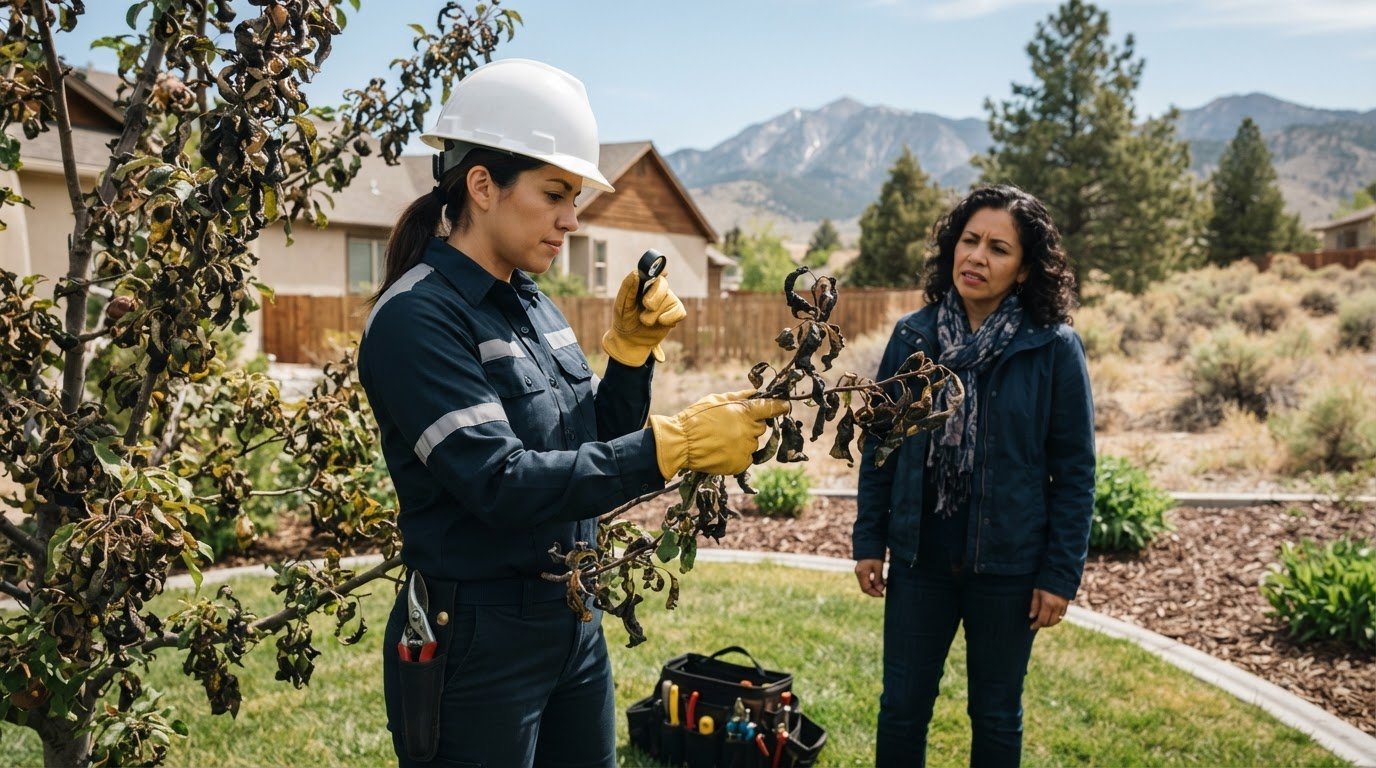
A branch tip suddenly looks scorched, with brown or black leaves still clinging to it. Is it fire blight, and could the problem reach nearby trees? Those signs can be concerning, but they can also resemble other tree stresses. A quick diagnosis based on appearance alone may lead to the wrong response. A search for “fire blight treatment carson city” often starts with one practical question: can the tree be saved?
It’s understandable to want a fast solution, especially when susceptible trees grow close together. Effective care starts with identifying the likely cause and assessing how much of the tree is affected, not relying on a product that promises a quick fix.
This guide covers common fire blight symptoms, when a professional assessment can help, and what treatment can and can’t accomplish. You’ll also learn how pruning, preventive measures, and ongoing care may fit into a plan tailored to the tree and its surroundings. In Carson City, an arborist-led tree health assessment can clarify the next steps and support a measured response focused on tree health and property safety.
Key Takeaways
- Scorched-looking leaves and curled branch tips can signal fire blight, but an assessment helps distinguish it from other tree problems.
- Flowering stage and weather can influence infection risk, so understanding the disease cycle helps guide timely prevention.
- Pruning and other management steps may limit spread, but they can’t reverse existing damage or guarantee a tree’s survival.
- For suspected fire blight treatment carson city, document symptoms, avoid unnecessary handling, and follow an assessment-based plan.
- Certified arborists can tailor tree health assessments and disease management to the tree’s condition and surroundings.
Fire Blight in Carson City: Recognize Symptoms Before Choosing Treatment
Fire blight is a bacterial disease caused by Erwinia amylovora that can damage blossoms, shoots, and branches of susceptible apple, pear, and related plants. The name comes from the scorched appearance affected growth can take on, but a scorched-looking branch alone doesn’t confirm the disease. The Fire blight overview describes its cause, symptoms, and range of susceptible plants. A tree’s species and the pattern of damage still matter when symptoms are assessed on site.
Which trees and symptoms should Carson City homeowners watch for?
Common susceptible hosts include apple and pear trees, along with some ornamental plants in the rose family, such as crabapple and hawthorn. These are useful groups to watch, not proof that fire blight is present in a particular Carson City tree. An assessment considers whether the plant is a potential host and whether its symptoms follow a pattern consistent with the disease.
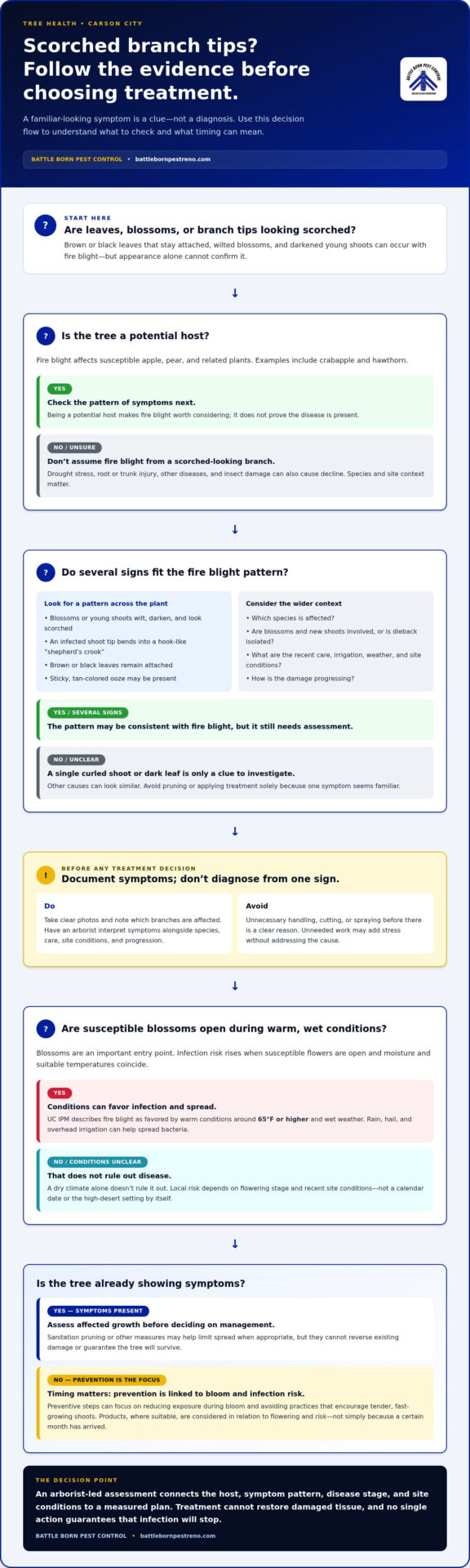
Look for blossoms or young shoots that wilt, darken, and appear scorched. Infected shoot tips may bend into a hook-like shape, often called a “shepherd’s crook.” Leaves can turn brown or black and remain attached to the branch, while some infections produce sticky, tan-colored ooze. Symptoms may affect multiple shoots, but their extent and distribution vary. Take clear photos and note which branches are affected rather than relying on a single leaf or twig.
How can fire blight be distinguished from other tree problems?
Branch dieback and discolored leaves aren’t unique to fire blight. Drought stress, root or trunk injury, other diseases, and insect damage can also cause parts of a tree to decline. A curled shoot or darkened leaf is a clue to investigate, not a diagnosis. Avoid cutting branches or applying a treatment solely because one symptom looks familiar. Unnecessary work may add stress without addressing the cause.
An arborist interprets symptoms alongside the tree’s species, recent care, site conditions, and the way damage is progressing. For example, a pattern affecting blossoms and new shoots on a susceptible host raises different questions than isolated dieback on an unrelated tree. Irrigation, pruning, weather exposure, and visible wounds can also help guide the assessment. This context is especially useful when several trees show different symptoms or affected branches are near structures, paths, or other plantings.
If you’re unsure whether symptoms point to fire blight, an arborist-led tree health assessment can clarify what you’re seeing before you decide on pruning or another intervention. Accurate identification gives fire blight treatment carson city homeowners consider a careful starting point: a plan matched to the tree and the evidence, rather than a quick response to one alarming sign.
How Fire Blight Develops and What Carson City Conditions Mean
Fire blight follows a cycle. The bacterium can survive through winter in infected areas of a tree, then spread when conditions support its movement and growth. In spring, bacteria may reach blossoms through rain splash or insect activity. From there, infection can move into shoots and branches. The disease’s presence in a tree and the weather during flowering both inform risk, but neither a calendar date nor Carson City’s high-desert setting alone determines whether infection will occur.
When can fire blight infect susceptible trees?
Blossoms are an important entry point because bacteria can infect susceptible flowers when moisture and suitable temperatures coincide. UC IPM describes fire blight as favored by warm conditions, around 65°F or higher, and wet weather. Rain, hail, and overhead irrigation can help spread bacteria. Its UC IPM Fire Blight Management guidance explains the disease cycle and how environmental conditions influence infection.
Infection risk rises when susceptible blossoms are open and warm, wet conditions allow Erwinia amylovora to spread and enter flowers. Later, rain or hail can move bacteria to additional plant tissue. This is established disease biology, not a forecast for Carson City in any particular year. A dry climate doesn’t rule out disease if favorable conditions occur during a vulnerable stage. Local risk depends on the tree’s flowering stage and recent site conditions.
Why does timing matter for treatment decisions?
Timing changes the purpose of management. Before infection, preventive steps can focus on reducing exposure during bloom and avoiding practices that encourage tender, fast-growing shoots. Once symptoms appear, the priority shifts to assessing affected growth and deciding whether sanitation pruning or other measures are appropriate. Preventive products, where suitable, are generally considered in relation to flowering and infection risk, not applied simply because a certain month has arrived.
After symptoms develop, treatment can’t restore damaged tissue, and no single action guarantees that infection will stop or the tree will survive. That’s why identifying the disease stage matters: the right response for an actively flowering tree may differ from the response for a tree with established branch symptoms. Cutting or spraying without a clear purpose may add stress or miss the relevant infection stage.
For fire blight treatment carson city homeowners are considering, an arborist can assess the host tree, symptom progression, flowering stage, and site conditions before recommending a course of action. A measured tree health assessment connects disease biology to what’s happening on the property, rather than treating a general weather pattern as a diagnosis.
Fire Blight Treatment Options: What Helps, What Has Limits
There isn’t one treatment that fits every tree. The right response depends on whether the goal is to reduce infection risk before symptoms appear, manage affected growth, or understand how much of the tree is involved. Even well-chosen measures have limits: fire blight can damage tissue beyond repair, and no treatment guarantees that a tree will survive.
| Approach | Purpose and timing | Important limits |
|---|---|---|
| Preventive care | Reduce conditions that favor infection, especially around flowering, through careful site and tree management. | Prevention can lower risk but can’t ensure that infection won’t occur. |
| Sanitation pruning | Remove infected growth when recommended, using appropriate timing and careful cutting practices. | Pruning won’t restore damaged tissue; extensive or poorly planned cuts can harm tree structure. |
| Professional assessment | Identify likely causes, evaluate disease extent, and guide a response suited to the tree and site. | An assessment informs decisions, but it can’t promise a cure or tree survival. |
Can pruning manage fire blight without harming the tree?
Pruning can be part of disease management, but it isn’t a guaranteed cure. The appropriate season, cut location, and tool sanitation practices should follow current, authoritative plant-health guidance and the tree’s condition. Removing too much live wood or cutting without considering branch structure may create avoidable stress. If affected growth is extensive, an arborist can help weigh disease management against the tree’s stability and long-term health.
Do sprays or other products cure fire blight?
Some chemical treatments are intended to reduce infection risk when used preventively, often around bloom. They don’t reverse established symptoms or restore dead tissue. Product choice and timing depend on the host, disease stage, and site. Always follow the current product label and applicable guidance, and don’t assume a product marketed for plant disease is suitable for fire blight.
For homeowners considering fire blight treatment carson city, a product’s promise of a quick cure shouldn’t replace diagnosis and a considered plan. A professional assessment can clarify whether symptoms fit fire blight, what intervention is appropriate, and what results are realistic. Treatment planning should account for the tree’s condition and surroundings rather than applying the same approach to every case.
What to Do About Suspected Fire Blight in Carson City
Possible fire blight doesn’t mean you need to remove a tree or treat every nearby plant. A calm, consistent response preserves useful evidence, limits unnecessary disturbance, and gives an arborist a clearer picture of what’s happening. Use these steps while arranging an assessment.
- Document the symptoms. Photograph affected blossoms, shoots, leaves, and branches up close and from farther away. Note when you first noticed the changes and whether they’re spreading or staying in the same area.
- Record the tree and its surroundings. Write down the tree type if you know it, recent pruning or irrigation, and whether nearby susceptible trees show similar symptoms. A simple location note or sketch can show which plants are close together.
- Limit unnecessary handling. Avoid extensive pruning or applying sprays before the cause is assessed. Don’t move potentially infected pruning material around the property or transport it elsewhere. Keep it undisturbed until you’ve verified appropriate disposal guidance.
- Arrange an assessment and follow the plan. Share your photos and observations, then use the findings to guide monitoring, pruning, disease management, or other next steps.
What should you do before an arborist assesses the tree?
Good notes are more useful than a rushed attempt to “clean up” the tree. Keep your photographs and observations together, and avoid cutting into affected branches to inspect them. If nearby susceptible trees appear healthy, don’t assume they’re infected. Watch for changes and include those trees in your notes. If symptoms appear on another tree, photograph them separately so the pattern is clear.
For a broader perspective on evaluating tree diseases and care decisions, the article “Tree Disease Management in Sparks, NV” discusses disease management in a regional context. The same measured approach applies here: document what you see, avoid premature treatment, and base action on an assessment rather than suspicion alone.
How does an arborist-led assessment guide next steps?
An assessment considers the tree’s condition, visible symptoms, species, site, and nearby plants together. That context helps distinguish between a tree that may benefit from targeted pruning or disease management and one that needs monitoring or closer evaluation. If symptoms are limited, the plan may differ from the response to extensive decline. Removal is a separate consideration, not an automatic result of suspected infection.
Battle Born Pest Control’s certified arborists tailor tree health assessments and disease management to each tree and property. A clear plan can also address how to handle affected material and what changes to watch for, helping you act carefully without assuming a guaranteed cure. For fire blight treatment carson city, homeowners can take a considered next step by arranging an assessment based on the symptoms and site.
Request a tree health assessment to get guidance suited to your tree’s condition and surroundings.
Get Arborist-Led Fire Blight Care in Carson City
Suspected fire blight can leave homeowners unsure whether to prune, monitor, or consider more extensive care. An arborist-led assessment gives those choices a sounder starting point by looking at the whole tree, not just one scorched shoot. Battle Born Pest Control provides tree health assessments and disease management in Carson City and surrounding Northern Nevada communities, including Reno, Sparks, and Dayton, with tree care performed by certified arborists.
What can a professional tree health assessment clarify?
An assessment considers the tree’s species, visible symptoms, affected areas, overall condition, and growing site. That broader view helps determine whether the signs fit fire blight or may have another cause, and how extensive the decline appears. Recommendations can then reflect the specific tree and its surroundings, including nearby plants and structures that matter when planning careful work.
Not every affected tree needs the same intervention. Depending on its condition and the assessment findings, a plan may involve disease management, pruning, or monitoring for changes. If the tree is declining severely, an arborist can also discuss its overall condition and whether further evaluation is warranted. An assessment can guide decisions, but it can’t promise a cure or that every tree can be saved.
How to move forward with tree disease management
When requesting guidance, share clear photos of the affected growth, when symptoms appeared, and whether they’ve changed. Include the tree type if you know it, any nearby trees with similar symptoms, and recent care such as pruning or irrigation. These details make the initial conversation more useful, while an on-site assessment can account for features photographs may not show.
Recommendations should be tailored to the tree’s health, the extent of symptoms, and the property. That may mean discussing careful pruning, disease management, or observation rather than treating every nearby tree or applying a product without a clear purpose. If a tree also raises concerns about stability or falling branches, mention that during the assessment so property safety can be considered alongside disease symptoms.
For homeowners seeking fire blight treatment carson city, Battle Born Pest Control can help turn uncertainty into a measured care plan. The goal is to support tree health, consider surrounding plants, and guide practical decisions without overstating what treatment can achieve.
Contact Battle Born Pest Control for tree care to discuss an assessment and the symptoms you’ve observed.
Make Your Next Tree-Care Decision with Confidence
A suspected disease can also be a prompt to consider the long-term health of your landscape. After the immediate concern is assessed, think about how future planting and routine care can support a more resilient yard. If you’re adding trees, ask about selecting varieties suited to your site and less vulnerable to fire blight. Keep a simple record of notable changes as the seasons pass so emerging concerns are easier to discuss during future care.
For fire blight treatment carson city homeowners, the most constructive next step is one grounded in the tree’s condition and the property’s needs, not a one-size-fits-all promise. A thoughtful plan can help you decide what to address now and what to keep observing, with realistic expectations for recovery.
Request an arborist-led tree health assessment and take an informed step toward caring for your landscape. With clear guidance, you can move forward with greater confidence and give your trees attentive care.
Frequently Asked Questions
Can fire blight spread from one tree to another?
Yes. Fire blight bacteria can spread between susceptible trees, especially when infected material and favorable conditions are present. Rain splash and insects can move bacteria, and contaminated pruning tools may also contribute to spread. If an apple or pear tree has suspicious symptoms, avoid using the same tools on nearby trees without proper cleaning. Watch other susceptible plants for new changes, but don’t assume they’re infected simply because they’re close by.
Can a tree recover from fire blight?
A tree may survive, particularly when infection is limited and its overall condition remains good, but recovery can’t be promised. Damaged leaves, shoots, and branches won’t return to healthy tissue, even if the tree later produces new growth. A tree with a few affected shoots may have a different outlook from one with extensive dieback or structural decline. An arborist can assess its condition and help set realistic expectations.
When is the best time to prune a tree with fire blight?
The appropriate pruning time depends on the tree, symptom extent, and current plant-health guidance. Dormant-season pruning is often part of managing infected branches, but the right response to actively developing symptoms can require a case-specific decision. Avoid heavy or repeated cutting based on a calendar date alone. Before pruning, consider whether the affected limbs are small and accessible or whether the work could alter the tree’s structure or create a safety concern.
Do fire blight sprays cure an infected tree?
No spray can restore branches or leaves already damaged by fire blight, and products shouldn’t be treated as a guaranteed cure. Some treatments are intended to reduce infection risk when used preventively, rather than reverse established symptoms. Product suitability depends on the tree and disease stage, and label directions must be followed. If symptoms are visible, identify the likely cause before applying anything so the response addresses the actual problem.
Is fire blight a concern for trees in Carson City?
It can be a concern if susceptible trees are present and conditions support infection. Carson City’s generally dry climate doesn’t rule it out. Homeowners with apple, pear, or related ornamental trees can watch new growth during and after flowering, particularly following wet weather. This doesn’t mean an outbreak is occurring locally. If you notice a pattern of shoot or branch decline, document it and arrange an assessment before deciding on treatment.
Should I remove a tree with fire blight?
Not automatically. Removal may be considered if a tree is severely affected, declining, or presents a structural risk, but limited symptoms alone don’t establish that removal is necessary. The decision should account for the tree’s overall health, the extent of affected growth, and its location near people or property. An arborist can evaluate those factors and discuss whether monitoring, targeted care, or removal is more appropriate.
What should I do with branches cut from a tree suspected of fire blight?
Don’t carry suspected infected branches around the yard or transport them elsewhere before checking suitable disposal guidance. Keep cut material contained and separate from healthy plant debris while you determine the appropriate local handling method. Don’t assume composting, burning, or placing it in green waste is suitable in every situation. If pruning hasn’t happened yet, an arborist can advise whether cutting is appropriate and how to manage the material safely.