Hazardous Tree Removal in Reno: A Homeowner’s Guide to Safer Decisions

A tree that looks damaged isn’t automatically dangerous, and one that appears sound may still need a closer look. If you’re researching hazardous tree removal Reno options, start with signs of risk rather than appearance alone. Cracks, dead limbs, a changing lean, or root disturbance may call for a professional assessment, but each can point to a different solution.
It’s understandable to feel uncertain when a tree could affect your family, home, or a neighbor’s property, especially if removal advice comes with a sales pitch. A qualified assessment can clarify what’s happening and whether pruning, ongoing care, or removal may be appropriate. The goal is to make a decision based on the tree’s condition and surroundings, not pressure.
This guide covers warning signs that merit professional attention, what to expect from a responsible removal process, and questions to ask when comparing local providers. You’ll also learn how Battle Born Pest Control’s tree health assessments and tree removal services can support careful, property-conscious tree care in Reno and Northern Nevada.
Key Takeaways
- For hazardous tree removal Reno decisions, watch for meaningful changes such as major cracks, root movement, or canopy decline, then seek a professional assessment.
- A tree-risk assessment considers potential failure concerns and what could be affected. It can inform a recommendation, but it can’t guarantee a tree will never fail.
- Removal isn’t the only possible recommendation. Depending on the findings, consider targeted pruning, monitoring, or tree health and disease management.
- Before work begins, confirm the scope, access, safety arrangements, and cleanup. Keep household members and pets away from the active work area.
- Ask prospective providers to explain their relevant qualifications, insurance, references, and written scope, including the observed concern and any alternatives.
When Is a Tree Hazardous in Reno? Signs That Deserve an Arborist’s Attention
Visible tree damage can be worrying, particularly when a tree stands near a home or a place people regularly pass. But a damaged appearance alone doesn’t mean removal is necessary. For hazardous tree removal Reno decisions, first consider what the signs may indicate and how the tree’s condition, location, and surroundings affect the concern. Urban trees are part of a broader system of urban forestry, where tree health must be considered alongside nearby people, structures, and landscapes.
Which visible tree problems should Reno homeowners notice?
Look for changes in the trunk, root area, limbs, and canopy, but don’t try to diagnose a tree from a photo or a single symptom. An arborist can interpret what you see in context.
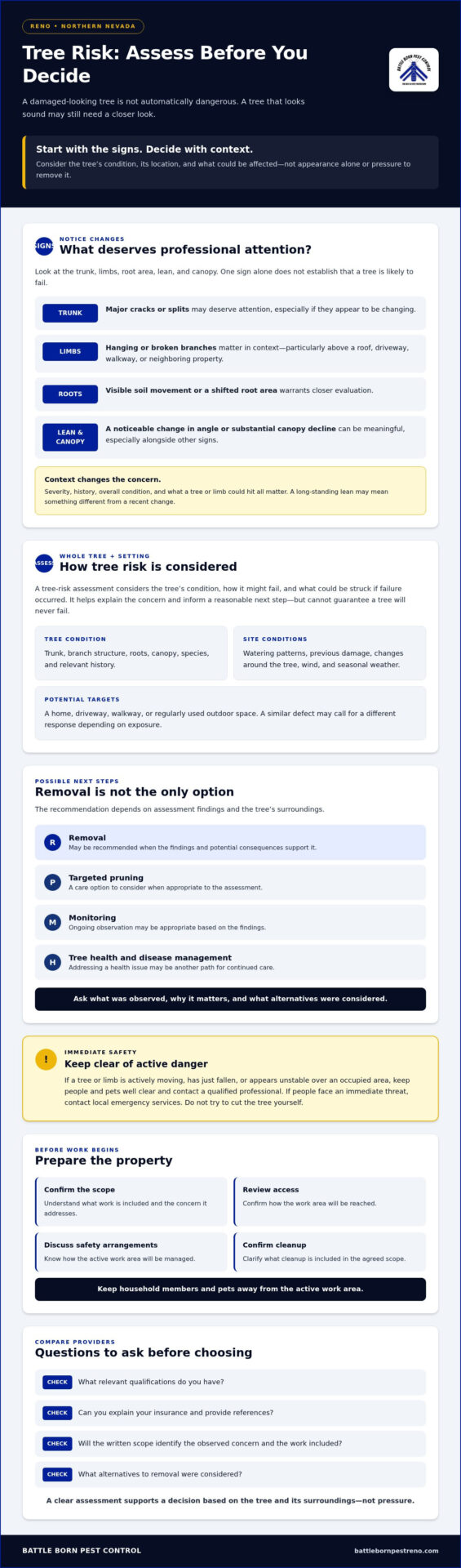
- Trunk: Major cracks or splits may deserve attention, especially if they appear to be changing.
- Limbs: Hanging or broken branches may be a concern above a roof, driveway, walkway, or neighboring property.
- Roots: Visible soil movement or signs that the root area has shifted warrant closer evaluation.
- Lean and canopy: A noticeable change in the tree’s angle or substantial canopy decline can be meaningful, especially alongside other signs.
One warning sign alone doesn’t establish that a tree is likely to fail. Its severity, history, overall condition, and what it could hit all matter. A damaged limb above an area people use calls for careful evaluation because the potential consequences differ from those of damage in an area with no nearby targets.
Does a leaning or dead-looking tree always need removal?
No. A long-standing lean may have a different significance from a recent change, and an arborist will consider the tree’s history along with its root condition and other visible evidence. Likewise, a few dead branches may indicate partial decline, while extensive canopy loss may warrant a closer assessment. These examples are illustrative, not a diagnosis or a substitute for an on-site evaluation.
If a tree or limb is actively moving, has just fallen, or appears unstable over an occupied area, keep people and pets well clear and contact a qualified professional for guidance. If the situation appears to pose an immediate threat to people, contact local emergency services. For concerns without active movement or immediate exposure, arrange a professional assessment rather than trying to cut the tree yourself.
Keep clear of an actively moving or fallen tree and contact a qualified professional. For immediate danger to people, contact local emergency services.
How a Reno Arborist Assesses Tree Risk Before Recommending Removal
A tree-risk assessment considers a tree’s condition, how it might fail, and what could be struck if a failure occurred. It helps an arborist explain the concern and recommend a reasonable next step. The assessment can inform a decision, but it can’t guarantee that a tree will never fail.
What does an arborist examine during a tree assessment?
An arborist considers the whole tree and its setting instead of relying on one visible defect. The review may include the trunk, branch structure, root area, canopy, and site conditions, along with the tree’s species and any relevant history shared by the property owner. The arborist also considers potential targets, such as a home, driveway, walkway, or regularly used outdoor space.
These factors help frame the options. A defect above an occupied area may call for a different response than a similar concern where there’s little exposure. Depending on the findings, the recommendation may involve removal or continued care, such as pruning, monitoring, or addressing a health issue. A professional assessment supports the decision, but it isn’t a promise of zero risk. Purdue Extension provides broader information about the property owner’s duty to inspect and maintain trees. For local responsibilities, verify the requirements that apply to your property.
What local conditions can affect tree health in Northern Nevada?
Site conditions and tree history matter. An arborist may ask about watering patterns, previous damage, and changes around the tree, and consider exposure to wind and seasonal weather. In the Reno area, heavy, wet snow, high winds, and freeze-thaw cycles can contribute to tree damage, but their effects depend on the individual tree and site. Dry periods or temperature swings may also be relevant considerations, but they don’t prove that a particular tree is hazardous.
Visible decline can have more than one explanation, so a closer look may help distinguish a health concern from a structural one. If disease or pests may be involved, see the Sparks tree disease management guide for additional context.
For homeowners weighing hazardous tree removal Reno options, an assessment can replace guesswork with a clearer explanation of the tree’s condition, potential targets, and possible care choices. Battle Born Pest Control offers tree health assessments. Request a tree health assessment to discuss what an arborist may evaluate at your property.
Tree Removal or Another Option? Compare the Arborist’s Recommendations
An unhealthy or unattractive tree doesn’t automatically need to come down. A recommendation should connect observed conditions with the tree’s location, the possible consequences of failure, and your goals for the property. The U.S. Forest Service’s guidance on Hazard Trees offers background on defects that may warrant attention, but a professional must interpret a tree’s specific condition and setting.
Depending on the assessment, care may focus on the whole tree, a particular limb, or changes in its condition over time. These options aren’t interchangeable, and some may not suit a tree with serious structural concerns.
| Option | When it may be considered | What to clarify |
|---|---|---|
| Removal | When assessment findings suggest the tree’s condition and potential impact make keeping it an unsuitable choice. | Which concerns support removal, what the work includes, and how the site will be considered. |
| Targeted pruning | When specific limbs or growth may be addressed without removing the entire tree. | Which parts need attention and what the pruning is expected to address. |
| Monitoring | When immediate removal isn’t recommended and changes can be checked over time. | What signs to watch for and when to seek another evaluation. |
| Health or disease management | When the concern appears related to tree health or a pest or disease issue that may have management options. | What condition is suspected and whether management could address it. |
When might pruning or monitoring be considered instead?
If a concern is limited to a particular limb, an arborist may consider targeted pruning after evaluating the tree. Monitoring may make sense when the arborist doesn’t recommend immediate removal but wants changes in the tree’s condition tracked. Neither option should be assumed safe without considering the site and potential targets. For related homeowner guidance, see the Carson City hazardous tree removal guide.
What questions help clarify a removal recommendation?
Before agreeing to work, ask the provider to explain the recommendation in plain language. A clear conversation can help you understand whether the advice is based on the tree’s condition, its location, or both, and whether other care options are worth considering.
- Which observed conditions support removal, and what concern would it address?
- Could pruning, monitoring, or disease management be reasonable alternatives?
- What work is included, and what site-specific access or protection considerations should we discuss?
A careful hazardous tree removal Reno decision should be based on the assessment, not pressure or appearance alone. If removal is recommended, ask for a clear explanation of the scope and why other options aren’t suitable for the tree and property.
How to Prepare for Hazardous Tree Removal on a Reno Property
Once removal has been recommended, a clear plan helps protect people, property, and the surrounding landscape. Before work begins, confirm what’s included, discuss access and safety, and agree on debris handling. A written scope gives you and the provider a shared understanding of the work, while allowing for site-specific conditions.
What should homeowners clarify before work begins?
Start by identifying the exact tree and any sections included in the work. Ask how nearby structures, fences, planting beds, and other landscaping will be considered, and discuss how the crew will access the site. Gates, narrow paths, parked vehicles, overhead obstacles, and proximity to neighboring property may affect the work plan, so raise them before work is scheduled.
Then clarify the practical details in writing:
- Scope: Which tree or sections are included, and what work is excluded?
- Scheduling and access: When is the work planned, and which areas need to be clear?
- Site protection: How will people, nearby structures, and landscaping be considered?
- Debris and cleanup: Who is responsible for handling debris, and what cleanup is included?
- Stump work: Confirm whether stump grinding is excluded or needs to be arranged separately.
Also verify whether any City of Reno, Washoe County, or other property-specific requirements apply to your tree and location. Requirements can depend on the site and circumstances, so check with the relevant authority rather than assuming a permit is or isn’t needed.
How can you keep people and property safer during the work?
Follow the provider’s directions about boundaries around the active work area, and keep household members and pets away from it. Move vehicles or other items from access routes if requested. Tell the provider about gate access, overhead obstacles, and nearby property in advance so these details can be considered during planning.
Don’t climb the tree, cut limbs, or try to move unstable sections yourself. If you’re concerned about a branch or trunk before the scheduled work, keep clear and contact the provider for guidance instead of approaching it.
Good preparation turns hazardous tree removal Reno planning into a clear sequence: confirm the scope, discuss access, protect people, clarify cleanup, and check applicable requirements. For tree removal and tree health assessment services, discuss your tree removal needs with Battle Born Pest Control.
Choosing a Company for Hazardous Tree Removal Reno Homeowners Need
A good provider should help you understand the tree and proposed work, not pressure you into a decision. When comparing hazardous tree removal Reno companies, look for clear answers about who will assess the tree, what qualifications apply, how the work will be managed, and what’s included in writing.
What should you ask before hiring a Reno tree service?
Use these questions to compare providers and make sure you understand the recommendation and work plan before agreeing:
- Who will assess the tree? Ask about that person’s role and relevant arborist qualifications, and how those qualifications apply to the assessment or removal.
- Can you provide proof of relevant insurance? Request documentation and confirm which work it applies to.
- What does the written scope include? Check that it identifies the tree and work, along with cleanup responsibilities and exclusions. If stump grinding matters to you, ask whether it’s excluded and make separate arrangements if needed.
- How will site safety be communicated? Discuss how the work area will be managed and how the provider will address unexpected conditions or changes to the planned scope.
- Can you share references? Ask for references relevant to similar work, then use them to understand the provider’s communication and follow-through.
How can a local arborist support an informed decision?
A useful assessment connects the observed condition to the property’s setting and explains whether removal, pruning, or continued care may fit. You should be able to ask what evidence supports the recommendation and get a clear explanation of alternatives without being rushed. A provider who explains both the concern and the limits of an assessment gives you a better basis for deciding.
Battle Born Pest Control serves Reno, Sparks, Carson City, Dayton, and surrounding Northern Nevada communities with tree health assessments, pruning, pest and disease management for trees, and tree removal. The company’s removals are performed by certified arborists. Before hiring any provider, including Battle Born, verify current credentials and ask who will be responsible for your project. The right choice should take account of your tree, property, and questions without promising an outcome no assessment can guarantee.
If you’d like to discuss a tree concern or removal in Reno, contact Battle Born about tree removal in Reno.
Make Your Next Tree-Care Decision with Confidence
A concerning tree deserves a thoughtful response, not an automatic removal decision. The signs you notice are a starting point. An arborist can assess the tree’s condition and setting, explain the options, and clarify why a particular recommendation may fit. Before work begins, make sure the scope, site-safety arrangements, and cleanup expectations are clear.
Choosing hazardous tree removal Reno services is easier when you know what to ask and can weigh removal against continued care. Battle Born Pest Control offers tree health assessments and tree removal in Reno and surrounding Northern Nevada communities. The company’s removals are performed by certified arborists, giving homeowners a local option for discussing a tree’s condition and possible next steps.
Contact Battle Born to discuss a tree assessment or removal in Reno. A clear conversation can help you move forward with greater confidence and care for your home, family, and surrounding landscape.
Frequently Asked Questions
How do I know if a tree is hazardous?
Signs such as major trunk cracks, hanging limbs, root movement, a recent change in lean, or substantial canopy decline warrant attention, but one symptom alone doesn’t establish that a tree is likely to fail. Consider what could be struck if a limb or the tree fell, such as a home, driveway, walkway, or neighboring property. A qualified arborist can assess the tree and its setting before you decide whether hazardous tree removal Reno is appropriate.
Does a leaning tree always need to be removed?
No, a lean doesn’t automatically mean removal is necessary. Its history matters: a long-standing lean may be less concerning than a recent change, especially if there are signs of root movement or other damage. An arborist can consider the tree’s condition, site, and potential targets together. Avoid trying to correct the lean or cut the tree yourself, particularly if people or structures could be exposed.
Can a hazardous tree be saved with pruning?
Sometimes, targeted pruning may address a specific limb or defect, but it isn’t suitable for every tree or concern. An arborist should assess whether pruning could help manage the issue or whether the tree’s overall condition and location make another option more appropriate. Depending on the findings, continued monitoring or tree health and disease management may also be considered. Ask what the recommended work addresses and what risks may remain.
Who is qualified to assess a hazardous tree in Reno?
Look for an arborist with relevant qualifications and experience assessing tree condition and risk. Ask who will evaluate the tree and explain the recommendation, and verify current credentials directly rather than relying on an unconfirmed claim. Battle Born Pest Control offers tree health assessments, and its tree removals are performed by certified arborists. The company serves Reno, Sparks, Carson City, Dayton, and surrounding Northern Nevada communities.
Do I need a permit to remove a tree in Reno?
As of September 2026, a permit isn’t required to remove a tree on private property in Reno, according to current local guidance. Tree work on city-owned property or within the city right-of-way requires a Tree Work Permit. Requirements may differ if removal is part of a construction project requiring a grading or building permit, so confirm the rules for your property and tree with the relevant authority before work begins.
What should I expect during hazardous tree removal?
Before work begins, confirm which tree or sections are included, discuss site access and safety arrangements, and get cleanup responsibilities and exclusions in writing. Keep household members and pets away from the active work area, and follow the provider’s directions about vehicles and nearby property. The work plan depends on the site and scope, so ask how unexpected conditions will be handled. Don’t climb, cut, or move unstable tree sections yourself.
Does tree removal include stump grinding?
Not necessarily. Stump grinding may be separate from tree removal, so ask the provider to state in writing whether stump work is included or excluded and clarify who is responsible for any work not covered. Battle Born Pest Control offers tree removal but does not offer stump grinding. If removing the stump matters to you, confirm your options with a separate provider rather than assuming it’s part of the removal scope.