How to Handle Paper Wasps in Sparks and Spot Nest Signs

A tiny paper wasp nest isn’t automatically a safe DIY job. A small, exposed nest may be manageable to treat yourself, but a paper wasp exterminator in Sparks is the safer choice when the nest is hard to reach, growing, or close to people and pets. In spring, a founding nest can be about the size of a quarter, but even a small nest can become defensive if disturbed.
It makes sense to address a nest early and avoid a close encounter with stinging wasps. This guide explains what to look for, when DIY treatment may be suitable, and when to leave the nest alone and seek professional help.
Learn how to recognize paper wasps and their nests, assess risks around your home, and choose a practical next step for your property in Sparks.
Key Takeaways
- Learn to distinguish a paper wasp nest from ordinary insect activity by watching for repeated flight paths and the nest’s open, umbrella-like structure.
- Use the nest’s location, accessibility, and wasp activity to judge whether a DIY approach is sensible, and avoid disturbing a nest when the risk is unclear.
- Reduce appealing nesting spots by screening openings and keeping exterior surfaces maintained.
- Recognize when nest placement or repeated activity makes professional wasp control the more practical next step.
- Understand how targeted treatment can help address a nest while keeping the safety of people, pets, and property in view.
Can you DIY Paper Wasp?
In Sparks, paper wasps become active in spring, when queens emerge and begin umbrella-shaped nests; by midsummer, nests may have workers that defend them. For a DIY pesticide application in Nevada, follow the product label and use only products labeled for wasp and hornet control; professional pest-control work must follow applicable state licensing requirements.
-
Check Paper Wasp Activity in Sparks
In spring, watch outdoor eaves, porch ceilings, railings, and shrubs for wasps returning to the same spot. A founding queen may build a starter nest about one inch wide, with a few open cells beneath a small, umbrella-shaped comb. Observe from a distance and note any repeated flight path. Don’t touch the nest or stand beneath it, especially as activity increases toward midsummer.
-
Prevent and Remove Spring Starter Nests
Inspect sheltered outdoor areas in spring, before a nest grows and becomes harder to address. Paper wasps commonly choose protected spots such as roof overhangs, porch ceilings, branches, and shrubs. If a tiny founding nest is easy to reach and only one or two wasps are present, removing it early may prevent a colony from developing. Don’t knock down a nest if more wasps are present or access is unsafe.
-
Assess Risks Before Disturbing a Nest
Before approaching, consider the nest’s location, accessibility, and activity. Paper wasps usually sting when disturbed or when they perceive a threat to the nest, and they can sting repeatedly. A nest near a doorway, outdoor seating area, or frequently used path raises the chance of an accidental encounter. Avoid DIY work if anyone nearby has a known stinging-insect allergy, or if wasps could enter a wall void or attic.
-
Compare DIY Removal With Professional Service
Choose DIY treatment only for a small, exposed nest that you can address without standing beneath it or approaching closely. A ready-to-use aerosol labeled for wasp and hornet control can reach up to 20 feet; follow its label, including directions for application and protective clothing. If the nest is elevated, hidden, active, or difficult to reach, professional removal avoids a close approach and reduces the chance of driving wasps into a structure.
- If using an aerosol, follow its label and apply it in the early evening, when wasps are on the nest and less likely to fly. Keep out of the flight path, don’t stand directly below the nest, and don’t shine a flashlight at it. After treatment, watch from a safe distance for ongoing activity. If wasps remain, the nest is partly intact, or activity returns, stop attempting removal. Paper wasps may rebuild after incomplete treatment.
DIY treatment suitability and risk
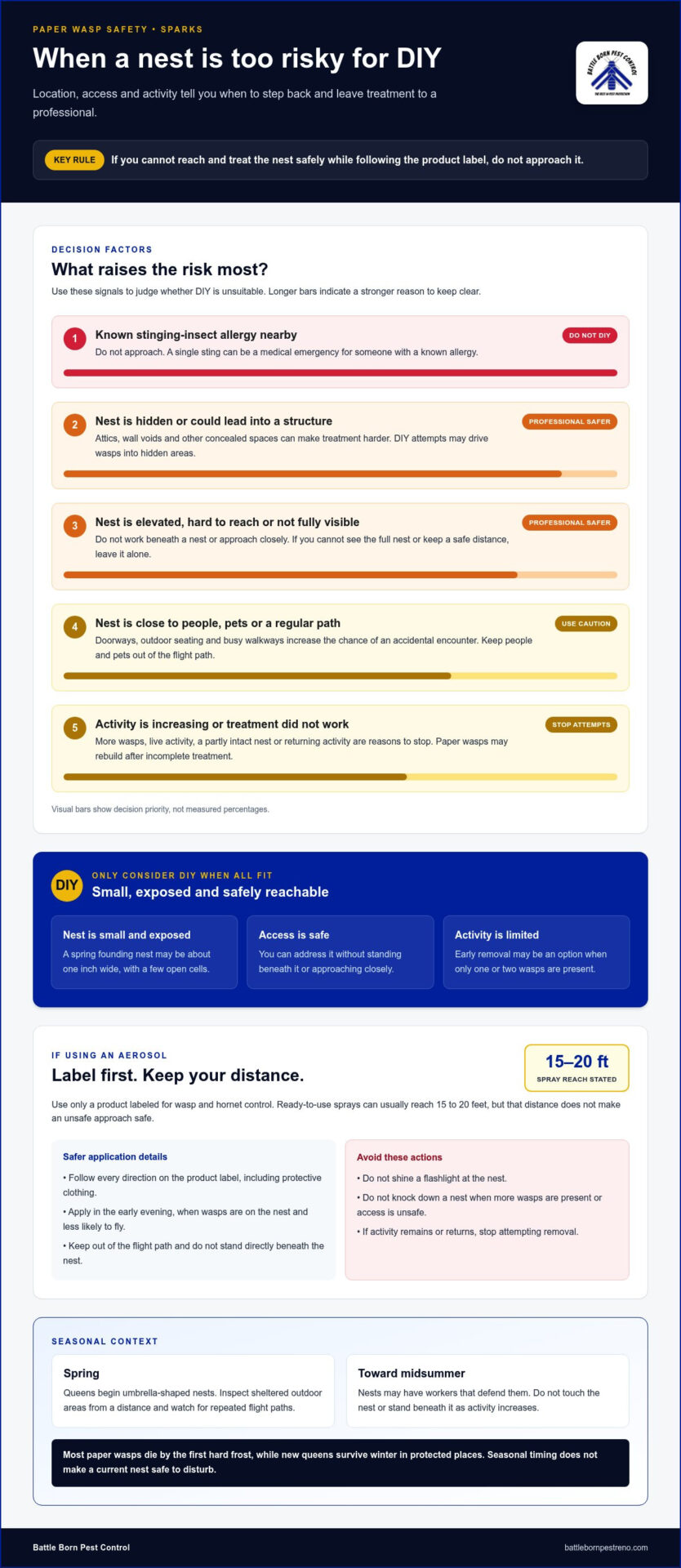
- Assess the nest and your exposure before choosing DIY treatment. Paper wasps generally sting when their nest is disturbed, and they can sting repeatedly while defending it. A nest beside an entrance, outdoor seating area, or busy walkway increases the chance of accidental contact. Keep people and pets away from the flight path, and don’t approach if anyone nearby has a known stinging-insect allergy. A single sting can be a medical emergency for someone with that allergy.
- Use the nest’s activity and location to decide whether you can safely follow a product label. A small, exposed nest differs from one tucked into an attic, wall void, or other hidden space. Some DIY attempts can drive insects into concealed areas, making the situation harder to manage. Don’t proceed if you can’t see the full nest, reach it without standing beneath it, or apply pesticide while keeping a safe distance.
- Choose only an aerosol labeled for wasp and hornet control, and follow every direction on its label. Ready-to-use wasp and hornet sprays can usually reach 15 to 20 feet, but that distance doesn’t make an unsafe approach safe. Apply directly to the nest in the early evening, when wasps are on it and less likely to fly. Don’t use a flashlight to illuminate the nest, since light may attract the insects; don’t stand directly underneath it.
- Stop if treatment leaves live wasps, an intact nest, or returning activity. Paper wasps may rebuild if part of the nest survives, and repeated attempts can increase the chance of a sting. Don’t improvise with another pesticide or method, and never direct insects toward a building opening. Most paper wasps die by the first hard frost, while new queens survive winter in protected places, so an outdoor nest may not remain active year-round. This seasonal pattern doesn’t make a current nest safe to disturb.
- Consider professional help if a nest is elevated, hidden, growing, or close to regular household activity. A professional can assess its location and choose an appropriate treatment approach, so you don’t have to attempt a close-range application. When choosing a paper wasp exterminator in Sparks, consider whether you can reach and treat the nest safely while following the pesticide label. If not, leave the area undisturbed and arrange professional wasp control.
Sealing potential nesting sites
- Inspect sheltered outdoor surfaces in spring, before paper wasps establish a nest. Check porch ceilings, roof overhangs, shrubs, and tree branches, where protected sites can support umbrella-shaped, paper-like nests. From the ground, look for wasps repeatedly approaching the same spot. Don’t touch a nest to identify its species, and don’t seal an opening while wasps are actively entering or leaving. A careful inspection can distinguish a possible nest site from ordinary exterior wear.
- Screen attic openings and vents to block access to interior voids. Check that each screen sits securely over the opening, with no obvious gaps around the edges. Paper wasps may use protected spaces, and screening openings or vents can help exclude them from attics and other voids. Include vents serving roof extensions and other sheltered parts of the home in your inspection. If wasps gather at a vent, observe their route from a distance before making repairs.
- Maintain exposed wood and other exterior surfaces with fresh paint or varnish. A fresh coat can make it difficult for paper wasps to attach a nest, so inspect porch ceilings, railings, and sheltered trim for worn or bare areas. The finish doesn’t need to be yellow; maintaining the surface matters more than choosing a particular color. Don’t paint over an active nest or apply a finish where wasps are present, since disturbing them may provoke defensive stinging.
- Revisit the same sheltered areas after maintenance and during autumn. Future paper wasp queens seek protected places for winter and may enter buildings, so check screens and vents for gaps and note recurring activity. If a nest appears, don’t cover it with paint, varnish, or screening. These measures can help prevent attachment or entry, but they aren’t nest-removal methods. Leave the nest undisturbed and assess its position before deciding what to do. A yellow mark on a wall or trim alone isn’t evidence of a nest; look for a paper comb and repeated wasp activity.
Signs of an infestation
- Observe repeated flight paths from a safe distance before approaching any suspected nest. Paper wasps often travel between a nest and nearby feeding areas, so recurring movement toward one eave, branch, or porch corner can help locate activity. Stay 10 to 15 feet away while watching, and note where the insects enter or leave. A single wasp flying past doesn’t establish a colony; repeated traffic toward the same sheltered point is a stronger sign.
- Look for the nest’s open, umbrella-shaped comb rather than relying on insect color alone. Paper wasps build paper-like nests with uncovered cells, often beneath porch ceilings, roof overhangs, shrubs, or tree branches. From the ground, check for a small comb attached by a narrow stalk, then watch for insects returning to it. Don’t touch or knock down the structure to confirm its identity. Disturbing it can provoke defensive stinging, making close inspection dangerous.
- Compare ongoing activity with the nest’s apparent size and location. A small founding nest may have only a few cells, while continued building and regular wasp traffic can indicate a developing colony. By midsummer, workers may defend the nest, so increased activity near a sheltered site calls for caution. Note the location and when you see wasps, then keep household members away from that route rather than attempting removal.
- Check nearby openings if wasps repeatedly disappear behind siding, into a vent, or beneath a roof edge. Insects coming and going through an entry point may indicate activity in a hidden space, where the nest itself isn’t visible. Don’t seal the opening while wasps are using it or spray into an unseen cavity. These actions can push insects farther inside or leave the nest untreated. Observe from a distance and note the exact entry point.
- Use several signs together to decide what to do next: a visible paper comb, repeated traffic, and a consistent entry point provide stronger evidence than any one sign alone. Paper wasps are generally less aggressive than yellowjackets, but they can sting repeatedly when a nest is disturbed. If activity is near a doorway, outdoor seating, or a frequently used path, don’t approach for a closer look. Keep people and pets clear, and treat hidden or elevated activity as a reason not to attempt removal yourself.
When to hire a pest-control professional
When choosing a Nevada pest-control company, ask for its license information and verify it through the state licensing authority. Compare the proposed treatment plan, how it accounts for the nest’s location, and the precautions for people and pets.
- Seek professional help if the nest is difficult to reach or above a doorway, walkway, or outdoor seating area. Height and nearby activity can make a close approach harder to control, especially if wasps defend the nest. Keep people and pets away, and share the nest’s location and visible flight path when arranging service.
- Call a professional if wasps enter a wall void, attic, vent, or another hidden space. Spraying into an opening may not reach the nest, and some DIY attempts can drive insects farther inside. Note where wasps disappear, then leave the opening undisturbed. A treatment plan should account for the concealed location rather than treating only the visible entry point.
- Stop DIY attempts if wasps remain active after treatment or return to the same spot. Paper wasp nests may be rebuilt if part survives, while repeated applications can expose you to more stings. Don’t switch pesticides, block the entrance, or knock down a nest that still has activity. Tell the professional what you’ve already tried and which product label you followed.
- Arrange pest control if a household member has a known stinging-insect allergy. A single sting can be a medical emergency for someone with that allergy, so don’t approach the nest to test its activity or remove it yourself. Professional treatment is also worth considering when regular household routes pass close to the nest, since daily movement can increase accidental encounters.
- Ask for a clear explanation of the treatment approach before work begins. Describe whether the nest is exposed or hidden, how much wasp activity you’ve observed, and whether previous treatment was attempted. These details help shape a response suited to the property instead of relying on a generic method. For a nest that’s unsafe to handle yourself, arrange professional wasp control.
Ask the Nevada pest-control company for its license information and verify it through the state licensing authority.
Battle Born Pest Control: Ant Control
Battle Born Pest Control provides Wasp Control for homeowners dealing with paper wasp nests that are difficult to reach or unsafe to treat themselves. Professional help can be especially useful when a nest is near a doorway, hidden in a structure, or still active after a DIY attempt. Treatment is tailored to the property, with attention to the safety of family members, pets, and surrounding areas.
If you’re weighing nest location, ongoing wasp activity, and household safety, Wasp Control offers a practical next step. Battle Born Pest Control also provides Ant Control, Spider Control, and Tree Pruning for other property concerns.
Contact Battle Born Pest Control to discuss paper wasp treatment for your property.
Make a Confident Next Move for Your Property
Choosing a paper wasp exterminator in Sparks can help address a nest that feels unsafe to manage alone. You can also consider how outdoor spaces are maintained over time. Think about how you use the areas around your home, where people and pets regularly pass, and whether other concerns need attention. This can help you decide what support makes sense for your property.
Battle Born Pest Control offers Wasp Control for paper wasp concerns, along with Ant Control and Tree Pruning for other home and landscape needs. Choose the next step that fits the issue you’re facing and helps make your outdoor space more comfortable.
Contact Battle Born Pest Control to discuss your property’s needs and take the next step with confidence.
Frequently Asked Questions
Do Paper Wasps Sting?
Yes, paper wasps can sting, especially when they feel their nest is threatened. Paper wasps may sting when they feel threatened. Give wasps room to fly, and don’t swat at one near its nest, since sudden movement may provoke a defensive response. If someone experiences signs of a systemic reaction after a sting, call 911. A sting site can also become red and swollen.
How Risky Is It, Really?
Risk depends largely on how close people come to the nest and whether wasps are disturbed. A nest beside a frequently used door creates more opportunities for contact than one in an unused corner. Risk is especially serious for someone with a known insect-sting allergy, because a single sting can be a medical emergency. Keep children and pets away from active flight paths, and don’t test whether wasps will defend the nest.
Are Paper Wasp Nest Removal Services Available in Sparks, Nevada?
Battle Born Pest Control offers Wasp Control for paper wasp concerns in Sparks. When describing a nest, note whether it is on a porch, under an eave, or near a doorway, and explain if wasps enter a gap or cavity. These details help clarify the problem and the conditions on the property. The company also serves homeowners and businesses in Reno, Carson City, and surrounding Northern Nevada communities.
What Is the Average Price to Remove a Paper Wasp Nest in Nevada?
There isn’t one average price for removing every paper wasp nest. The cost depends on the situation, including the nest’s location, access, height, and the treatment required. A visible nest beneath a reachable porch ceiling involves different work conditions from activity inside a wall void. Contact Battle Born Pest Control for a free estimate based on your property and the nest.
What Are Paper Wasp Extermination Methods and Treatment Steps?
Treatment starts with identifying the nest’s location and assessing whether it is exposed or concealed. For a visible nest, a professional selects a treatment suited to the site and applies it according to product directions. The area can then be observed for continuing wasp activity, since surviving insects or nest material may need further attention. Avoid disturbing the nest during assessment, and share any previous treatment attempts with the technician.
What Are Paper Wasp Removal Risks and Safety Precautions?
Disturbing a nest can trigger defensive stings, so keep people and pets away from the approach and flight paths. Don’t stand directly beneath the nest, block an opening where wasps are entering, or shine a flashlight at active wasps. If someone is stung, clean the area with soap and cold water. Seek emergency help for signs of a systemic reaction, especially breathing difficulty or widespread symptoms.
Should I Remove a Paper Wasp Nest Myself or Hire a Professional Exterminator?
DIY removal is most appropriate only when the nest is small, exposed, safely reachable, and you can follow the pesticide label precisely. Choose professional treatment if the nest is elevated, hidden, near a busy entrance, or still active after an attempt. For example, wasps entering a siding gap may indicate a concealed nest that aerosol spray cannot reach directly. Keep clear rather than opening or sealing that space.
Can I Get a Same-Day Paper Wasp Exterminator in Sparks, NV?
Same-day service isn’t promised. For a paper wasp nest in Sparks, contact Battle Born Pest Control to discuss Wasp Control and describe the nest’s location, access, and current activity. Mention whether wasps are near a door or entering a structure; those details help explain the situation. If the nest is active, keep the area clear while arranging your next step.