Signs of Rodent Infestation in Reno: What to Look For
Could one small clue point to a larger rodent problem, or is it just ordinary household mess? The signs of rodent infestation Reno homeowners should watch for are more convincing when several clues appear together, rather than when a single dropping, noise, or gnaw mark is considered alone.
It’s understandable to feel uncertain, especially when you’re also thinking about food, pets, and keeping your home clean. Rodent activity can be hard to trace, and evidence near a wall or pantry doesn’t always show where rodents are getting in. Looking at patterns and locations can help you assess what’s happening without jumping to conclusions.
This guide explains how to recognize common signs, check for activity carefully, and take sensible next steps. You’ll learn what droppings, nighttime sounds, damaged materials, and possible entry points may indicate, along with when a professional inspection in Reno may help. If signs recur or appear in several areas, a tailored assessment can clarify the issue and help guide a safer response.
Key Takeaways
- One clue alone doesn’t confirm an infestation. Recurring evidence or several different signs can offer a clearer picture.
- Learn how the location and condition of droppings, gnaw marks, nesting material, sounds, tracks, or odors may help you assess activity.
- Compare possible rodent evidence with common lookalikes, such as plumbing noises, insect activity, or ordinary wear.
- If you find signs, keep your distance, note where they appear, and protect food rather than handling droppings or nests.
- This guide to signs of rodent infestation Reno homeowners may notice also explains when recurring clues or uncertainty may warrant a tailored professional inspection.
What are the signs of rodent infestation in Reno homes?
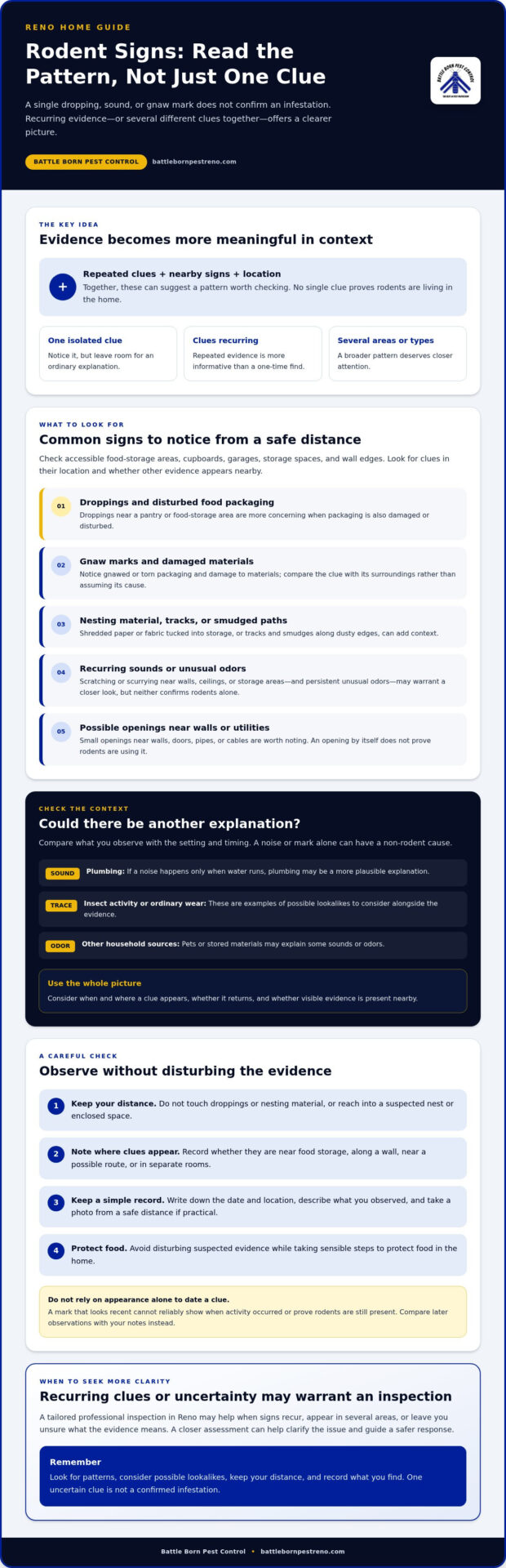
A single mark or sound is worth noticing, but it doesn’t prove rodents are living in your home. Look at the context: where the clue appears, whether it returns, and whether other evidence shows up nearby. Droppings in a pantry, for example, call for a closer look if you also find damaged food packaging or shredded material tucked into a storage space.
Rodent infestation evidence is a pattern of activity, not one isolated clue. Droppings, gnaw marks, nesting material, tracks, sounds, and unusual odors become more meaningful when they recur or appear in multiple areas. This approach can help Reno homeowners assess possible activity without treating every household noise or scuff as a confirmed problem.
Which visible clues should you check first?
From a safe distance, scan food-storage areas, cupboards, garages, and places where boxes or household supplies are kept. Look for droppings, torn or gnawed packaging, shredded paper or fabric, and small openings near walls, doors, or utility lines. Tracks or smudged paths may also be visible along dusty edges. Rodent size and appearance vary, so one dropping or opening isn’t enough to identify a species. Even information about the House mouse shouldn’t substitute for assessing the full set of clues.
Don’t touch droppings or nesting material, and don’t reach into a suspected nest or enclosed space to investigate. Note where you see evidence and whether other clues are nearby. Repeated signs in several locations deserve more attention than one isolated mark.
What sounds or smells can suggest rodent activity?
Scratching, scurrying, or other movement sounds near walls, ceilings, or storage areas may warrant a closer look, particularly if they recur in the same place. A persistent, unusual odor can also be a clue, but neither sound nor smell confirms rodents on its own. Plumbing can make noises behind walls, while pets, stored materials, or other household sources may explain sounds and odors.
Consider when and where a sound occurs, then compare it with visible evidence rather than relying on one impression. If a noise happens only when water runs, for instance, plumbing may be a more plausible explanation. Recurring sounds alongside droppings, gnaw marks, or disturbed nesting material make the overall pattern more concerning and may warrant a closer assessment.
How can you assess rodent evidence and tell whether it is fresh?
A visual clue rarely reveals exactly when rodent activity occurred. Rather than relying on one mark’s appearance, consider where it is, whether similar evidence appears again, and whether different types of clues are present nearby. Droppings near a food-storage area, for example, provide more context if you also see disturbed packaging or signs of activity along an adjacent wall.
Recurring evidence is more informative than an isolated mark because it can show a pattern of activity over time. The U.S. Environmental Protection Agency’s overview of signs of rat or mouse infestation describes common clues such as droppings, nesting material, and chew marks. Even evidence that looks recent may need professional interpretation. Appearance alone can’t reliably date it or prove rodents are still present.
Where should Reno residents look for signs?
Start with areas you can inspect safely and easily: around food storage, at the edges of garages, near visible utility openings, and in accessible storage spaces. Check wall-adjacent areas where evidence might collect, and look at an attic or crawl space only if it’s safely accessible. Don’t enter a confined, unstable, or otherwise hazardous area to investigate. Observe visible openings from a safe position instead.
As you look, note whether clues are clustered near a possible route into the home or spread across separate rooms. An opening by a pipe or cable is worth recording, but it doesn’t prove rodents are using it. Its location is more useful when considered alongside other evidence.
What makes a sign more concerning than an isolated clue?
An unexplained mark in one spot may have an ordinary explanation, while recurring evidence in several areas deserves closer attention. For example, similar clues near a pantry and in a garage suggest a broader pattern than one uncertain trace. Different types of clues in the same area can add context, though they still don’t establish exactly when activity happened.
Keep a simple record: write down the date and location, describe what you observed, and take a photograph from a safe distance if practical. Compare later observations with your notes rather than disturbing the evidence to test whether it is fresh. This can help distinguish a one-time finding from a recurring pattern while protecting you from direct contact with potentially contaminated material.
If signs recur or appear in multiple parts of your home, a tailored professional inspection can help assess the evidence and determine an appropriate response. Reno residents can learn more about rodent control in Reno as a next step when the pattern remains unclear.
Could the evidence be something other than a rodent infestation?
Yes. One sound, odor, or mark doesn’t confirm rodents, and ordinary household activity can create similar clues. A scrape on a cupboard might come from general wear, while crumbs or torn food packaging may result from a spill or handling. Scratching behind a wall could come from plumbing or another animal. The signs of rodent infestation Reno homeowners notice are more meaningful when their location, recurrence, and accompanying evidence point to the same explanation.
A simple comparison can help you pause before drawing a conclusion:
- Possible rodent activity: Similar droppings or gnaw marks recurring near the same route, especially alongside other signs.
- Possible insect activity: Small debris or damage concentrated around insect activity rather than a pattern of gnawing or movement.
- Possible household wear: An isolated scuff, tear, or damaged edge with no other evidence nearby.
- Possible building or animal sounds: Scratching or tapping that coincides with plumbing use, heating or cooling systems, or activity elsewhere in the home.
These are comparison points, not a diagnosis. Don’t handle suspected droppings or debris to inspect them more closely. Note where and when a clue appears, then consider whether it returns or is accompanied by another type of evidence.
How can you distinguish rodent signs from common lookalikes?
Repeated damage in a consistent location is more suggestive than one worn corner or unexplained crumb. Scratching sounds are also difficult to interpret without context. Their timing, location, and recurrence may help you compare them with plumbing or household systems. Consider the whole picture instead of trying to identify the source from one clue. If the evidence remains ambiguous, avoid disturbing it and keep a record for later review.
Can you tell whether the sign came from a mouse or rat?
Size may offer a clue, but droppings or gnawing marks alone aren’t reliable enough to confirm whether a mouse or rat was responsible. The evidence can be partial, old, or difficult to compare, and a mark’s appearance doesn’t establish which animal made it. Avoid identifying a species based on a single feature. Identification is more dependable when the evidence is assessed together and, if needed, interpreted by a professional.
For Reno homeowners, the practical question is often whether the clues suggest recurring rodent activity, not whether one mark can name the species. If evidence appears repeatedly or in more than one area, a professional assessment can help clarify what’s happening and guide an appropriate response.
What to do after finding rodent signs in Reno?
Finding possible rodent evidence can be unsettling, but a calm, careful response helps protect your household and makes it easier to understand what’s happening. You don’t need to touch or move anything to begin. Keep children and pets away from the area, then observe from a safe distance and note where the signs appear.
What are safe first steps after spotting possible evidence?
Use a simple sequence to gather useful information without disturbing the area:
- Keep distance. Don’t handle droppings, nests, or materials that may be contaminated, and prevent children or pets from approaching them.
- Record what you see. Note the location and date, and take a photo from a safe distance if practical. Include whether you’ve noticed similar signs elsewhere.
- Protect food. Put food and pet food in secure containers, and avoid leaving exposed items near the area of concern.
- Check current health guidance. Before cleaning, consult the CDC’s latest instructions for rodent droppings and nesting materials. Don’t rely on improvised cleanup advice.
Avoid reaching into enclosed spaces or disturbing a suspected nest to investigate. Rodent poisons and traps also require careful consideration around children and pets, and any product must be used strictly according to its label. If you’re unsure how to manage the evidence safely, leave it undisturbed while you seek advice.
For an overview of treatment and prevention considerations, see this Reno rodent control services guide. The most appropriate response depends on the evidence and the property, so general advice may not fit every situation.
When should you ask a pest professional to inspect?
Consider a professional assessment if signs recur, appear in several areas, or remain difficult to explain. A pest professional can evaluate the evidence, look for likely access points in appropriate areas, and discuss options based on your home’s layout and household needs. A single ambiguous clue may not call for the same response as a repeated pattern, which is why an assessment can help clarify next steps.
Battle Born Pest Control provides tailored rodent control in Reno, with recommendations shaped around the property and the evidence found. If you’d like help assessing possible signs of rodent infestation Reno households may encounter, ask Battle Born Pest Control about rodent signs.
When to seek professional rodent help in Reno?
A professional assessment may be useful when clues keep returning, show up in more than one area, or remain difficult to explain. You don’t need to be certain rodents are present before asking for guidance. Sharing what you’ve observed can help determine whether an inspection makes sense and what information would be useful to gather first.
For homeowners researching signs of rodent infestation Reno properties may show, the key is the pattern, not a single mark. Repeated evidence near food storage and in a separate part of the home, for example, raises different questions than one isolated, unclear clue. A tailored inspection can help put those observations in context.
What can a rodent inspection help clarify?
A professional may assess visible evidence and look for possible access points in areas that can be checked safely. The building’s layout, the location and recurrence of signs, and household considerations can all affect recommendations. An assessment can provide a clearer basis for next steps, but it shouldn’t be treated as a guarantee that every clue will be identified or that one visit will resolve the issue.
Before an inspection, it can help to share dated notes or photographs taken from a safe distance, along with where and when you noticed activity. This gives the professional context without requiring you to touch or disturb suspected evidence. Ask what the assessment includes and how any proposed treatment would suit your property.
How does local rodent control support long-term prevention?
Rodent control recommendations should address the property and the evidence rather than rely on the same approach for every home. Prevention planning may consider where activity has been observed, the building’s features, and practical steps for protecting the home over time. Household needs matter too, so discuss children, pets, and any concerns about how treatment could affect people or property.
Battle Born Pest Control provides tailored rodent control for homes and businesses in Northern Nevada, including Reno, and emphasizes family, pet, and property safety. Recommendations depend on what an assessment finds. No particular outcome should be assumed before the evidence and property needs are reviewed.
If signs continue or you’re unsure what they mean, a conversation can help you understand possible next steps. Contact Battle Born Pest Control about rodent control.
Take the Next Step Toward a Rodent-Free Home
The most useful signs of rodent infestation Reno homeowners can look for are patterns, not isolated clues. Droppings, damage, sounds, or odors deserve closer attention when they recur, appear in several areas, or occur together. Household wear, plumbing, and other sources can create similar evidence, so avoid jumping to conclusions based on one sign.
If you find possible evidence, keep your distance, note where it appears, protect food, and follow current public-health guidance before cleaning. When signs continue or remain unclear, a professional assessment can help put the clues in context and guide next steps suited to your property and household.
Battle Born Pest Control is locally owned and licensed in Northern Nevada, with tailored rodent control and ongoing pest prevention for Reno, Sparks, Carson City, Dayton, and surrounding communities. For a property-specific assessment of the signs you’ve noticed, contact Battle Born Pest Control about rodent signs.
Frequently Asked Questions
What are the first signs of a rodent infestation?
Common early clues include droppings, gnawed food packaging, shredded nesting material, small tracks, or repeated scratching sounds. Check whether signs appear together or recur in places such as food storage or along walls. The signs of rodent infestation Reno residents notice can also have other explanations, so one clue alone doesn’t confirm rodents. Observe from a safe distance and note where evidence appears rather than touching or disturbing it.
How can I tell if rodent droppings are fresh?
You generally can’t reliably determine the age of droppings by appearance alone. Their condition may offer a clue, but lighting, dust, moisture, and the surface can affect how they look. Don’t touch or move droppings to test whether they’re fresh. Instead, note the location and date, and watch from a safe distance to see whether evidence recurs. Consult current public-health guidance before cleaning any suspected rodent waste.
Can you have rodents without seeing them?
Yes. Rodents can be present even if you never see one, since they may stay out of sight while leaving droppings, damaged packaging, nesting material, or repeated sounds. Look for a pattern rather than relying on a direct sighting. For example, similar evidence in a storage area on separate occasions may warrant attention, especially if another clue appears nearby. Keep notes and avoid disturbing any suspected nesting area.
What does scratching in the walls at night mean?
Scratching or movement sounds at night may indicate activity in a wall or ceiling space, but they don’t prove rodents are responsible. Plumbing, heating or cooling systems, and other animals can produce similar noises. Note when the sound happens and where it seems to come from, then compare it with visible evidence nearby. If it keeps recurring or appears alongside other clues, consider asking a professional to assess the situation.
Are rodent droppings dangerous to clean up?
Rodent droppings may pose a health risk, so don’t handle, sweep, or vacuum them based on guesswork. Keep children and pets away from the area, and check the CDC’s current instructions for cleaning rodent waste before taking action. If you’re uncertain how to proceed, leave the material undisturbed and seek advice. This cautious approach helps limit contact with potentially contaminated material while you determine the appropriate next step.
When should I call a rodent control professional in Reno?
Consider contacting a professional if signs recur, appear in multiple areas, or remain unexplained after safe observation. A tailored assessment can help interpret the evidence and consider possible access points and property-specific needs. Battle Born Pest Control provides rodent control and ongoing pest prevention in Reno and surrounding communities, including Sparks, Carson City, and Dayton. Recommendations depend on the home and the signs observed, so discuss your concerns and household needs.
Can one sign confirm that I have a rodent infestation?
No. One unexplained sound, odor, dropping, or mark may deserve attention, but it doesn’t confirm an active infestation by itself. Consider where the clue appears, whether it returns, and whether other types of evidence are present. A recurring pattern across more than one area offers stronger reason to seek an assessment, though it may still require professional interpretation. Avoid touching suspected droppings or nests while you gather information.