Tree Pest Identification in Nevada: Signs, Species, and Next Steps
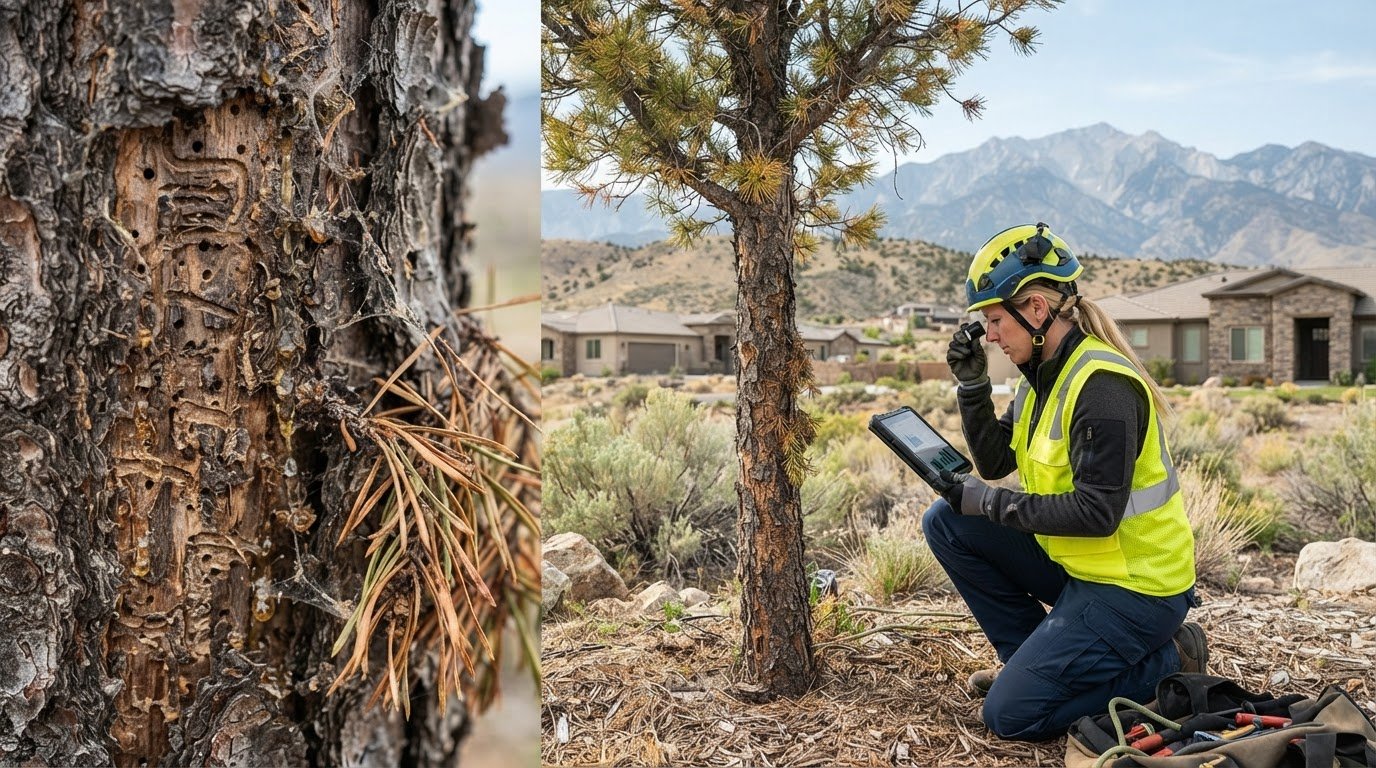
A tree’s most noticeable symptom may not point to a pest at all. Holes in bark, thinning needles, unusual leaves, or sticky sap can raise concern, but drought stress, disease, and other environmental conditions can leave similar clues. Reliable tree pest identification Nevada starts with looking at patterns rather than treating one symptom as a diagnosis.
It’s understandable to want a clear answer when a tree begins to look different, especially when you’re unsure whether to keep observing or seek help. This guide explains which signs are useful to record, how tree type, location, and season affect what you’re seeing, and when a professional assessment can help clarify next steps.
We’ll cover common pest clues in Nevada, including signs associated with bark beetles and aphids, and explain why the same symptom can have more than one possible cause. You’ll also learn when careful observation may be reasonable and when a tailored tree health assessment from certified arborists can help interpret the evidence and guide an appropriate response, such as management or pruning.
Key Takeaways
- Use several clues together when considering tree pest identification nevada; a single mark or symptom can’t confirm the cause.
- Foliage changes, webbing, and other evidence may help narrow possibilities such as bark beetles, aphids, scale insects, or spider mites.
- Tree species, site conditions, and season can change how symptoms appear, while drought or other stress may complicate interpretation.
- Photograph affected areas and note timing, nearby plants, and recent changes to make your observations more useful.
- A certified arborist can assess symptoms alongside tree health and site context, then help determine whether management, pruning, or another response is appropriate.
What tree pest damage looks like in Nevada, and what it cannot tell you
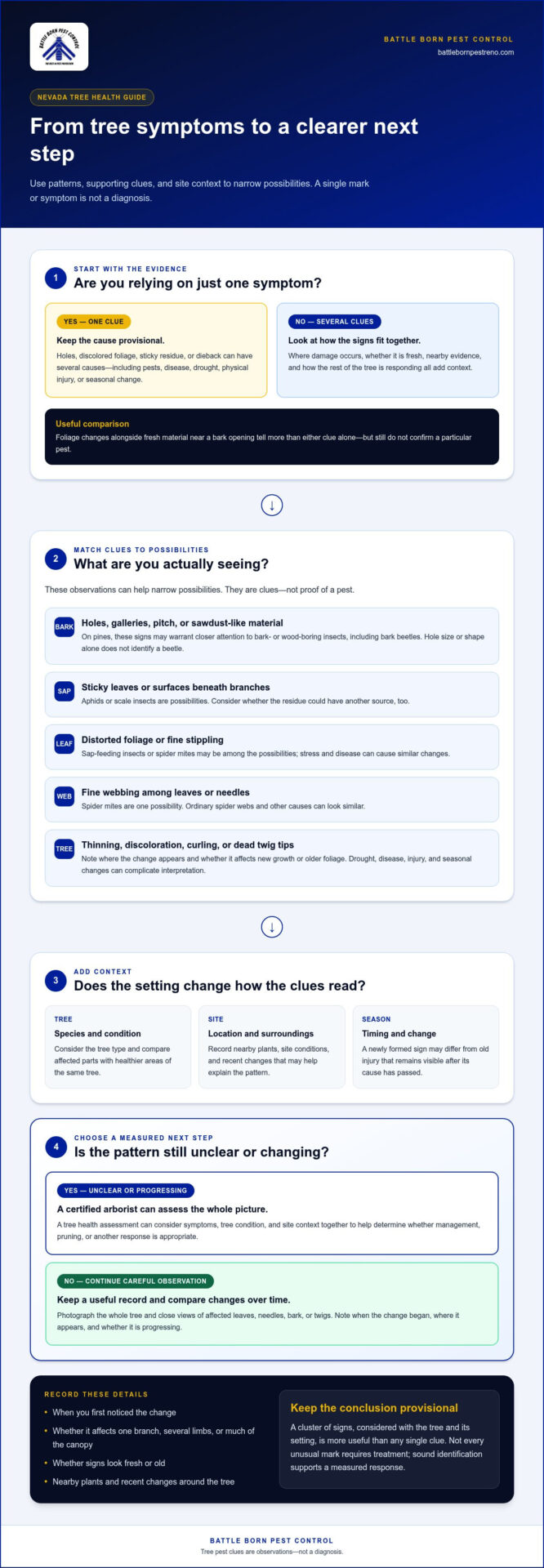
Tree pest identification in Nevada is an evidence-based process: consider the tree’s condition, the pattern of symptoms, and the surrounding site before weighing possible causes. A small hole, discolored foliage, or sticky residue can be a useful clue, but none is a diagnosis on its own. Insects, disease, drought, physical injury, and normal seasonal changes can produce similar signs.
Look for details that add context. Foliage may thin, discolor, curl, or drop; bark may show holes, cracks, or damaged areas; and twigs may have dead tips or unusual growth. Fine material near an opening may be frass, or insect waste and boring debris. Webbing and sap can also merit closer observation. A general overview of bark beetles explains why galleries and boring evidence attract attention, but identifying a pest on a specific tree requires more than matching one sign.
Which visible tree changes are worth noticing?
Note where symptoms appear and how widely they are distributed. Do they affect one branch, several limbs, or much of the canopy? Compare the affected area with healthier parts of the same tree, and note whether damage is on new growth or older foliage. Timing matters, too: a newly formed sign may help distinguish an active change from old injury that remains visible after its cause has passed.
Write down when you first noticed the change and whether it is progressing. Photograph the whole tree, then take closer views of affected needles, leaves, bark, or twigs. Dated photos give you a useful point of comparison and help separate observations from assumptions.
Why one symptom does not prove a pest is present
Water stress can affect foliage and twig growth, while a broken branch or equipment impact can leave bark damage that resembles other injury. Disease may also cause discoloration or dieback. Even if an insect or other pest is present, that alone doesn’t show whether it is causing current harm or how much of the tree is affected.
A single symptom rarely identifies a tree pest reliably because different causes can produce similar signs, and the surrounding pattern matters. Consider the clues together: where damage occurs, whether it is fresh, what evidence appears nearby, and how the rest of the tree is responding. For example, foliage changes alongside fresh material near a bark opening tell a more complete story than either observation alone, but still don’t confirm a particular pest.
Keep conclusions provisional until the evidence fits. A tree health assessment can consider symptoms, tree condition, and site context together, helping determine whether pest and disease management, pruning, or another response is appropriate. Not every unusual mark requires treatment; sound identification supports a measured next step.
Common Nevada tree pests: clues that can narrow the possibilities
After noting what changed, compare the evidence with possible pest groups rather than trying to name a species from one clue. Bark beetles are a concern on pines in Nevada, and aphids are among the pests treated by arborists in the Reno area. The location of a symptom and how it appears alongside other signs still matter. Scale insects and spider mites are also possibilities to consider when foliage or twigs look unusual, but those clues alone don’t confirm either group is present.
The guide below connects observations with possibilities, not diagnoses. The University of Nevada, Reno Extension: Pests & Plant Diseases provides educational resources on pest and plant disease identification and management. These can help explain why careful identification comes before choosing a response.
Observed evidence
- Small holes, galleries, or pitch on pine bark: Bark- or wood-boring insects, including bark beetles, may warrant investigation.
- Sawdust-like material near an opening: This may indicate boring activity, though debris and holes don’t identify the insect by themselves.
- Sticky leaves or surfaces beneath branches: Sap-feeding insects such as aphids or scale insects are possibilities. Consider whether the residue could come from another source, too.
- Distorted foliage or fine stippling: Sap-feeding insects or spider mites may be among the possibilities, but stress and disease can cause similar changes.
- Fine webbing among leaves or needles: Spider mites are one possibility; ordinary spider webs and other causes can look similar.
A cluster of signs, considered together with the tree and its setting, is more useful than any single clue. Use the list as a starting point, look for supporting evidence, and note whether each sign appears fresh or old.
Bark and wood-boring pest clues
Look at the affected bark and nearby foliage for holes, pitch, galleries visible on already exposed wood, or fresh sawdust-like material. On pines, these signs can justify closer attention to possible bark beetle activity, but hole size or shape alone isn’t enough to identify a beetle. Don’t peel away healthy bark to search for galleries. Photograph what’s visible and record where the evidence appears.
Sap-feeding and foliage pest clues
Aphids and scale insects may be worth considering when sticky honeydew, leaf distortion, or unusual deposits appear. Stippling or fine webbing may raise the possibility of spider mites. These are clues, not proof: drought, disease, and other insects can produce overlapping symptoms. Check whether the change is limited to new growth, one branch, or a wider area before settling on an explanation.
If signs remain unclear or are spreading, an arborist-led tree health assessment can interpret the evidence alongside the tree’s condition and site. Battle Born Pest Control provides tree health assessments and pest and disease management in Northern Nevada. A tree health assessment can help clarify whether management, pruning, or another response is appropriate.
How tree species, site, and season change pest-identification clues
The same symptom can point to different possibilities depending on the tree and where it grows. In Northern Nevada, bark beetles are a concern in pines, while aphids are among the pests arborists treat in the Reno area. These examples can narrow what to investigate, but they don’t mean every pine with bark damage has beetles or every curled leaf has aphids. Accurate tree pest identification in Nevada considers the host tree, affected plant part, site conditions, and timing together.
Start with the tree itself. If you don’t know its name, take clear photos of the whole tree and close views of its needles or leaves, bark, and twigs. Note whether the issue appears on the trunk, older branches, new growth, or across the canopy. Tree type matters because pests and diseases don’t affect every species or plant part in the same way.
Read the tree and its setting together
Record conditions that could help explain the pattern: where irrigation reaches, how much sun the affected side receives, whether the tree was recently pruned, and whether nearby construction or other site changes occurred. Compare affected branches with apparently healthy parts of the same tree. If several trees share the symptom, note whether they also share a species, irrigation line, or exposure. These details help distinguish a localized problem from wider site-related stress.
Context can change the meaning of a clue. For example, thinning foliage on a stressed pine may warrant checking for several causes, including bark beetle activity, but the tree’s condition and visible evidence still need assessment. A landscape tree beside a home also calls for a different evaluation than signs observed across a woodland or forest. The first concerns an individual tree and its setting; broader forest-health patterns are generally assessed at a larger scale.
Use season and location as context, not proof
Insect activity and visible symptoms can vary during the year, and a sign may become noticeable after the event that caused it. Record when you first saw the change, whether it has progressed, and any recent weather or watering changes. Avoid relying on a fixed pest calendar unless it comes from current local guidance; timing can differ with conditions and location.
Nevada-wide assumptions can also mislead. A pest noted in Northern Nevada shouldn’t automatically be treated as equally likely everywhere in the state, and a general symptom guide may not reflect local conditions. If symptoms seem more consistent with disease than insect activity, a tree disease management guide offers related tree-health information. Disease and pest symptoms can overlap, so use the comparison as a prompt for further assessment, not a diagnosis. Keeping tree identity, location, site history, and symptom timing together gives an arborist a more useful picture of what may be affecting the tree.
A safe Nevada tree inspection: what to observe and record
A careful ground-level inspection can give you and an arborist a clearer starting point without putting you at risk or disturbing the tree. For tree pest identification in Nevada, collect observations rather than trying to prove a diagnosis. Don’t climb, use a ladder to reach damaged areas, cut suspect branches, peel bark, or handle unfamiliar insects. If a sign is out of reach, photograph it from a safe distance and leave closer inspection to a professional.
Follow a simple sequence:
- Observe from a safe distance. Look at the whole tree and note whether the canopy appears even or whether changes are concentrated on one side, branch, or section.
- Photograph the evidence. Take a wide view, then closer images of the trunk, affected limbs, foliage, holes, residue, or other visible signs. Stay on stable ground and don’t enter an area with hanging or broken limbs.
- Record timing and changes. Write down when you first noticed the symptoms and whether they seem stable, worsening, or spreading.
- Compare affected and healthier areas. Note what differs between them and whether nearby trees show similar changes.
What to photograph and write down
Include enough context for someone else to understand what each photo shows. Record the tree’s location on the property and its type, if known. A clear picture of the whole tree and its leaves or needles can help with identification. Note which parts are affected, what the signs look like, and whether the damage appears fresh or old.
Add details about irrigation patterns, recent pruning, construction, or other changes around the tree. Mention whether nearby plants have similar symptoms. These notes can help distinguish a tree-specific concern from a pattern associated with watering, exposure, or work at the site, without requiring you to decide the cause yourself.
When observation should give way to professional guidance
Arrange an assessment if decline is spreading, substantial parts of the canopy are changing, or you’re unsure how to interpret the signs. Major limb damage, a newly leaning tree, or a hanging branch raises a safety concern as well as a health question. Keep people and pets away from the area, and don’t approach or work beneath unstable branches.
Photographs can document what you see, but they can’t establish the full condition of a tree or determine that removal is needed. A certified arborist can evaluate symptoms alongside tree health and site conditions, then explain whether pest and disease management, pruning, or another response is appropriate. If you’d like a professional interpretation of your observations, learn about tree health assessments.
When a certified arborist can help with tree pest identification
Consider professional guidance when symptoms are spreading, the tree’s condition is changing, or the signs still don’t fit a clear explanation after observation. Pest activity, disease, and environmental stress can overlap, and a reliable assessment looks beyond a single leaf, hole, or patch of bark. The goal is to understand the tree and its surroundings well enough to choose a measured next step, not to assume every unusual sign requires treatment.
What an arborist-led assessment can clarify
A certified arborist can evaluate visible symptoms alongside the tree’s overall condition and site factors, such as irrigation, exposure, and recent changes nearby. That broader view can help distinguish possible pest or disease concerns from other sources of stress and identify which evidence needs closer attention. An assessment provides a basis for a tailored recommendation; the appropriate response depends on what the evaluation finds.
Battle Born Pest Control provides tree health assessments and pest and disease management, with tree services performed by certified arborists. Depending on the findings, guidance may involve pest or disease management, pruning, or another suitable response. An assessment doesn’t mean treatment or removal is automatically needed, and no particular outcome should be assumed before the tree has been evaluated.
Choosing a practical next step for a Northern Nevada tree
Before seeking guidance, prepare a brief record: the tree type, if known; when symptoms began; which parts are affected; whether the pattern has changed; and any relevant site or irrigation changes. Bring photographs that show the whole tree as well as close views of the signs. These details help put your observations in context without requiring you to diagnose the cause yourself.
Local conditions matter, so tree pest identification Nevada homeowners can use should account for both the tree and its Northern Nevada setting. Battle Born Pest Control serves Reno, Sparks, Carson City, Dayton, and surrounding communities with tree health assessments and pest and disease management. If symptoms seem more consistent with disease than insect activity, a tree disease management guide may also help you understand what to observe.
Whether the next step is a closer assessment or a different form of care, a measured evaluation can help you avoid acting on a guess. Explore Battle Born Pest Control tree care services for local support with tree health concerns.
Make your next observation count
Keep a simple record of what changes over time. A dated photo or brief note can help distinguish a lasting pattern from a temporary change and give a future assessment more context. You don’t need to identify the pest yourself; careful observations are enough to support a more informed conversation about the tree’s condition.
If the cause remains uncertain or the tree’s condition is changing, professional guidance can help turn those observations into a practical plan. Battle Born Pest Control provides tree health assessments and pest and disease management performed by certified arborists for Northern Nevada communities, including Reno, Sparks, Carson City, and Dayton. For locally grounded support with tree pest identification nevada, explore Battle Born Pest Control tree care services.
Frequently Asked Questions
Are tree pests active in Nevada during winter?
Some pests may remain on or within a tree during winter, while visible activity can vary with the pest, weather, and location. A lack of moving insects doesn’t rule out a problem, and old damage may remain visible after activity has slowed. For tree pest identification nevada homeowners should distinguish signs that are newly appearing from marks that have stayed unchanged, rather than assuming every tree is pest-free or actively infested in winter.
Can tree pests spread from one tree to nearby trees?
Some pests can move between suitable host trees, but nearby damage doesn’t prove that one tree infected or infested another. Trees may show similar symptoms because they share conditions, such as a watering issue, or because more than one cause is present. Note whether nearby trees are the same type and whether their symptoms look alike. That pattern can help an assessment consider possible spread without treating proximity as proof.
Are small holes in a tree trunk always caused by insects?
No. Small openings can have other explanations, including old branch attachments, physical injury, or damage associated with birds searching for insects. Their appearance alone may not reveal when they formed or what caused them. Avoid probing the hole or scraping surrounding bark, since that can create additional injury. Note whether there is fresh material, sap, or nearby canopy change, then use those details as context rather than treating the opening as a diagnosis.
Can a tree recover after pest damage?
Recovery is possible, but it depends on the tree’s condition, how much living tissue is affected, and whether the underlying cause continues. Limited damage to a few leaves or twigs may have a different outlook from decline affecting major limbs or much of the canopy. A tree can also retain old damage while producing new growth. An assessment can help determine the tree’s condition and what care may be appropriate.
Should I remove a tree with visible pest damage?
Visible pest damage alone isn’t enough to decide that a tree should come down. Removal decisions require consideration of the tree’s overall health, structure, and location, not just a photograph of a damaged area. If a large limb is broken or the tree appears unstable, keep people clear of the area and seek qualified guidance. A certified arborist can assess whether management, pruning, removal, or another response is warranted.
Can a photo identify the pest affecting my tree?
A clear photo can help narrow possibilities, but it may not capture details needed to identify the cause confidently. For example, a close-up may show leaf stippling but omit the tree species, affected branch, or wider pattern that helps interpret it. Images are most useful as supporting evidence, not a stand-alone verdict. If a photo is inconclusive or symptoms are progressing, an in-person evaluation can provide more context.
Which Nevada resources can help verify tree pest information?
University of Nevada, Reno Extension offers educational pest and plant disease resources, while the Nevada Division of Forestry provides forest-health information. The Nevada Department of Agriculture publishes information on pest advisories and quarantines. For a residential tree in Reno, Sparks, Carson City, or Dayton, use resources that match the tree and location; forest-wide guidance may not answer a landscape-specific question. Local context helps keep general information in perspective.