Effective Ant Control Reno: Professional Kitchen Protection Guide

Imagine walking into your kitchen on a bright Reno morning only to find a steady trail of ants marching directly into your pet’s food bowl. It’s a frustrating sight that many homeowners in our high-desert climate face every spring, especially when traditional store-bought sprays don’t seem to stop the cycle. Achieving effective ant control reno requires more than just a quick fix; it demands a deeper understanding of how our local environment drives these pests indoors in search of moisture. You likely feel that no matter how much you scrub the counters, the scouts always find a way back to the same spot.
This persistent cycle can make your home feel less like a sanctuary and more like a battleground, but you can reclaim your kitchen and protect your family. We’ll show you how to implement a professional-grade protection plan that addresses the root causes of infestations rather than just the symptoms. This guide explains why Reno’s unique landscape makes your home a target and outlines the precise, safety-conscious steps needed to establish a lasting barrier that keeps your food prep areas clean and secure for the long term.
Key Takeaways
- Understand how Reno’s high-desert climate drives ants into your kitchen in search of moisture and how to disrupt these predictable patterns.
- Learn to identify the specific behaviors of Northern Nevada’s most common species, including the sugar-seeking Odorous House Ant and the hardy Pavement Ant.
- Discover why common DIY baits often fail during specific seasons and how to implement truly effective ant control reno that targets the entire colony.
- Master a simple interior sanitation routine and learn to identify critical entry points in local stucco and siding to prevent future trailing.
- See how a customized, localized management plan provides more stability and safety for your home than generic, one-size-fits-all pest control approaches.
Why Reno Homes Face Unique Ant Challenges
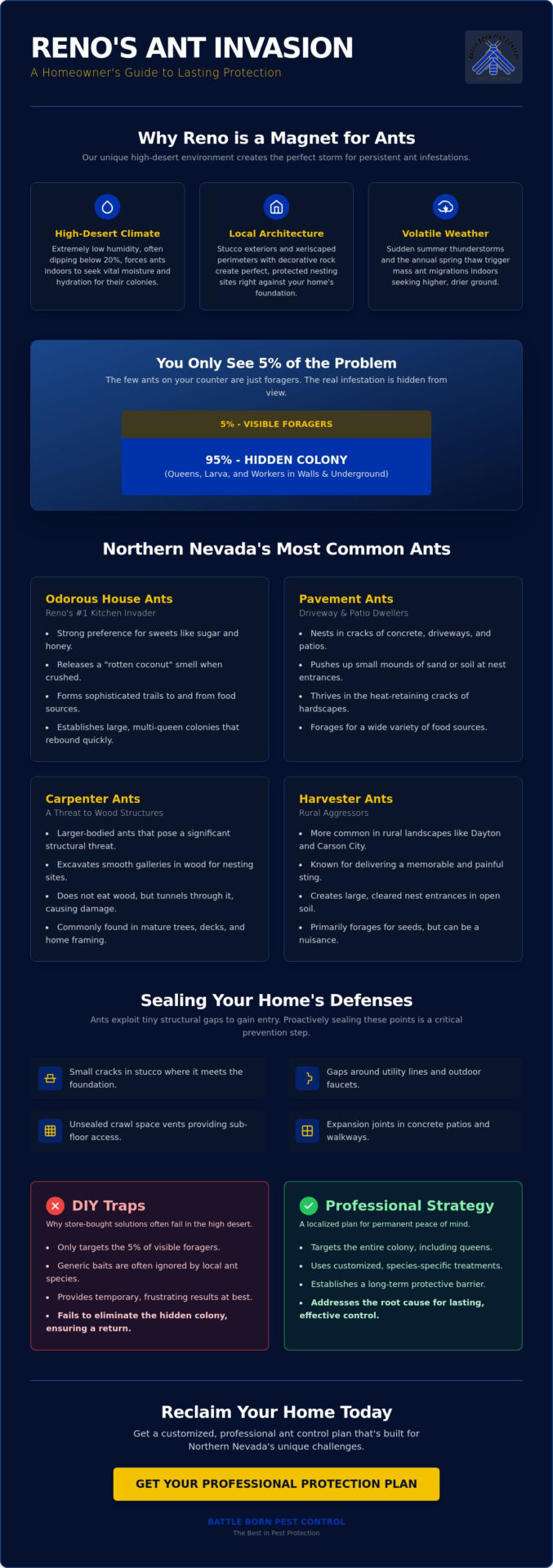
Living in Northern Nevada means dealing with a climate that is as demanding as it is beautiful. Our high-desert environment, characterized by extremely low humidity levels that often dip below 20%, creates a constant struggle for survival for local insect populations. Because ants require consistent moisture to thrive, your kitchen isn’t just a source of food; it’s a vital hydration station. This is why effective ant control reno must be viewed as a multi-layered strategy that addresses the environmental pressures driving pests indoors, rather than just a reaction to a few visible bugs on the counter.
Local architecture also plays a significant role in how these infestations take root. Many homes in the Truckee Meadows feature stucco exteriors or xeriscaped perimeters with decorative rock. While these choices are excellent for water conservation, they often provide perfect nesting sites right against your foundation. Ants find easy passage through several common entry points as soon as the snow melts in Washoe County:
- Small cracks in stucco where it meets the concrete foundation.
- Unsealed crawl space vents that provide access to the sub-floor.
- Expansion joints in concrete patios and walkways.
- Gaps around utility lines and outdoor faucets.
The Impact of Northern Nevada Weather on Ant Behavior
Reno’s weather is famously unpredictable. When sudden summer thunderstorms roll through Sparks, the rapid change in barometric pressure and soil moisture often triggers a mass migration of ants seeking higher, drier ground inside your walls. Similarly, the transition from winter dormancy to spring “waking” creates a massive demand for resources. As the ground warms, colonies become active and send out scouts to find the nearest reliable food source, which is frequently your pantry. This seasonal volatility is why a plan for effective ant control reno needs to be proactive rather than reactive.
The Difference Between Foragers and the Colony
Understanding ant biology and behavior is crucial for long-term success. Most homeowners only see about 5% of the total population, a phenomenon often called the “iceberg effect.” These visible ants are mere foragers; the vast majority of the colony, including the queens, remains hidden deep within wall voids or underground. Professional-grade treatments are designed to be carried back to the nest to ensure the entire population is addressed. Colony-level control is the only permanent solution for Reno infestations.
Identifying the “Big Three” Ants in Northern Nevada
While national pest control chains often provide generic lists of invasive species, homeowners in the Truckee Meadows primarily contend with a select few that have adapted to our high-elevation environment. Achieving effective ant control reno begins with accurate identification, as a strategy that works for a pavement ant might be completely ignored by an odorous house ant. Each species has distinct nesting habits and dietary needs that dictate how we approach management within your home.
In our region, you’re most likely to encounter these four specific types:
- Odorous House Ants: These are the primary culprits for kitchen infestations, known for the distinct, unpleasant “rotten coconut” smell they release when crushed.
- Pavement Ants: These thrive in the heat-retaining cracks of Reno driveways and under patio stones, often pushing up small mounds of sand or soil.
- Carpenter Ants: These larger ants pose a significant threat to local wood structures and mature trees by excavating galleries for their nests.
- Harvester Ants: More common in the rural landscapes of Dayton and Carson City, these ants are known for their painful stings and large, cleared nest entrances in the soil.
Odorous House Ants: Reno’s Most Common Kitchen Guest
Odorous house ants are small, dark brown to black, and remarkably mobile. They don’t just wander into your kitchen; they establish sophisticated trails that lead directly from their nests to your food storage areas. These pests are particularly fond of the voids behind kitchen cabinets and under appliances where they can find warmth and protection. Because they have a strong preference for sweets, your sugar bowl or a spilled drop of honey is often their primary target. Their colonies are often multi-queened, which means they can quickly rebound if a treatment only addresses the foragers you see on the surface.
Carpenter Ants vs. Termites: Knowing the Difference
It’s common for homeowners to worry when they see large, winged insects, but knowing the physical distinctions can provide peace of mind. Carpenter ants have bent antennae and clearly segmented bodies with a narrow “waist,” whereas termites have straight antennae and a more uniform, rectangular body shape. Unlike termites that consume wood, carpenter ants simply remove it to create “clean” galleries that look like they’ve been sanded. For those concerned about structural integrity, understanding the habits of Carpenter ants in Northern Nevada is essential for early detection. Because these ants often migrate from distressed trees into the home, our team utilizes a specialized arborist perspective to identify potential threats in your yard before they reach your foundation. If you’re noticing large ants or mysterious wood shavings, a professional pest assessment can help you determine the best course of action for your property.
Why DIY Baits Often Fail in the High Desert
Many homeowners in the Truckee Meadows begin their battle against infestations with a quick trip to a local big-box store. It’s a logical first step, yet the most common objection we hear is, “I already tried the traps from the store, and they didn’t work.” The reality is that effective ant control reno depends on understanding biological responses that many over-the-counter products simply don’t account for. When you use common repellent aerosols, you might kill the few foragers on your counter, but you also risk triggering a survival mechanism called “budding.” This occurs when the colony senses a threat and the queens split off to form multiple satellite nests, effectively turning one small problem into several larger ones throughout your home.
Another hurdle is the “bait shyness” phenomenon. If a bait is too fast-acting or improperly applied, ants may associate the site with danger and stop visiting it entirely. This leaves the core of the colony untouched while the pests simply find a new route to your pantry. Success in our unique environment requires a more patient, strategic approach that respects the complex social structure of the nest.
The Science of Baiting: Timing and Nutrition
Ants in Northern Nevada have nutritional needs that shift dramatically as the seasons change. In the early spring, as the colony focused on growth and reproduction, they typically seek out protein-rich sources to support the queen and developing larvae. As the summer heat intensifies, their preference often pivots toward sugars and carbohydrates to sustain high energy levels. Most DIY baits are formulated with a single attractant, which explains why ants might swarm a trap one month and completely ignore it the next. Professional-grade baits are engineered to be far more attractive than the crumbs in your toaster, ensuring the workers prioritize the treatment. Non-repellent liquid treatments allow foragers to pass through the active ingredient without detection, enabling them to return to the nest and distribute the material throughout the entire social structure via grooming and food sharing.
The Risks of DIY Chemical Misuse
Using high-concentration sprays without proper training can have unintended consequences for our sensitive high-desert ecosystem. Over-spraying can lead to runoff that affects local soil health and beneficial insect populations. We believe in a more considered approach that aligns with Integrated Pest Management (IPM) for ants, focusing on precise applications that minimize environmental footprints. Safety is our primary concern, especially in households with curious children or animals. By choosing Pet Safe Pest Control Reno methods, you ensure that your kitchen remains a healthy environment while still achieving the long-term results you need to keep your home pest-free.
Step-by-Step: Reno Homeowner’s Guide to Ant Prevention
Achieving effective ant control reno starts with a proactive mindset that views your home and yard as a single, connected ecosystem. While we’ve explored why ants are drawn to our high-desert climate, the most successful management plans rely on physical prevention to supplement professional treatments. A simple 15-minute kitchen reset each evening can significantly disrupt scout ants before they establish a permanent trail. This routine should include wiping down surfaces to remove food residue and ensuring pet food bowls are picked up after meals, as even a few stray kibbles can attract an entire colony overnight.
Moisture management is equally critical in our arid environment. Check your outdoor spigots and irrigation lines for slow leaks; these small water sources are often the only reason a colony chooses to nest near your foundation rather than further out in the desert. Inside, ensure your under-sink areas remain dry and well-ventilated to avoid creating the humid microclimates that Odorous House Ants crave.
The Arborist’s Secret: Vegetation as an Ant Highway
Many homeowners don’t realize that their landscaping often provides a direct bridge into their living spaces. When tree branches or overgrown shrubs touch your roof or siding, they act as a private highway for foraging ants. This is particularly problematic if your trees are hosting aphids or scale insects, which produce a sugary substance called honeydew that ants prize. For Sparks and Carson City residents, regular professional tree pruning is a vital defensive measure. By maintaining a clear gap between your home and your vegetation, you create a “pest-free moat” that forces ants to cross treated ground-level barriers where they are much easier to manage.
Sealing the Perimeter: Northern Nevada Edition
Reno’s intense temperature fluctuations cause building materials to expand and contract, often leading to small cracks in stucco and siding. These gaps are all an ant needs to enter your wall voids. Use a high-quality, weather-resistant silicone caulk to seal utility penetrations and gaps around window frames. In many Washoe County homes, it’s also important to check weep holes in brick or stone facades; while these are necessary for ventilation, they can be fitted with specialized mesh inserts to keep pests out without blocking airflow.
If you find an active trail in your kitchen, don’t reach for the bug spray immediately. Instead, use this natural solution to neutralize their communication:
- Mix one part white vinegar with one part water in a spray bottle.
- Spray the entire length of the trail to dissolve the pheromone scents.
- Wipe the area clean with a microfiber cloth.
- Seal any immediate entry points with temporary tape until you can apply a permanent fix.
This process removes the “road map” that other ants use to follow their scouts, giving your professional perimeter barrier the best chance to work effectively.
Professional Ant Management in the Truckee Meadows
Choosing a partner for your home’s protection is a decision that impacts your family’s daily peace of mind. While national franchises often rely on “one-size-fits-all” chemical applications, effective ant control reno requires a more nuanced understanding of our specific high-desert challenges. We don’t just treat the visible symptoms; we analyze the environmental factors unique to Northern Nevada that allow infestations to persist. Because we are rooted in the Truckee Meadows, we know exactly how our rapid temperature swings and seasonal moisture cycles influence the movement of local colonies.
Our methodology is distinct because we merge traditional pest management with specialized arborist insights. Since many kitchen infestations actually begin in the canopy of a distressed tree or within an overgrown shrub, we look beyond your baseboards to identify the true source of the problem. This holistic view allows us to create a more stable, long-term solution that protects both your interior living spaces and your exterior landscape. Whether you are dealing with a sudden spring surge or a persistent summer trail, our goal is to provide a service that feels professional, neighborly, and thoroughly transparent.
Customized Treatment Plans for Reno Families
Every property in Washoe County has its own set of vulnerabilities, from the type of siding used to the specific variety of ornamental trees in the yard. During your initial professional inspection, we conduct a comprehensive health assessment of your perimeter to identify active nesting sites and potential entry points. We then tailor our applications to your specific needs, prioritizing the safety of your children and pets. This careful application ensures that we address the pests without compromising the health of your home environment. Many homeowners find that transitioning from reactive treatments to a structured schedule is the most reliable way to maintain a pest-free kitchen. You can learn more about our service options and Recurring Pest Maintenance Fees to find a plan that fits your household’s requirements.
The Peace of Mind Guarantee
Investing in long-term prevention is consistently more cost-effective and less stressful than waiting for an emergency. By establishing a consistent defensive barrier, we stop scouts before they can signal the rest of the colony to enter your pantry. As a local, veteran-owned business, we take immense pride in acting as guardians for our community. We believe in honest recommendations and clear communication, ensuring you always know exactly what is being applied and why it is necessary for your property’s protection. Our commitment to integrity and local reliability means we’re more interested in providing a lasting solution than a quick fix. Protect your kitchen today with Battle Born Pest Control and experience the difference that expert, localized care makes for your home.
Reclaiming Your Kitchen Sanctuary
Maintaining a pest-free home in the Truckee Meadows is a continuous process of environmental management and strategic protection. You now understand how Reno’s unique high-desert climate drives ants indoors and why a holistic approach, blending arborist insights with professional pest management, is the most reliable way to achieve lasting results. By focusing on colony-level eradication and physical exclusion rather than just surface-level sprays, you can finally disrupt the seasonal cycle of trailing ants in your kitchen. It’s about looking at your entire property as a single ecosystem and addressing vulnerabilities before they become infestations.
As a locally owned and licensed business in Northern Nevada, we prioritize the safety of your family with customized, pet-friendly treatment plans. Our team includes a Certified Arborist to ensure your property’s total health is addressed from the tree canopy down to the foundation. For effective ant control reno residents can depend on year-round, we are here to act as your dedicated local guardian. Get Your Free Reno Ant Control Estimate and take the first step toward a more secure, comfortable home. We look forward to providing the peace of mind you deserve.
Frequently Asked Questions
Is professional ant control safe for my pets in Reno?
Professional ant control is safe for your pets when managed by experienced technicians who prioritize careful, targeted application. We use products designed to be low-impact for mammals and birds while remaining highly effective against target pests. Once the treatment has dried, your pets can resume their normal activities in the treated areas. This localized approach ensures your companions stay safe while we secure your home.
How long does it take to see results after an ant treatment?
Most homeowners observe a significant reduction in ant activity within two to seven days after a professional application. This timeline allows enough time for foragers to carry non-repellent treatments back to the queen and the rest of the colony. While you might see a few stray ants shortly after the visit, this is a normal part of the process as the social structure of the nest begins to collapse.
Why do ants keep appearing in my bathroom even if there is no food?
Ants are often drawn to bathrooms in Northern Nevada because they are seeking moisture rather than food. In our arid high-desert climate, the condensation on pipes, damp bath mats, and even the water left in sink drains provide a vital lifeline for a thirsty colony. Effective ant control reno strategies often involve checking these humid microclimates to ensure scouts aren’t establishing a permanent water source inside your walls.
Can Reno’s winter weather actually kill off an ant colony?
Reno’s freezing winter temperatures do not kill off established ant colonies; instead, the insects enter a state of dormancy called diapause. They retreat deep into the soil or into the insulated voids of your home’s foundation to wait for warmer weather. This is why you often see a sudden surge of activity the moment the ground begins to thaw in the spring, as the colony becomes active once more.
What is the most common ant species found in Sparks and Reno?
The Odorous House Ant is the most frequently encountered species in both Sparks and Reno households. These small, dark pests are notorious for their multi-queen colonies and their preference for sugary kitchen spills. Pavement ants are also quite common, often building their nests in the heat-retaining cracks of driveways and sidewalks before eventually finding their way into your home through the foundation.
How often should I have my home treated for pests in Northern Nevada?
We typically recommend a quarterly maintenance schedule to provide the most consistent protection against the changing seasons in Northern Nevada. Each visit addresses the specific biological needs of pests as they shift from spring foraging to summer heat-seeking and fall shelter-finding. Regular maintenance is often more cost-effective than trying to manage a full-blown infestation after it has already taken hold in your kitchen or bathroom.
Do I need to leave my house during a professional ant treatment?
You generally do not need to leave your home during a professional ant treatment. Most modern, professional-grade products are low-odor and applied with precision to specific cracks, crevices, and perimeter areas. Our technicians work methodically to ensure the application is thorough without disrupting your daily routine, though we always recommend keeping pets and children away from treated surfaces until they are completely dry.
Why are ants attracted to certain trees in my yard?
Ants are attracted to certain trees because they are searching for a sugary substance called honeydew, which is produced by aphids and scale insects. They will actually protect these pests from natural predators to ensure a steady food supply for the nest. This is why our effective ant control reno plans often involve an arborist’s assessment to manage the health of your yard’s vegetation and eliminate these outdoor food sources.