How to Tell if a Tree is Dying in Nevada: A High Desert Homeowner’s Guide
Imagine waking up during a midnight windstorm in the Truckee Meadows, listening to the gusts rattle your windows while you wonder if that leaning cottonwood in the backyard will finally give way. For many homeowners in Northern Nevada, the line between a majestic shade tree and a structural liability feels dangerously thin. It’s completely natural to feel a sense of dread when you see yellowing needles or brittle branches, especially when you’re worried about the safety of your home and the high cost of unexpected removal. Learning how to tell if a tree is dying Nevada style requires looking past the surface, as our unique high desert climate often mimics signs of death during simple seasonal dormancy.
You deserve the peace of mind that comes from knowing exactly what is happening in your landscape. This guide provides the specific visual signs and simple diagnostic tests you need to determine if your tree is sick, dying, or a genuine safety hazard. We’ll walk you through a clear “stay or go” decision framework, while explaining how to spot Nevada-specific stressors like the Mountain pine beetle. By the end of this article, you’ll know if your tree remains a healthy asset or if it has become a pest reservoir that threatens the rest of your yard.
Key Takeaways
- Learn how to distinguish between seasonal dormancy and permanent decline, especially after the late spring frosts common in Northern Nevada.
- Discover how to tell if a tree is dying Nevada style by identifying specific visual cues like brittle “self-pruning” branches and progressive canopy dieback.
- Master the simple bark scratch test to verify the presence of living tissue and determine if a branch still has the potential for recovery.
- Understand why a sick tree acts as a reservoir for pests like the Ips beetle, potentially threatening the health of every other tree in your yard.
- Apply the “50% Rule” to make an informed decision on whether to invest in professional tree health assessments or proceed with a safe removal.
Understanding Tree Stress in Nevada’s High Desert
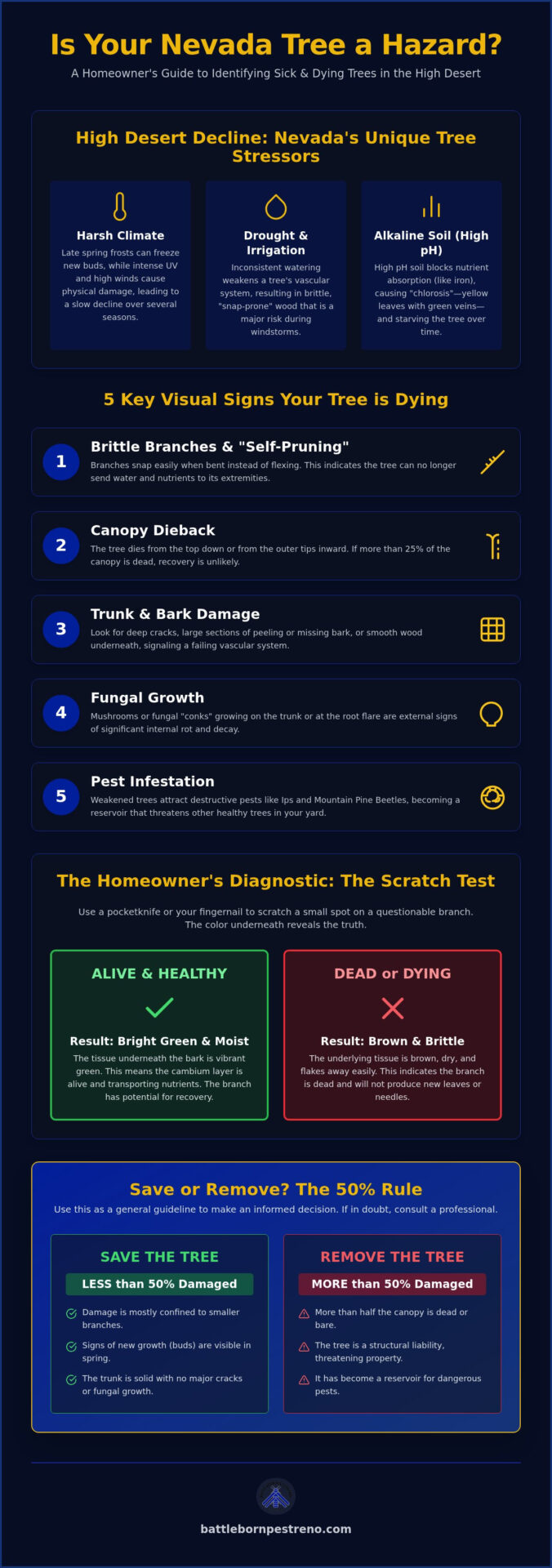
Living in the Truckee Meadows means dealing with a climate that is often as harsh as it is beautiful. For homeowners, the biggest challenge is often distinguishing between a tree that is simply resting and one that is failing. Because our environment is so arid, knowing how to tell if a tree is dying Nevada style requires an understanding of how local stressors like late spring frosts and intense UV radiation affect plant biology. In Reno and Sparks, a sudden cold snap in May can freeze new buds, leaving a tree looking skeletal well into June. This isn’t always a death sentence, but it is a significant stressor that contributes to a phenomenon we call “High Desert Decline.” This is a process where a tree doesn’t die overnight; instead, it slowly loses its vigor over several seasons until it can no longer support its own weight or defend against pests.
The Role of Drought and Irrigation
Water management is the most critical factor for tree survival in our region. Many people assume that once a tree reaches a certain age or size, it no longer requires supplemental water. This is a dangerous misconception in the high desert, where our annual rainfall is minimal. When irrigation is inconsistent, the tree’s internal vascular system suffers. This leads to brittle, “snap-prone” wood that is likely to fail during our frequent high-wind events. Evergreens are particularly deceptive in this regard. By the time they show signs of reaching a “permanent wilting point”-marked by brittle, brown needles that stay attached to the branch-the internal damage is often already irreversible. A tree in this state isn’t just thirsty; it’s structurally compromised.
Soil pH and Nutrient Chlorosis
The earth beneath our feet in Northern Nevada is notoriously alkaline, characterized by high pH levels that can be hostile to many non-native species. These soil conditions often block a tree’s ability to absorb essential minerals like iron and manganese. This leads to nutrient chlorosis, a condition where leaves turn a pale, sickly yellow while the veins remain a stark green. It’s a cry for help that many homeowners mistake for a simple lack of water or permanent death. Understanding The Silent Killers of Nevada Trees helps us realize that soil chemistry is often the hidden culprit behind a tree’s decline. A tree starved of nutrients over several years cannot produce the strong cellular walls needed to withstand heavy snow loads or the relentless Sierra winds, making it a safety hazard long before it actually turns brown.
5 Visual Signs Your Nevada Tree is Dying
Identifying the physical symptoms of decline is the first step in deciding whether a tree requires professional intervention or simple patience. In our region, homeowners often struggle to differentiate between a dead or dormant tree because many species enter a deep protective state during extreme temperature swings. Knowing how to tell if a tree is dying Nevada style requires looking for definitive indicators of structural failure. Brittle branches that snap cleanly rather than bending are a primary sign of “self-pruning,” which occurs when a tree can no longer transport nutrients to its extremities. You should also look for canopy dieback, where death begins at the top or the outer tips and moves inward. While some bark shedding is natural for species like the Scotch Pine, large sections of peeling bark that reveal smooth or rotting wood underneath indicate a breakdown in the tree’s vascular system.
Canopy Health and Leaf Distribution
When you evaluate your tree’s health, pay close attention to the distribution of foliage. Stressed trees often produce “clumped” leaves or needles, a desperate attempt to maximize photosynthesis with limited resources. If you notice that one side of the tree is completely bare while the other remains green, you’re likely dealing with localized root failure or severe vascular damage. Arborists generally use the 25% rule as a benchmark; if more than a quarter of the canopy is dead or missing, the tree’s ability to recover on its own is significantly diminished. If you see these patterns developing, a professional tree health assessment can provide the clarity needed to make a safe decision for your property.
Trunk and Root Flare Integrity
The base of the tree provides critical clues about internal health that often go unnoticed. Inspect the root flare for fungal conks or mushrooms, which are the fruiting bodies of internal rot. These growths suggest that the structural heartwood is decomposing, making the tree a hazard during the high-wind events common in the Truckee Meadows. Look for “frass,” a fine sawdust-like material, or oozing sap, which often signals that boring insects have compromised the trunk. A tree that begins to lean suddenly after a storm, or one that shows soil heaving around the base, requires immediate attention. These signs indicate that the root system can no longer anchor the weight of the tree, posing a direct risk to nearby structures.
The Homeowner’s Diagnostic: The Scratch Test
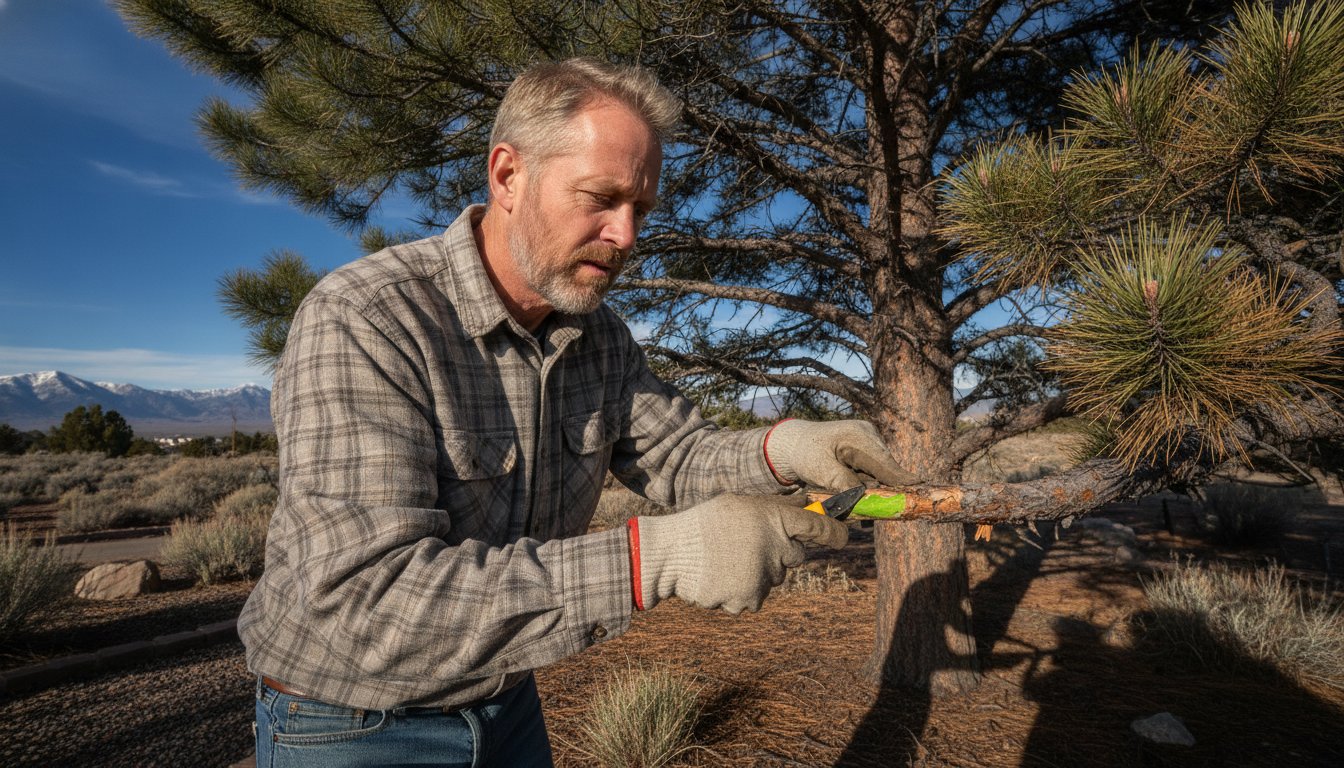
When you’re standing in your yard in Reno or Sparks, looking at a tree that hasn’t leafed out by June, you need more than just a visual guess. The scratch test is the most reliable way for a homeowner to determine the immediate health of a specific limb. It allows you to peek beneath the protective outer layer to see if the tree’s circulatory system is still functioning. This simple diagnostic tool provides immediate feedback, helping you move past the confusion of seasonal dormancy and toward a clear decision. It’s an essential skill for anyone learning how to tell if a tree is dying Nevada style, where our extreme temperature swings can make even healthy trees look temporarily ragged.
To perform the test correctly, follow these four steps:
- Step 1: Choose a young twig or small branch about the thickness of a pencil from the area that looks suspicious.
- Step 2: Use a fingernail or a small, sharp knife to carefully peel back a tiny sliver of the outer bark. You don’t need to gouge the wood; a small window is enough.
- Step 3: Examine the cambium layer. This is the thin tissue located directly between the bark and the wood.
- Step 4: Repeat the test in multiple locations. Check the top canopy, the lower branches, and different sides of the trunk to see if the decline is localized or systemic.
This repetition is vital because our high desert sun often damages the south-facing side of a tree while the north-facing side remains healthy. By checking several spots, you get a complete picture of the tree’s overall vitality.
Interpreting the Cambium Color
The color and moisture level of the cambium tell the true story of the tree’s health. A vivid green and moist layer indicates the tree is alive and likely just stressed by our fluctuating temperatures or a lack of deep watering. If you find a dull brown and dry layer, that specific section is dead. A pale yellow or brittle texture suggests the tree is in a state of advanced decline, where the vascular system is failing but hasn’t completely shut down yet. These variations are common in Northern Nevada, where trees often fight for survival against alkaline soil and low humidity.
The Flex Test for Smaller Branches
Before you even pull out a knife, you can perform a quick flex test on the outer canopy. Gently bend the smaller twigs to check for elasticity. Healthy wood should be springy and resistant to breaking, while dead wood will snap with a sharp crack. In our region, this test varies between species. Our desert pines have high resin content that can make even dead wood feel somewhat flexible for a time, whereas hardwoods like maples or ashes will become brittle very quickly once they lose moisture. If you find that twigs are snapping throughout the canopy regardless of the species, it’s time to stop guessing and call for a tree health assessment reno nv to ensure the tree doesn’t become a safety hazard to your home or family.
Pests and Diseases: The Silent Killers of Nevada Trees
In our arid environment, a tree’s health is often its only defense against the local insect population. When a tree becomes stressed by drought or poor soil, it stops producing the resin and chemical compounds that naturally repel invaders. This transition is critical because a failing tree quickly becomes a “pest reservoir.” Instead of just being a landscape flaw, a dying tree acts as a magnet, drawing in wood-boring insects that will eventually look for their next meal in your healthy neighboring pines or aspens. Understanding how to tell if a tree is dying Nevada homeowners should look for signs that the tree’s natural defenses have collapsed, allowing these silent killers to take hold.
The Ips beetle is a primary threat across Northern Nevada, particularly in the Reno and Sparks areas. These beetles are attracted to the stress signals emitted by weakened trees. Once they arrive, they tunnel into the bark to lay eggs, effectively girdling the tree from the inside out. You can spot their presence by looking for tiny, perfectly round exit holes or “pitch tubes,” which look like small clumps of popcorn-shaped sap on the trunk. These tubes are the tree’s attempt to push the beetles out, but a dying tree often lacks the water pressure to succeed. Addressing these issues early through professional tree disease management Sparks NV is the best way to prevent a single sick tree from endangering your entire yard.
Common Northern Nevada Tree Pests
Different species attract different threats. The Bronze Birch Borer is a common culprit in our local birch populations, typically causing the tree to die from the top down. If the uppermost branches are skeletal while the bottom remains green, it’s a classic sign of infestation. We also frequently see Scale insects, which appear as small, immobile bumps on twigs. They excrete a sticky substance called “honeydew” that can coat your patio or car. Battle Born Pest Control manages the intersection of bugs and bark by identifying these specific threats during our health assessments, ensuring your treatment plan is tailored to the exact pests present in your landscape.
Diseases to Watch For
Fungal and bacterial diseases also thrive in specific conditions. Cytospora Canker is a common sight in local poplars and aspens, appearing as sunken, discolored patches of bark that may ooze orange or black liquid. In the orchards and residential gardens of Carson City, Fire Blight often strikes fruit trees, causing branches to look as if they’ve been scorched by a flame. Professional disease management can often save a tree if the infection is caught early enough to prevent it from reaching the main trunk. Protect your healthy landscape by scheduling a professional pest and disease management assessment today.
When to Remove vs. When to Save Your Tree
Once you have gathered your observations, the next step is a clear-eyed evaluation of the tree’s future. Professionals often use the “50% Rule” as a primary guideline for these decisions. If more than half of the tree is showing the signs of decline we have discussed, the chances of a full recovery are slim. In our high desert environment, a tree that has lost 50% of its canopy or has significant trunk decay is often too far gone to safely maintain. However, if the damage is localized to specific limbs, professional tree pruning services reno can often remove the dead weight and redirect the tree’s remaining energy to its healthy core, effectively saving the specimen and restoring its appearance.
Safety must always be the priority when determining how to tell if a tree is dying Nevada homeowners should look closely at the “target” area. A dying tree in an open field is a natural part of the ecosystem, but a dying tree near a house, power line, or driveway is a serious liability. If the tree poses a direct threat to your property or your loved ones, safe tree removal Carson City becomes the most responsible path forward. Making this choice early prevents the stress of a potential failure during a winter storm.
The Benefit of a Certified Arborist
Investing in a professional tree health assessment reno nv is always more cost-effective than dealing with the aftermath of a fallen tree. A certified expert can identify whether a tree is truly failing or if it just needs a customized nutrient and pest management plan. This is especially important for high-value landscape trees that provide significant shade and property value to your home. Ignoring a known hazard on your property can also lead to insurance complications, as most policies expect homeowners to perform basic preventative maintenance to mitigate risks.
Taking the Next Steps
If you are concerned about a tree’s stability, start by documenting the decline with clear photos of the canopy, trunk, and root base. This information is incredibly helpful for an arborist review and can help track the speed of the decline. We invite you to schedule a consultation with Battle Born Pest Control to get an honest, experience-backed recommendation for your yard. Our goal is to provide you with a lasting solution that prioritizes the well-being of your community. Protect your property and schedule a tree health assessment today.
Securing the Future of Your High Desert Property
Navigating the complexities of how to tell if a tree is dying Nevada homeowners often find themselves at a crossroads between patience and action. By mastering the scratch test and recognizing the early warning signs of canopy dieback or pest infestations, you can take a proactive stance in protecting your home and family. It is essential to remember that a sick tree isn’t just a landscape flaw; it’s a potential safety risk that requires careful management to prevent structural failure during our frequent Sierra windstorms.
As Northern Nevada climate experts, our team at Battle Born Pest Control is here to provide the clarity you need. We offer certified arborist health audits that look beyond the surface to deliver honest, experience-backed recommendations. Whether your tree needs targeted pruning to restore its vitality or a safe removal to eliminate a structural hazard, our locally owned and licensed team is committed to the long-term well-being of our community. Get a Professional Tree Health Assessment in Reno today to ensure your landscape remains a safe, beautiful, and thriving asset for years to come.
Frequently Asked Questions
How can I tell if my pine tree is dying or just shedding old needles?
Pine trees in our region naturally shed their inner needles every autumn in a process called needle cast. If you see browning needles near the trunk while the tips remain green, your tree is likely healthy. However, if the browning starts at the branch tips or affects the entire canopy, it’s a sign of severe stress. Learning how to tell if a tree is dying Nevada homeowners should look for brittle branches that snap easily.
Can a tree with no leaves be saved in Nevada?
A tree without leaves in June isn’t always dead, as late spring frosts in Northern Nevada can delay leaf production significantly. You can verify its status by performing a scratch test on a small twig to look for a green cambium layer. If the wood underneath is brown and brittle throughout the canopy, the tree has likely reached its permanent wilting point. In such cases, an arborist can determine if nutrient management or removal is necessary.
Is it normal for bark to fall off my tree in Reno?
Bark loss depends entirely on the species. Trees like the Scotch Pine or Sycamore naturally shed bark as they grow. However, if you notice large patches of bark falling off to reveal rotting wood or fungal growth, the tree’s vascular system is likely failing. This often happens after severe drought or internal pest damage. If the bark is peeling away from the root flare, it suggests a structural issue that requires a professional health assessment.
How much does a tree health assessment cost in Northern Nevada?
The cost of a tree health assessment in Northern Nevada varies based on the size of the tree and the complexity of the diagnostic tests required. Factors like the number of trees being inspected and the property’s location in Reno or Sparks also influence the final fee. While we don’t provide flat rates, investing in a professional audit is a preventative measure that protects your home and family from the high costs of emergency tree failure.
What are the most common signs of wood-boring beetles in Sparks?
In Sparks and surrounding areas, wood-boring beetles like the Ips beetle leave distinct evidence on the trunk. Look for “pitch tubes,” which are small, popcorn-shaped clumps of sap that the tree uses to try and push out the invaders. You might also see tiny, perfectly round exit holes or “frass,” which is a fine, sawdust-like material. These signs indicate that the tree’s internal defenses are weakened and that the pests have established a reservoir in your yard.
Can a dying tree attract termites or other pests to my home?
A dying tree acts as a magnet for various pests that can eventually move toward your home. While termites are less common in our high desert soil than in wetter climates, a rotting tree provides a perfect habitat for carpenter ants, rodents, and wood-boring beetles. Removing a dead tree is a critical step in integrated pest management, as it eliminates the primary food source and nesting site for insects that might otherwise target your property or structures.
When is the best time of year to remove a dead tree in Carson City?
Winter is generally the best time for tree removal in Carson City and the surrounding high desert areas. Removing a tree between December and February allows for easier access when the ground is firm, and it avoids the extreme summer heat that can complicate the process. Additionally, removing a dead tree during the dormant season prevents wood-boring beetles from emerging and spreading to your healthy trees during their active spring and summer cycles.
Does homeowner insurance cover the removal of a dying tree?
Most homeowner insurance policies in Nevada provide limited coverage for tree removal, typically ranging from $500 to $1,000 per tree. However, this coverage usually only applies if the tree has already fallen and caused damage to a covered structure, such as your house or garage. Insurance companies generally view the removal of a standing, dying tree as a maintenance responsibility. It is always best to review your specific policy or consult with your agent for confirmation.