Odorous House Ants in Carson City: Identification, Prevention, and Control

If you’re seeing odorous house ants in Carson City, identifying the species can help explain why trails return after visible ants are gone. A line of tiny ants doesn’t mean cleaning has failed. Food, moisture, or a nearby nest may still be drawing them in. These small, dark ants can resemble other species, but their appearance, trail patterns, and distinctive odor when crushed offer useful clues.
Recurring trails can be frustrating when you’re trying to protect your home, family, and pets. Wiping up ants removes the ones you see, but it may not address what’s supporting their activity or where they’re nesting.
This guide covers how to recognize likely odorous house ants, what may attract them, and where they can nest indoors and outside. You’ll also find practical prevention steps and guidance on when tailored ant control from a local Carson City pest professional can help, with attention to your property and household.
Key Takeaways
- Small, dark coloring and a distinctive odor can help identify odorous house ants, but neither clue confirms the species on its own.
- For odorous house ants in Carson City, tracing nearby food, moisture, and possible nesting areas can help explain where activity is coming from.
- Compare visible clues and nesting context before assuming a trail belongs to odorous house ants rather than pavement ants.
- Record trail locations, timing, and nearby food or moisture, then use those observations to guide prevention steps.
- If trails keep returning or identification remains uncertain, tailored ant control can help address activity with attention to family, pets, and property.
How to Recognize Odorous House Ants in Carson City
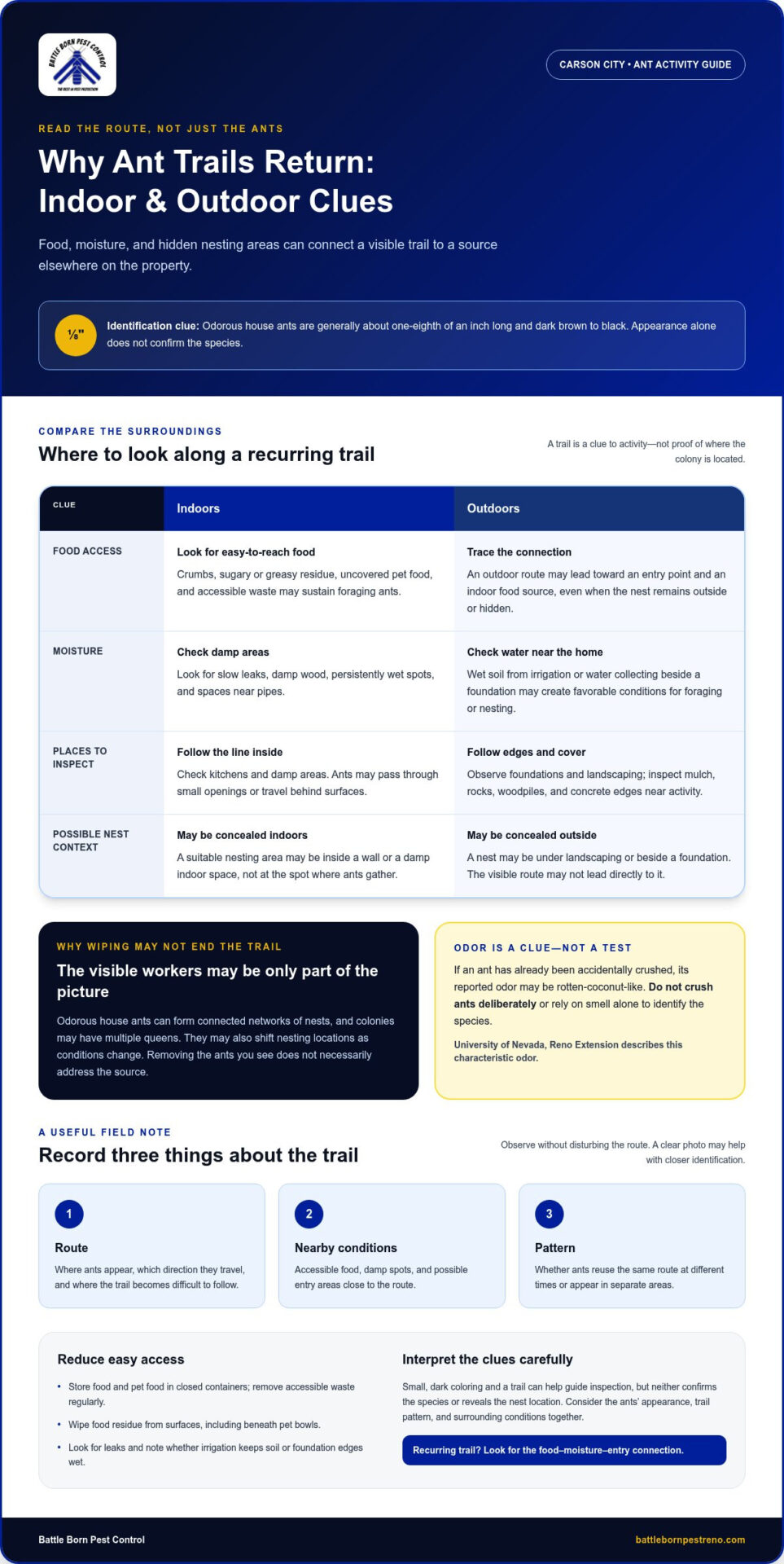
Small, dark ants moving in a steady line can be difficult to identify at a glance. Odorous house ants are generally about one-eighth of an inch long and range from dark brown to black. Other ants can have a similar size and color, so appearance is a starting point, not a definite identification. Consider the ants’ appearance alongside their trail patterns and the places they travel.
Tapinoma sessile is the scientific name for the odorous house ant. The species is known for its dark coloring and a characteristic odor when crushed. University of Nevada, Reno Extension describes the odor as rotten-coconut-like. There’s no need to crush an ant to investigate. Use the other clues, or seek closer identification if the distinction matters to your response.
What do odorous house ants look and smell like?
These ants are typically small and dark brown to black, making individual ants easy to overlook. A trail makes them more noticeable, but a line of ants alone doesn’t confirm the species. If an ant has already been accidentally crushed, its odor may offer another clue. Don’t crush ants deliberately or rely on smell as a stand-alone test. Similar-looking species may need closer examination.
To gather more clues, take a clear close-up photo if you can do so safely, and note where the ants are travelling. Their appearance, reported odor, and behavior together provide more context than any one feature. A local sighting still needs to be assessed using observable clues rather than color alone.
Where might Carson City homeowners notice trails?
Ant trails may run between a food or moisture source and an entry point, such as a gap near a door, a foundation edge, or another opening. Indoors, check kitchens and damp areas. Outside, observe along foundations and landscaping. These are places to look for activity, not proof of where a colony is located.
Follow a trail visually without disturbing it, and note where it appears to start and disappear. Ants can travel through small openings or behind surfaces, so the visible route may not lead directly to a nest. A trail entering from the yard, for example, may lead to an indoor food source while the nest remains outdoors or hidden from view.
- Note the route: Record where ants appear, the direction they travel, and where the trail becomes difficult to follow.
- Check nearby conditions: Look for accessible food, damp spots, or an entry area close to the trail.
- Compare sightings: Note whether ants use the same route at different times or appear in separate areas.
These observations help distinguish a one-time sighting from a recurring pattern and provide useful context if you need professional help with identification. Focus on the trail and its surroundings rather than assuming the nest is visible.
Why Odorous House Ants Find Food and Nesting Sites Around Carson City Homes
Ants entering a home aren’t necessarily a sign of poor housekeeping. Small, accessible food sources and dependable moisture can attract foraging workers even in a well-maintained space. Suitable nesting areas may be hidden outdoors or inside a wall. Understanding how these conditions overlap helps explain why a trail may appear in one room even when the nest is elsewhere.
In Carson City, inspect the full route rather than focusing only on the spot where ants gather. An outdoor trail near landscaping or a foundation may connect to an indoor food source, a damp area, or an opening ants can use to move between the two.
Which food and moisture sources can attract house ants?
Odorous house ants forage for different foods, so the attraction may be less obvious than a spill. Crumbs, sugary or greasy residues, uncovered pet food, and accessible waste can all provide food. The University of Wisconsin-Madison Extension Odorous House Ant Information describes the species’ food preferences and nesting habits, useful context when considering what may be sustaining activity around a home.
Moisture matters, too. A slow leak, damp wood, wet soil near irrigation, or water collecting beside a foundation can create favorable conditions for ants to forage or nest. Outside, check mulch, rocks, woodpiles, and concrete edges. Indoors, pay attention to persistently damp areas and spaces near pipes. These conditions may not be immediately visible, so a recurring trail is a reason to look for the source, not to blame your cleaning routine.
Use these checks to look for patterns:
- Store food and pet food in closed containers, and remove accessible waste regularly.
- Wipe food residues from surfaces and check less obvious areas, such as beneath a pet bowl.
- Look for leaks or dampness and note whether irrigation keeps soil or foundation edges wet.
- Inspect mulch, rocks, and concrete borders near recurring outdoor activity.
How can connected nests affect what homeowners see?
The worker ants following a visible route may be travelling from a nest concealed under landscaping, beside a foundation, or within a damp indoor space. Odorous house ants can form connected networks of nests, and colonies may have multiple queens. That structure can make a trail’s destination difficult to locate and help explain why removing the ants you see doesn’t necessarily resolve the source.
Food, moisture, and nearby nesting sites can combine to draw workers along repeatable trails between an outdoor refuge, an entry point, and an indoor resource. Ants may also shift nesting locations as conditions change, so activity in a new spot doesn’t automatically mean the original trail was misidentified.
For Carson City homeowners, noting both the trail and nearby conditions can make the next step more informed. If activity keeps returning or the nesting area is hard to trace, tailored ant control in Carson City can help assess the property and guide a safety-conscious response.
Odorous House Ants or Another Ant? Carson City Clues and Common Missteps
A line of small, dark ants can point to more than one species. Guessing incorrectly may lead you to focus on the wrong nesting conditions. In Carson City, pavement ants are another common household comparison. Consider appearance, reported odor, and where the ants are active together, rather than using any one clue as a shortcut to certainty.
How do odorous house ants differ from pavement ants?
University of Nevada, Reno Extension describes useful differences in appearance and nesting context. Odorous house ants are generally dark brown to black, and a crushed ant may have a rotten-coconut-like odor. Pavement ants are also dark, so color alone doesn’t distinguish them. Closer inspection may reveal their different body features. Odorous house ants may nest in sheltered outdoor or indoor spaces, while pavement ants often nest beneath pavement, stones, or foundation edges.
- Appearance: Both can look dark and small to the unaided eye. A clear close-up may reveal details that aren’t obvious while ants are moving.
- Odor: A rotten-coconut-like smell from an accidentally crushed ant is associated with odorous house ants. Don’t crush ants deliberately, and don’t treat odor as a complete identification test.
- Nesting context: Activity near cracks in pavement or beneath stones may fit pavement-ant nesting habits, while odorous house ants can use a wider range of sheltered sites.
These are tendencies, not rules. A trail beside a concrete edge doesn’t prove pavement ants are present, just as an odor report doesn’t confirm odorous house ants. University of Nevada, Reno Extension can assist with ant identification when the clues don’t line up.
Why can quick surface fixes miss the source?
Visible workers are foragers. They follow routes between food or water and nesting areas, which may be tucked under landscaping, beside a foundation, or inside a concealed space. Removing ants from a countertop or sweeping away part of a trail can make activity less visible without revealing where it begins.
Odorous house ants may form interconnected nests and have multiple queens, so activity can involve more than one hidden location. This makes a surface-level response an incomplete guide to what is happening. A trail that disappears into a wall or reappears along another edge could reflect a route through concealed spaces, not a single nest directly behind the last visible ant.
Before deciding what the ants are or how to respond, note where trails run, where they vanish, and whether they’re close to food, moisture, pavement, or landscaping. If the clues conflict or recurring activity is difficult to trace, identification support can help guide a suitable response. A careful assessment is more useful than relying on one visual detail or an odor clue alone.
How to Reduce Odorous House Ant Activity at Your Carson City Home
A careful response starts with understanding the trail and addressing conditions that may be attracting ants. Use this sequence to gather useful clues and reduce accessible food and moisture without disturbing the route or applying products carelessly.
What should you do when you first notice an ant trail?
Work through these steps in order. Your observations can help you assess whether activity is changing and decide if further guidance is needed.
- Observe. Follow the ants visually where practical, without disturbing the trail. Notice where they enter, where they seem to be heading, and whether the route runs along a wall, counter, foundation, or landscaping.
- Document. Record trail locations and when you see activity, such as during meal preparation or near a damp area. Note nearby food, pet dishes, waste, leaks, or irrigation. Photos can help you compare activity over time.
- Remove accessible attractants. Secure food and pet food, clean crumbs and sticky or greasy residues, and manage household waste. Check less obvious spots, including beneath small appliances and around feeding areas.
- Reduce moisture. Look for dripping pipes, damp wood, standing water, and irrigation that keeps soil wet near the foundation. Address practical moisture sources and monitor areas that remain damp.
- Reassess. Check whether trails still appear, whether they use the same route, and whether activity has shifted to another area. Keep your notes so you can distinguish a temporary change from a recurring pattern.
Avoid spraying or wiping away every visible ant before you’ve observed the route, since doing so can make it harder to see where the trail leads. If you use a pest-control product, follow its label directions exactly. Don’t combine products or apply them in a way the label doesn’t allow, and keep treatments away from children and pets as directed.
Which home conditions are worth addressing?
Outside, look for mulch, stored materials, rocks, or debris close to the home that may conceal ant activity. Keep these areas observable and address persistent dampness where practical. Indoors, monitor moisture-prone spaces and check whether food or water is accessible along the route. These steps won’t reveal every hidden nest, but they can help identify conditions worth correcting.
After making changes, note whether trails persist, move, or appear in new locations. If ants continue to return or the species remains uncertain, tailored ant control can connect the observed activity with a response suited to your property. The ant control guide for Reno homes offers related management guidance. For a recurring trail that’s difficult to resolve, request tailored ant control in Carson City.
When Carson City Ant Control Can Help with Odorous House Ants
Home prevention is a useful first step, but professional guidance can help when trails keep returning, the species is uncertain, or activity disappears into areas you can’t inspect. Odorous house ants may use connected nesting sites, so the ants visible on a counter or along a foundation may not show the full extent or source of the activity.
Before seeking help, note where trails appear, when you see them, and whether nearby food or moisture could be contributing. These observations help describe what’s happening at your property rather than relying on a single clue. A tailored approach can be useful if you’ve already addressed accessible attractants but still see recurring activity, or if you’re unsure whether the ants are odorous house ants or another species.
What can a tailored ant-control plan address?
Battle Born Pest Control provides ant control for active concerns, with plans tailored to each property’s needs. Depending on the situation, service may involve a one-time targeted pest treatment or an ongoing maintenance plan. Ongoing plans include regular inspections and preventative treatments, providing continued attention to conditions that may contribute to pest activity.
The goal is to consider more than the ants in view. Trail locations, likely access points, food and moisture conditions, and the property itself can inform a suitable response. Battle Born uses eco-conscious methods and keeps family, pet, and property safety in mind when planning treatments. The approach is tailored to the circumstances, rather than assuming every home needs the same treatment or maintenance plan.
If activity is hard to locate, share the notes or photos you’ve gathered and describe the steps you’ve already taken. That context can help guide a more informed discussion of the ant concern and options suited to your home. Practical observations and a property-specific plan can be a more measured next step than repeating surface fixes without understanding the pattern.
What should Carson City homeowners expect from local service?
Battle Born is a locally owned and licensed Northern Nevada company serving homes and businesses in Carson City and surrounding communities, including Reno, Sparks, and Dayton. Its local team brings decades of experience in pest control and tree care, and approaches pest concerns with attention to the property and the people who use it. That local perspective supports clear, grounded guidance without overstating what a treatment can achieve.
Ant activity can be frustrating, but you don’t need to have every detail figured out before asking for guidance. If recurring trails, uncertain identification, or hard-to-trace activity are affecting your home, request a free estimate or consultation to discuss a tailored ant-control plan for your Carson City property.
Choose a Clear Next Step for Your Home
You don’t need every answer before deciding how to move forward. If ant activity is still disrupting your routine, choose a practical next step: track what you’re seeing, address conditions you can readily change, or seek guidance if you’re unsure how to proceed. A thoughtful plan can replace repeated guesswork with a response suited to your household.
Getting support for odorous house ants in Carson City doesn’t mean you’ve failed to manage your home. It gives you a chance to discuss what you’ve observed and consider an approach shaped around your property, with care for the people and pets who share it. You can decide what level of support makes sense for you.
For a tailored conversation about ant activity at your property, request a free estimate or consultation. A clear next step can help you feel more confident and comfortable at home.
Frequently Asked Questions
How can I tell if I have odorous house ants?
Look for a combination of clues rather than relying on one feature. Odorous house ants are usually small and dark, and an accidentally crushed ant may produce a rotten-coconut-like odor. Similar-looking species can be hard to distinguish without closer inspection. A clear photo, the location where ants are active, and notes about whether they follow a consistent route can help with identification without disturbing the trail.
Why do odorous house ants smell when crushed?
The noticeable odor comes from chemicals released when the ant’s body is crushed. People often describe it as similar to rotten coconut, which is why the species has its common name. The scent can be a helpful clue if an ant is already crushed, but it isn’t a reliable test by itself. There’s no need to crush ants deliberately; their appearance and activity provide safer context to consider.
Can odorous house ants nest inside a home?
Yes, odorous house ants can nest indoors, including in wall voids and spaces near hot water pipes. A nest may be concealed behind a wall or beneath a surface, so finding ants in a room doesn’t necessarily mean the nest is directly beside them. If activity appears near plumbing or a damp area, note the location and check for moisture concerns without opening walls or disturbing hidden spaces.
What attracts odorous house ants into a house?
Accessible food and moisture can draw foraging ants indoors, even in a tidy home. Crumbs beneath a toaster, residue around a recycling container, an uncovered pet dish, or a slow plumbing leak may offer an opportunity. Check less visible areas, such as under appliances or around pet feeding stations, and store food securely. These checks can reveal attractants without assuming housekeeping is the cause.
Will killing the ants I see get rid of the colony?
Not necessarily. The ants you see are workers, and removing them may not affect hidden nesting sites or the rest of the colony. If a trail disappears and later returns, record where it reappears and whether the route has changed. Avoid combining pest products or using them contrary to their labels. When activity continues, an assessment can help determine whether the visible ants are part of a broader pattern.
Are odorous house ants common in Carson City?
Ants are among the most commonly reported household pest problems in Carson City, but that doesn’t mean every small, dark ant sighting is an odorous house ant. The species occurs across North America, and local identification still depends on the clues at the property. Households in Carson City and nearby Reno, Sparks, and Dayton can use trail observations and close-up photos to help distinguish a likely species from other ants.
When should I call a pest control professional for odorous house ants?
Consider professional guidance if trails keep returning after you’ve addressed accessible food and moisture, if ants appear in several areas, or if you can’t confidently identify them. Share where and when you’ve seen activity and any steps you’ve tried. Battle Born Pest Control provides tailored ant control in Carson City, with treatment planning that considers the property and the safety of family and pets.