Professional Tree Health Assessment in Carson City: Protecting Your High Desert Landscape
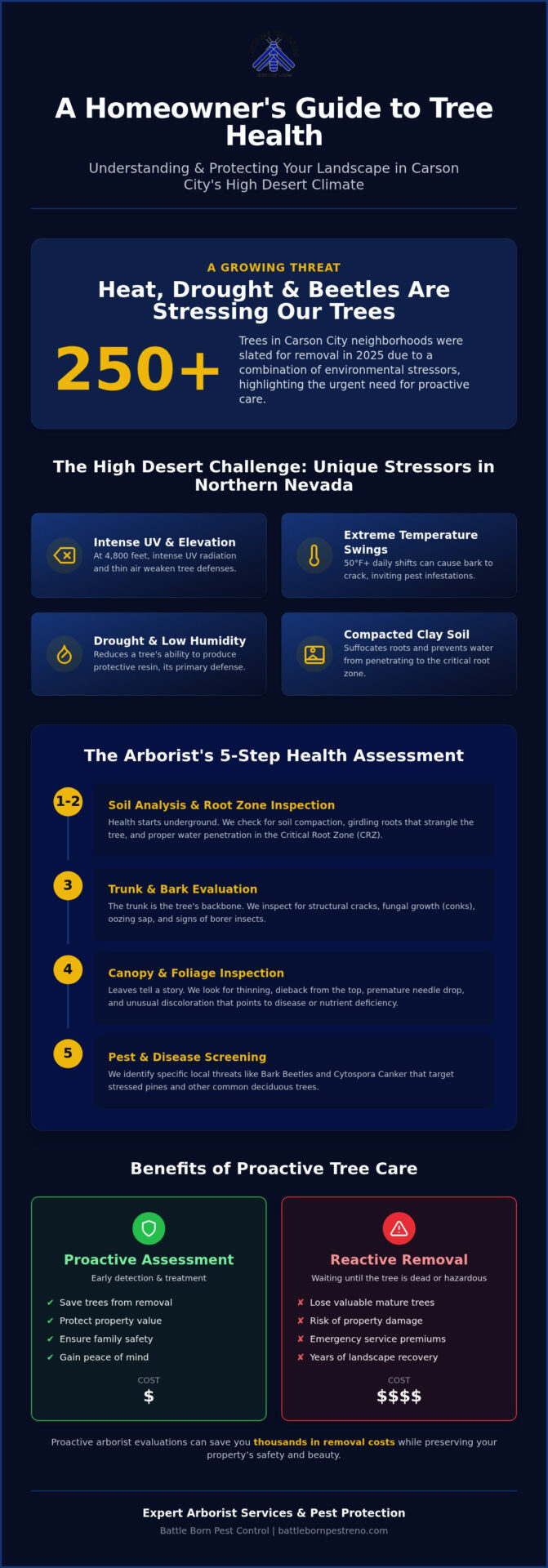
In 2025, over 250 trees in Carson City neighborhoods like Silver Oak and Northridge were slated for removal because of a combination of heat stress, drought, and bark beetle infestations. When you notice your pines losing their luster, it’s difficult to know if a professional tree health assessment in Carson City is truly necessary or if the tree is just reacting to our harsh high desert climate. You likely feel a sense of responsibility to protect your property from falling branches during high Sierra winds, yet the anxiety over the potential cost of removing a large dead tree can be overwhelming. We believe that caring for your landscape shouldn’t be a source of stress, but a predictable part of maintaining a safe and beautiful home.
A professional evaluation offers the clarity you need to move from worry to honest action. By identifying specific threats like the Pinyon Ips beetle or irrigation issues early, an expert can often develop a plan to save your trees rather than scheduling a permanent removal. This article explores how targeted evaluations detect hidden diseases and drought stress, giving you the peace of mind that your property remains a safe sanctuary for your family.
Key Takeaways
- Learn why a professional tree health assessment in Carson City serves as a diagnostic “physical” to catch environmental stressors before they become hazardous.
- Understand how our local 4,800-foot elevation and intense UV exposure create unique moisture challenges for high desert landscapes.
- Explore the methodical 5-step inspection process that evaluates the health of your trees from the critical root zone to the highest branches.
- Identify common Northern Nevada threats like Bark Beetles and Cytospora Canker that specifically target stressed pines and deciduous trees.
- Discover how proactive arborist evaluations can save you thousands in removal costs while increasing your property’s overall value and safety.
What is a Tree Health Assessment and Why Does Carson City Need Them?
A professional tree health assessment in Carson City is essentially a diagnostic physical for your landscape’s most valuable residents. While a standard gardening service focuses on aesthetics like mowing or surface-level trimming, a certified arborist examines the biological and structural health of the entire organism. This process relies on the science of Arboriculture to evaluate everything from soil compaction to the presence of microscopic fungal pathogens. By choosing a proactive assessment over a reactive wait and see approach, you’re often able to save mature pines and cottonwoods that would otherwise require expensive removal. It’s about protecting the safety of your home while preserving the natural beauty that defines our local neighborhoods.
The High Desert Challenge: Climate Stress in Northern Nevada
Carson City sits at a challenging 4,800-foot elevation where the air is thin and the UV radiation is intense. These conditions create a unique set of stressors for trees that aren’t found in lower, more humid climates. High diurnal temperature swings are common here; a tree might experience a 50-degree drop in temperature in just a few hours. This rapid fluctuation causes the bark to expand and contract, which often leads to winter kill or deep frost cracks that invite pests. In our high desert environment, low humidity and persistent drought conditions weaken a tree’s natural defense mechanisms. Without a strong immune system, even a healthy-looking pine can quickly succumb to local threats as its ability to produce protective resin diminishes.
When to Schedule Your First Evaluation
Timing is everything when it comes to preserving your landscape. We generally recommend an annual tree health assessment in Carson City for established, mature trees to monitor for slow-moving diseases. For newer transplants that are still struggling to find their footing in our rocky soil, bi-annual checks are more appropriate. You don’t always have to wait for your scheduled visit if you notice specific red flag symptoms on your property. Watch for these signs of distress:
- Premature needle drop or browning on evergreens.
- Oozing sap or bleeding areas on the main trunk.
- Visible thinning or dieback in the highest parts of the canopy tips.
- Unusual leaf discoloration that doesn’t match the current season.
Spring 2026 is the ideal window for a baseline evaluation. As the trees wake up from dormancy, it’s easier to see how they’ve handled the winter and identify which ones need extra support before the summer heat arrives. Catching a problem during the spring growth spurt gives us the best chance to implement a customized plan that ensures your trees remain a safe, beautiful part of your home for years to come.
The 5-Step Process: What Our Certified Arborists Evaluate
A comprehensive tree health assessment in Carson City is a structured investigation that moves from the soil up to the highest leaves. Our certified arborists follow a rigorous protocol to ensure no detail is overlooked. We don’t just identify symptoms; we look for the underlying causes of decline. This thorough documentation provides a clear record for homeowners, which is often essential for insurance claims or property disclosures during real estate transactions. Our goal is to move beyond a simple list of problems to create a long-term management plan that prioritizes the safety of your home and family.
Step 1 & 2: Soil Analysis and Root Zone Inspection
Many property owners forget that tree health begins underground. In Carson City, our clay-heavy soil is prone to severe compaction, especially in high-traffic areas or near newer construction. When soil is packed too tightly, it suffocates the root system and prevents water from penetrating the “Critical Root Zone” (CRZ). During this phase, we also look for girdling roots. These are roots that wrap around the base of the trunk and slowly cut off the flow of sap, effectively strangling the tree over several years. We evaluate your irrigation efficiency to ensure moisture is reaching the right depth without causing the root rot that often plagues over-watered desert landscapes.
Step 3, 4 & 5: Trunk, Canopy, and Pest Screening
Once the foundation is assessed, we move to the visible structure of the tree. We inspect the trunk for “conks,” which are mushroom-like fungal bodies that indicate internal wood decay. Deep structural cracks are also noted, as these can become major safety hazards during our frequent high-wind events. Next, we analyze the canopy’s density and color. Yellowing needles or stunted leaf growth often point to specific nutrient deficiencies common in our alkaline high-desert soils. Finally, we conduct a detailed pest screening. We search for tiny “exit holes” or piles of sawdust-like frass, which are the tell-tale signs of wood-boring beetles or larvae living inside the bark.
The result of this five-step process isn’t just a list of faults. It’s a customized management plan designed to stabilize and improve your landscape’s vitality. If you’re concerned about a specific tree on your property, scheduling a professional tree health assessment is the most reliable way to gain peace of mind about your property’s safety and long-term health.
Common Tree Threats in Carson City: Pests, Disease, and Decay
Identifying the specific biological threats in our region is a core component of a professional tree health assessment in Carson City. While our high desert environment is beautiful, it hosts a variety of opportunistic pests and pathogens that wait for a tree to show signs of stress. The “Big Three” local threats we frequently encounter are Bark Beetles, Pine Wilt, and Cytospora Canker. These issues often work in tandem with our erratic Northern Nevada weather to compromise a tree’s structural integrity. Catching these problems early is the difference between a simple treatment and a total landscape loss.
Bark Beetles and Borers: The Silent Killers
Bark beetles, particularly the IPS beetle, are notorious for targeting stressed pines throughout the Carson Valley. These insects bore into the bark and disrupt the tree’s vascular system, which is the network responsible for transporting water and nutrients. This damage often manifests as rapid “top-down” dieback, where the highest branches turn brown while the lower canopy remains green. In our local Ponderosas, we specifically look for “pitch tubes,” which are small globs of sap that the tree uses to try and push out Mountain Pine Beetles. Because these insects live hidden under the bark, a pest-focused arborist is essential for early detection before the damage becomes irreversible. Understanding these local patterns is similar to the expertise shared in our guide on Tree Disease Management in Sparks, NV.
Fungal Diseases and Environmental Decay
Fungal pathogens pose a different but equally serious risk to your property. In over-watered suburban landscapes, “Root Rot” can develop silently underground as excess moisture suffocates the roots and encourages decay. Another common issue is “Sunscald,” which occurs when our intense winter sun heats up the bark on the south side of a tree during the day, only for it to freeze rapidly at night. This creates dead patches of bark that serve as entry points for secondary fungal infections like Cytospora Canker. Additionally, Carson City’s high-alkaline soil often inhibits nutrient uptake, leading to a condition called Chlorosis. This causes leaves to turn yellow while the veins stay green, signaling that the tree is starving for iron and manganese. A thorough tree health assessment in Carson City identifies these subtle chemical and biological imbalances before they lead to total tree failure.
The Financial and Safety Benefits of Proactive Tree Care
Investing in a tree health assessment in Carson City is a matter of simple mathematics and long-term property protection. While a professional evaluation requires a modest initial investment, it provides a stark contrast to the financial burden of removing a large, dead tree, which can easily cost thousands of dollars. Beyond avoiding these sudden expenses, maintaining a vibrant landscape pays dividends in property value. Industry research indicates that healthy, mature trees can increase a home’s market value by up to 15 percent. Safety remains our primary concern; these assessments allow us to identify “Hazard Trees” that pose a direct threat to your roof, vehicles, or nearby power lines before a crisis occurs.
Reducing Liability and Storm Damage Risk
A professional assessment helps you fulfill a homeowner’s legal “duty of care” for insurance purposes. If a tree falls during a storm, insurance providers often look for evidence that the owner was proactive in maintaining the property’s safety. Our arborists specifically look for structural defects like “V-crotches” or weak branch attachments. These tight unions are notorious for failing when subjected to the 60mph Sierra gusts that frequently sweep through the Carson Valley. By identifying these risks early, we can recommend proactive pruning to reduce the “wind sail” effect, which significantly lowers the chance of branch breakage. For trees that have already reached a critical state of decay, we provide a detailed roadmap in our guide on Safe Hazardous Tree Removal in Carson City.
Long-Term Savings Through Customized Care Plans
Preserving a tree is almost always more cost-effective than replacing one. Through customized care plans that include deep-root fertilization and targeted pest management, we can often extend a tree’s lifespan by decades. This longevity offers a tangible “Value of Shade” during our intense Nevada summers. A well-placed, mature canopy can significantly reduce home cooling costs by shielding your structure from the high-desert sun. Early intervention also serves a neighborly purpose; by stopping a bark beetle infestation or fungal disease on your property, you prevent the “neighborhood spread” that can devastate an entire street’s landscape. If you’re ready to secure your property’s future, you can schedule a tree health assessment to begin a professional care plan today.
Partnering with Battle Born Pest Control: Expert Arborist Services in Carson City
Choosing a partner for your landscape means finding a team that values the safety of your home as much as you do. Battle Born Pest Control operates with a philosophy centered on protecting your family, pets, and property through science-based care. Because we’re a locally owned business, we understand the specific microclimates that define the Carson Valley. A cottonwood near the Carson River faces different moisture challenges than a pine in the higher elevations of the west side. Our integrated approach sets us apart; we don’t just treat the symptoms of a sick tree. We manage the pests and the underlying environmental stress at the same time to ensure long-term vitality. This dual expertise in both arboriculture and pest management allows us to address threats like bark beetles while simultaneously improving the tree’s natural resilience.
Why a Certified Arborist Makes the Difference
The difference between a standard gardener and a certified arborist is found in years of dedicated study and field experience. Our team at Battle Born Pest Control includes arborists who have met the rigorous standards of the International Society of Arboriculture. This certification requires a minimum of three years of full-time experience and the successful completion of a comprehensive examination. This expertise is vital for a thorough tree health assessment in Carson City, where the line between a seasonal change and a fatal disease is often thin. We focus on preservation over removal because we know that a mature tree is an irreplaceable asset to your property. By using precise diagnostic tools and evidence-based management, we can often save trees that others might simply cut down, maintaining the character and value of your landscape while ensuring your home remains safe.
Next Steps for Your Carson City Property
Your first consultation with Battle Born Pest Control is designed to be transparent and informative. We’ll walk your property with you, pointing out both the strengths and the vulnerabilities of your trees. Our service area extends across Carson City, Dayton, and the surrounding valleys, providing reliable care to our Northern Nevada neighbors. We provide clear, experience-backed recommendations that prioritize safety and structural stability. Securing your landscape’s future starts with a baseline evaluation. By scheduling your 2026 assessment today, you’re ensuring that your trees receive the customized care they need to thrive in our high desert environment. Protect your trees today with a professional health assessment and enjoy the quiet confidence that comes from a healthy, safe property.
Securing the Future of Your High Desert Landscape
Maintaining a healthy landscape in Northern Nevada is a long-term commitment that rewards you with safety and beauty. We’ve explored how a professional tree health assessment Carson City serves as an essential tool for identifying hidden threats like the IPS beetle and drought-related decay before they become irreversible. By choosing preservation over removal, you protect the mature canopy that provides shade during our hot summers and adds significant value to your property.
As a locally owned team of Northern Nevada experts, Battle Born Pest Control is dedicated to being the guardian of your home’s outdoor environment. We have certified arborists on staff who use methods that are safe for your families and pets, ensuring every treatment plan is as responsible as it is effective. Don’t wait for the next high-wind event to test the strength of your trees. You can Schedule Your Professional Tree Health Assessment today to gain the peace of mind you deserve. We look forward to helping your landscape thrive for generations to come.
Frequently Asked Questions
How much does a tree health assessment cost in Carson City?
The cost of a professional tree health assessment in Carson City typically depends on the size of your property and the number of trees being evaluated. A basic verbal consultation is more affordable, while a comprehensive written report for insurance or real estate purposes involves a higher investment. Regardless of the specific fee, this evaluation is a cost-effective way to prevent the massive expenses associated with removing large, dead trees from your landscape.
Can a sick tree be saved, or does it always have to be removed?
Many sick trees can be saved if the underlying issues are identified before structural failure occurs. A professional assessment focuses on preservation through customized management plans, such as targeted pest treatments or soil amendments. While some trees with advanced internal decay may require removal for safety, early intervention often provides a path to recovery. Our goal is always to protect your landscape’s long-term health rather than opting for a quick fix.
How often should I have my trees checked by a certified arborist?
We recommend that mature trees receive a professional check-up at least once a year to monitor for slow-moving diseases or environmental stress. For younger transplants or trees recently affected by construction, bi-annual visits are often more appropriate. Regular monitoring by a certified arborist ensures that subtle changes in health are caught early, which is especially important in the erratic climate of Northern Nevada where weather patterns shift rapidly and impact tree vitality.
What are the signs that my pine tree has bark beetles?
Primary signs of a bark beetle infestation include the presence of pitch tubes, which are small globs of sap on the trunk, and frass, a sawdust-like material found in bark crevices. You might also notice a rapid browning of the needles starting from the top of the canopy and moving downward. These insects disrupt the tree’s vascular system quickly, making immediate professional identification vital for protecting the rest of your landscape trees.
Does drought stress make my trees more vulnerable to pests?
Yes, prolonged drought stress is one of the primary factors that weaken a tree’s natural defense mechanisms. In the Carson Range, thirsty trees cannot produce enough resin to pitch out invading bark beetles, making them easy targets for infestation. A comprehensive tree health assessment in Carson City evaluates these moisture levels to determine if supplemental irrigation or deep-root treatments are necessary to bolster the tree’s immune system against local pests and environmental decay.
Is a tree health assessment necessary for real estate transactions in Nevada?
While not a universal legal requirement for every sale in Nevada, an assessment is often a vital component of the due diligence process. Buyers and lenders frequently request these reports to ensure there are no hidden liabilities or expensive removal costs looming on the property. Providing a professional health report can offer peace of mind to all parties and demonstrate that the landscape has been maintained with a focus on property safety and longevity.
What is the difference between a tree trimmer and a certified arborist?
A tree trimmer generally focuses on the aesthetic task of removing branches, whereas a certified arborist is a trained professional in the science of tree care. To become an ISA Certified Arborist, an individual must have at least three years of full-time experience and pass a rigorous examination covering all aspects of tree biology. This specialized training allows them to diagnose complex diseases and develop long-term health plans that go far beyond simple cosmetic trimming.
Will my homeowners insurance cover a tree health assessment?
Most standard homeowners insurance policies don’t cover the cost of a routine tree health assessment, as they view it as part of regular property maintenance. However, investing in a professional report can be beneficial if you ever need to file a claim for storm damage. Having a documented history of proactive care shows that you have fulfilled your duty of care, which can sometimes simplify the claims process after a major weather event occurs.