Tree Branch Removal Over a House in Reno: A Safe, Step-by-Step Guide

What if protecting your roof depends less on making a quick cut and more on planning how the branch comes down? If you’ve searched “tree branch removal over house Reno,” you’re likely concerned about a limb damaging your home or putting someone at risk. Those are sensible concerns, but an overhanging branch doesn’t always mean the entire tree needs to be removed.
A safe plan starts with assessing the branch’s condition, its connection to the tree, and the space around your home. This guide explains which risk factors to discuss with an arborist, how pruning and tree removal differ, and what to consider when planning overhead work. Battle Born Pest Control’s certified arborists provide tree health assessments, pruning, and removal for Reno-area properties, helping homeowners choose a suitable approach for the tree and site.
Key Takeaways
- Roof proximity alone doesn’t show whether a branch is unsafe. Visible changes and the tree’s condition help inform an arborist’s assessment.
- A planned removal involves assessing the tree and site, organizing the work area, and reviewing the result.
- Pruning may address a concern limited to one limb. The condition of the whole tree may call for a broader assessment.
- Help an arborist understand the issue by noting the branch’s location, visible changes, roof proximity, and access constraints.
- For tree branch removal over house Reno homeowners can turn to certified-arborist care to understand the options and next steps.
How to Assess a Tree Branch Hanging Over Your Reno Home
A branch above your roof can raise concerns about damage, but its position alone doesn’t show whether it’s weak or likely to fail. Start by noting what you can see from a safe place, then have the tree assessed before deciding whether pruning or another approach is appropriate. For tree branch removal over house Reno homeowners should consider both the branch and the tree it grows from.
What signs on an overhanging branch deserve attention?
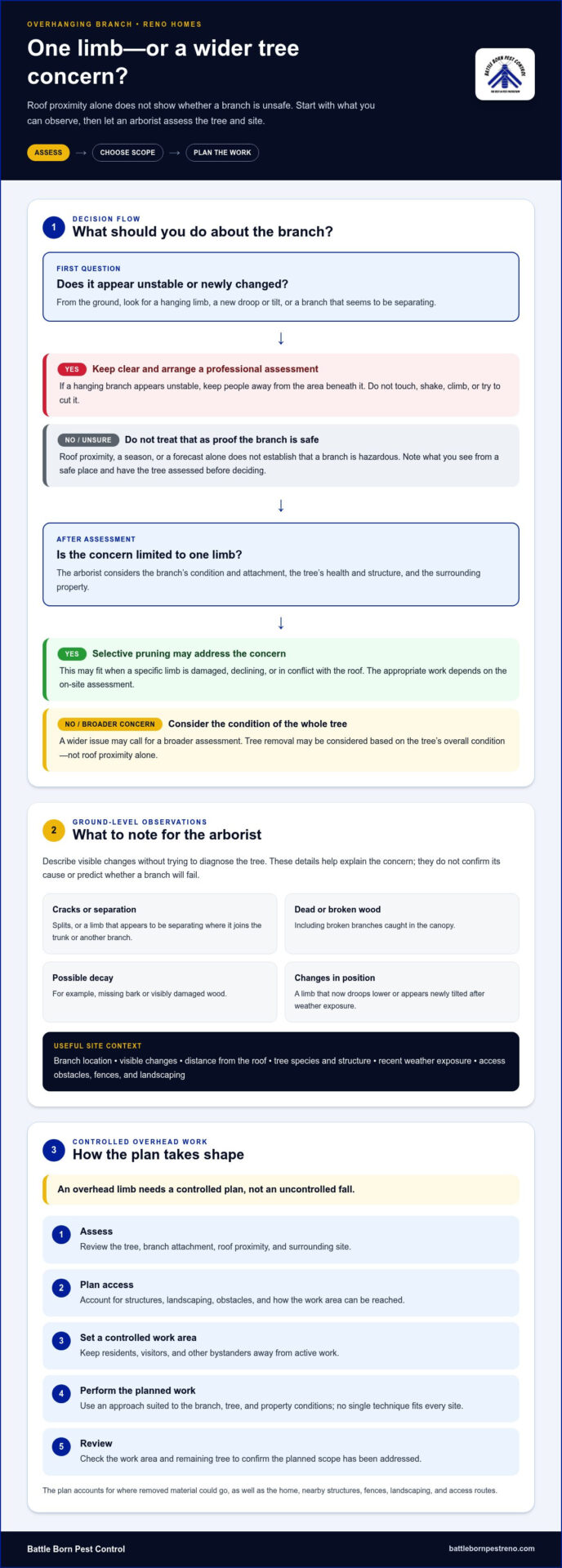
Look from the ground for visible changes. Don’t climb or handle the branch. Useful details to note include:
- Cracks, splits, or a branch that appears to be separating where it joins the trunk or another limb.
- Dead or broken wood, including branches caught in the canopy.
- Possible decay, such as missing bark or visibly damaged wood.
- A change in position, such as a limb that now droops lower or appears newly tilted after weather exposure.
These observations help describe the concern, but they don’t confirm the cause or establish how likely a branch is to fail. Avoid touching, shaking, or trying to cut a questionable limb. If a hanging branch appears unstable, keep people away from the area beneath it and arrange a professional assessment.
How Reno conditions fit into a branch assessment
In Northern Nevada’s high-desert setting, an arborist considers the specific tree and site rather than relying on roof proximity alone. Relevant details include tree species, branch structure, visible condition, recent weather exposure, and distance from the roof. Weather can change what deserves attention, but a season or forecast alone doesn’t establish that a branch is hazardous.
An arborist assessment is an evaluation of a tree’s condition, structure, and site context to help determine appropriate care. An arborist has knowledge of tree care, while an on-site evaluation connects that expertise to the particular branch, roof, and surroundings. The assessment can help distinguish a concern with one limb from a wider issue with the tree, giving you a clearer basis for discussing pruning or removal.
To make the assessment more useful, note the branch’s location, any changes you’ve observed, its proximity to the roof, and obstacles that may affect access. Describe what you see without trying to diagnose the tree. Battle Born Pest Control’s certified arborists provide tree health assessments and use those observations to guide recommendations for your property.
How Arborists Plan Tree Branch Removal Over a House
Removing a limb above a roof calls for more than choosing where to make a cut. Before deciding how work can proceed, the arborist needs to understand the tree, the branch, and the space around the home. An overhead limb needs a controlled plan, not an uncontrolled fall. Planning helps protect the roof, nearby structures, people, and landscaping from avoidable impacts.
What happens during an arborist’s site assessment?
The assessment considers the tree’s health and structure, how the branch is attached, and its position relative to the house. The arborist also reviews access to the work area, nearby fences or landscaping, and where people can remain safely clear. These details help determine whether pruning may address the concern or whether the tree’s broader condition warrants considering removal. The approach depends on the property, so it should be based on an evaluation rather than assumed in advance.
A careful plan generally follows a clear sequence:
- Assess: Review the tree, branch, roof proximity, and surrounding site.
- Plan access: Identify how the work area can be reached while accounting for structures, landscaping, and obstacles.
- Establish a controlled work area: Keep residents, visitors, and other bystanders away from the active work zone.
- Perform the planned work: Use an approach suited to the branch, tree, and site conditions.
- Review: Check the work area and the remaining tree to ensure the planned scope has been addressed.
How does a crew protect the house during branch work?
Protection starts with planning where removed material could go and how its movement can be controlled, rather than allowing a large limb to drop toward the roof. The plan accounts for the home and nearby structures, as well as fences, landscaping, and access routes that could be affected. Crew members also need a clear work area, with bystanders kept at a safe distance while the work is underway.
No single technique or piece of equipment suits every tree. A branch’s size and position, the tree’s structure, obstacles, and available access all influence the approach. The arborist determines these details on site and shapes the work plan around the actual property, rather than relying on a one-size-fits-all method.
For Reno homeowners weighing tree branch removal over house Reno, an arborist-led assessment can turn a general roof concern into a practical plan. Battle Born Pest Control’s certified arborists provide tree assessments, pruning, and removals. Explore tree care in Reno to take the next step.
Pruning or Tree Removal: Which Option Fits a Branch Over Your Roof?
An overhanging limb doesn’t automatically mean the entire tree should come down. The appropriate scope depends on what an arborist finds: the condition of the branch, the health and structure of the rest of the tree, and how both relate to the home and surrounding property. For tree branch removal over house Reno concerns, roof proximity is one factor, not the decision by itself.
| Concern | Likely scope | Assessment needed |
|---|---|---|
| A specific limb is damaged, declining, or in conflict with the roof | Selective pruning may address that branch | Examine the limb, its attachment, and how its removal may affect the tree |
| Several limbs show concerns, or the tree appears to be in broader decline | Assess the whole tree; removal may be considered | Review overall health, structure, and the site around the tree |
| A branch is close to the roof, but no visible damage or decline is apparent | Scope should follow an arborist’s findings, not proximity alone | Consider branch condition, tree structure, and potential effects on the property |
When might selective pruning be considered?
If the concern is limited to one limb, an arborist may recommend removing or reducing that branch while retaining the rest of the tree. The aim is to address the specific conflict while considering the tree’s health and structure, not to remove more than the assessment supports. Pruning can address a particular concern, but it can’t guarantee that the tree will never develop another issue or be affected by future weather.
When should the whole tree receive a closer assessment?
Extensive decline, structural concerns, or several affected limbs can indicate a wider issue than one branch. In that case, the assessment should consider the condition of the entire tree alongside the home, access, and other nearby features. If disease is a concern, an arborist can evaluate tree health and guide appropriate care. See the Sparks tree disease management guide for related considerations.
Whole-tree removal is a decision about the tree itself, not simply a response to a limb’s position above the roof. An arborist-led assessment can clarify whether targeted pruning or a broader response fits the findings. For more context on the factors involved in removal, read the hazardous tree removal guide for Carson City.
How to Prepare Your Reno Property for Overhead Branch Removal
A few simple notes can help an arborist understand the concern and plan an assessment around your property. You don’t need to inspect the branch up close or move anything beneath it. For tree branch removal over house Reno homeowners can prepare by recording what they can safely observe from the ground and noting anything that could affect access.
What should homeowners note before an assessment?
Keep your observations specific and factual. Note whether the branch hangs over the roof, a garage, or another area, and whether its position or appearance seems to have changed. Describe what you see rather than diagnosing the tree. Bark damage or discolored leaves may be worth mentioning, but appearance alone doesn’t establish disease or explain a branch’s condition.
- Record the branch’s location and what it hangs above or near.
- Note visible changes, such as a new crack, break, or shift in position.
- Identify access considerations, including gates, parked vehicles, narrow paths, and nearby landscaping.
- Mention where pets or people typically use the yard so the work area can be planned with them in mind.
These details give the arborist useful context before evaluating the tree and surroundings in person. If you take a photo, do so from a safe location. Don’t climb, reach into the canopy, or stand beneath a limb that appears unstable to get a better view.
What should homeowners avoid doing themselves?
Leave overhead work to tree-care professionals. Don’t climb onto the roof, use a ladder to reach a limb, or try to cut a branch that may be under tension. A limb can shift unexpectedly as it’s cut, and working above the ground adds risk to you and the property. Keep family members and pets away from the area where the branch could fall.
Stay clear of overhead utility lines. Don’t approach or touch them, and don’t attempt to move a branch that is near or in contact with a line. If utility lines are part of the site, include that detail in the assessment so applicable local guidance can inform planning.
Before the visit, make access details clear without entering the work area. Note which gate provides entry, whether a vehicle blocks that route, and any landscaping or structures close to the branch. These practical details help the arborist consider the site as a whole while keeping you out of hazardous work.
Share your observations and arrange an arborist-led tree assessment with Battle Born Pest Control to discuss a careful next step for your Reno property.
Arrange Arborist-Led Tree Branch Removal in Reno
Once you’ve noted what concerns you, an arborist-led assessment can help turn that information into a clear plan for your property. Battle Born Pest Control’s certified arborists provide tree health assessments, pruning, disease management, and safe tree removals. Recommendations reflect the tree’s condition and the work needed, rather than assuming every branch above a roof calls for the same solution.
What to expect from Battle Born’s tree-care approach
An assessment considers the tree and its surroundings together. The arborist evaluates tree health and structure, the branch’s relationship to the roof, and property details that may affect the work. Those findings help guide whether pruning may address a specific limb or whether the tree’s wider condition calls for a broader discussion about removal.
This tailored approach keeps the focus on the home, the people who use the property, and the tree’s condition. If signs of disease are part of the concern, tree health and disease management can also inform the recommendation. Battle Born serves Reno, Sparks, Carson City, Dayton, and surrounding Northern Nevada communities, providing tree care for residential and commercial properties.
How to take the next step
When arranging tree-care help, share the branch’s location, what it hangs over, and any visible concerns or changes you’ve observed. Mention access details such as gates, parked vehicles, landscaping, or overhead utility lines, describing them from a safe vantage point. This gives the arborist helpful context for assessing the tree and property before recommending work.
You don’t need to diagnose the tree or decide in advance whether pruning or removal is best. A certified-arborist assessment can help clarify the concern and appropriate scope of care, with a plan specific to your home and site conditions.
For tree branch removal over house Reno homeowners can take the next step by sharing their concern with Battle Born Pest Control. Request tree-care help from Battle Born.
Take the Next Step Toward a Safer, Clearer Plan
A branch over your roof deserves a thoughtful assessment, not a rushed decision. Note visible changes and access considerations, then let an arborist evaluate the tree, branch, and surrounding property. That assessment can clarify whether selective pruning or a broader response is appropriate, while careful planning keeps your home and the people around it in view.
For tree branch removal over house Reno concerns, Battle Born Pest Control provides tree care performed by certified arborists, including pruning, health assessments, disease management, and tree removal. The team serves Reno and surrounding Northern Nevada communities, with recommendations shaped by the tree’s condition and your property’s needs.
Share what you’ve observed and take a practical next step with Request tree-care help from Battle Born. A clear assessment and considered plan can help you move forward with greater confidence in caring for your home and trees.
Frequently Asked Questions
Is it safe to remove a tree branch hanging over a house yourself?
Removing an overhead branch yourself isn’t a safe choice, particularly if it requires a ladder, roof access, or cutting a limb that may be under tension. A branch can shift unexpectedly, putting you and the house at risk. Keep people and pets clear of the area, and don’t try to move or cut an unstable limb. A certified arborist can assess the tree and plan work suited to the branch and property.
How do arborists remove branches over a roof without damaging the house?
Arborists assess the branch, tree, roof, access, and surrounding area before choosing an approach. They plan how to control removed material and organize a work area that keeps bystanders clear while accounting for nearby structures and landscaping. No single method or piece of equipment fits every property; the plan depends on the tree, branch, and site conditions. Careful planning helps reduce the chance of damage, though no work can eliminate every risk.
Can a branch over my house be pruned instead of removing the whole tree?
Yes, an arborist may recommend pruning if the concern is limited to a particular branch and the rest of the tree is suitable to retain. The assessment considers the limb’s condition, its attachment, and the tree’s overall health and structure. If there are broader concerns, the scope may need to include the whole tree. For tree branch removal over house Reno properties, roof proximity alone doesn’t determine which option is appropriate.
What signs suggest a tree branch over a house needs an arborist assessment?
Visible cracks, broken or dead limbs, a branch caught in the canopy, possible decay, or a recent change in the limb’s position are reasons to seek an assessment. Note what you can observe safely from the ground, but don’t climb or diagnose the tree based on appearance alone. If a hanging limb appears unstable, keep people and pets away from the area below it while arranging professional tree care.
Do I need a permit to remove a tree branch in Reno?
For a tree on private residential property in Reno, the City says a permit isn’t required for pruning or removal. Different rules apply to trees within the City right-of-way or on other City property, where a Tree Work Permit and inspection are required. If the tree’s location relative to a sidewalk or street is unclear, identify its location before work is planned and check the City of Reno’s current tree guidance.
What should I do if a branch is touching a power line?
Stay well away from the branch and line, and don’t touch, cut, or try to move either one. Keep other people and pets clear of the area, too. Contact the utility responsible for the line to report the situation and follow its instructions. Don’t approach the tree to take a closer look or attempt tree work near the line; utility involvement may be needed before any work can be planned safely.
Does a branch hanging over a roof mean the whole tree should be removed?
No, an overhanging branch doesn’t automatically mean the whole tree needs removal. An arborist assesses the specific limb and the tree’s overall health and structure, along with the home and surrounding site. If the concern is confined to one branch, pruning may be appropriate; broader decline, structural issues, or multiple affected limbs may call for a closer whole-tree assessment. The recommendation should follow those findings, not proximity to the roof alone.