Tree Health Assessment in Reno, NV: A Homeowner’s Guide to Professional Care
When the Washoe Zephyr begins to howl across the Truckee Meadows, many homeowners find themselves looking out the window at their tallest pines or cottonwoods with a sense of unease rather than admiration. It’s a common worry in Northern Nevada, where our high-desert climate and alkaline soils can quietly compromise a tree’s structural integrity long before the first branch snaps. If you’re concerned about a leaning trunk or a thinning canopy, a professional tree health assessment reno nv provides the clarity you need to move from worry to action.
You likely value the shade and beauty your trees provide, yet navigating the conflicting advice of unqualified cutters and the realities of Reno’s limited annual rainfall can feel overwhelming. This guide will teach you how to identify early stress signals and explain how a professional diagnosis can help save a struggling tree while protecting your family and home. We will examine the local pests and soil conditions unique to Washoe County and outline the structured steps experts take to ensure your landscape remains a safe, thriving asset for years to come.
Key Takeaways
- Learn to distinguish between natural seasonal shedding and critical stress indicators to catch health issues before they become hazardous to your home.
- Understand the systematic steps involved in a professional tree health assessment reno nv, from reviewing site history to identifying internal decay through visual inspections.
- Recognize how Reno’s unique “alkaline trap” and local pests like the Pine Bark Beetle target weakened trees in our high-desert environment.
- Gain clarity on the professional standards used to decide between saving a tree through specialized care or recommending removal for safety and liability reasons.
- Discover practical strategies to mitigate soil compaction and irrigation challenges to support the long-term stability and vigor of your landscape.
Signs Your Northern Nevada Trees Need a Health Assessment
A tree health assessment is a systematic evaluation of a tree’s structural integrity and biological vigor. It isn’t just a casual walk-through; it’s a diagnostic process rooted in the science of Arboriculture. By examining the physical and biological state of a tree, professionals can determine if it possesses the strength to withstand our local environment or if it requires specialized intervention to stay healthy and vibrant.
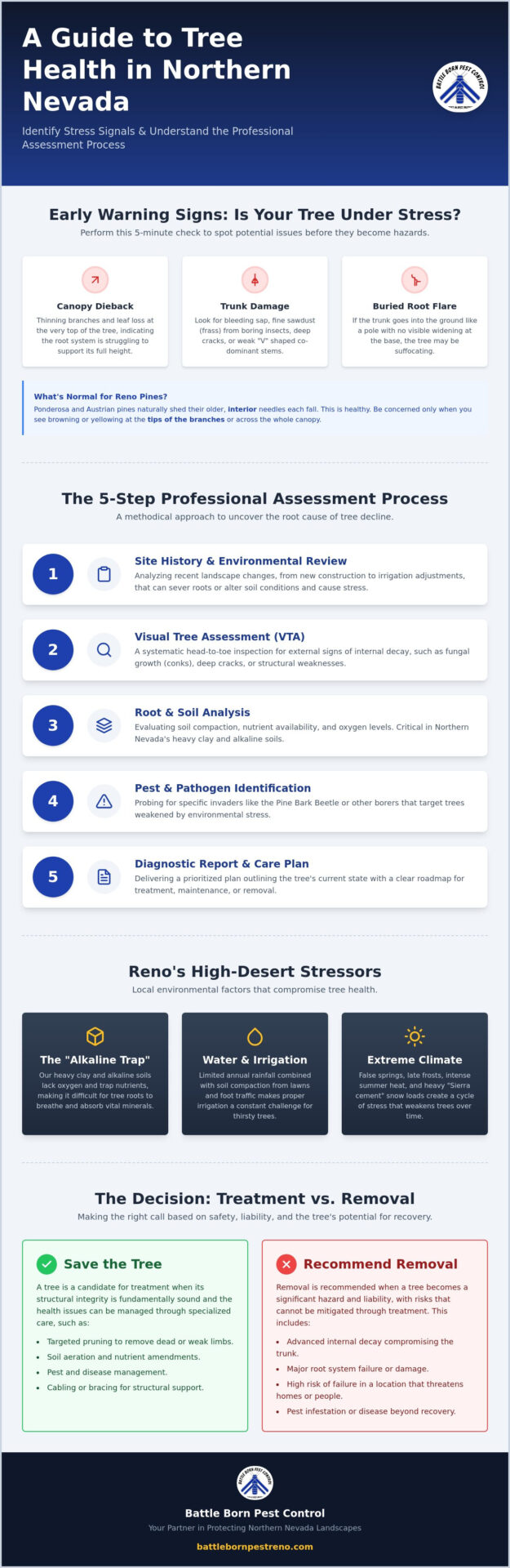
Many Reno homeowners feel a sense of alarm when they see yellowing needles on their pines, but this isn’t always a crisis. In the Truckee Meadows, ponderosa and Austrian pines naturally shed their older, interior needles every autumn. However, if you notice discoloration at the tips of the branches or across the entire canopy, your tree is likely struggling with more than just a seasonal change. Distinguishing between these patterns is a core component of a professional tree health assessment reno nv.
Structural red flags often hide in plain sight. Look for co-dominant stems, which occur when two large trunks grow from the same point in a tight V shape. These areas often develop included bark, where the bark grows inward and prevents the wood from actually bonding together. These joints are notoriously weak; they act as a primary failure point during heavy winter storms or high-wind events. Similarly, watch for thinning at the very top of the tree, known as dieback. When the top of the canopy loses its vigor, it’s a sign the root system can no longer support the tree’s full height.
The Homeowner’s 5-Minute Pre-Assessment
You can perform a preliminary check of your landscape in just a few minutes. Start at the base and look for the root flare, which is the natural widening where the trunk meets the soil. If the trunk looks like a straight pole or is buried under a mulch volcano, the tree may be suffocating. Check the bark for bleeding sap or fine, sawdust-like frass; these are often signs that boring insects have moved in. Lastly, compare the leaf size on different branches. If this year’s leaves are significantly smaller than those from previous seasons, the tree is likely under systemic stress.
Why Timing Matters in the Truckee Meadows
Reno’s climate presents specific challenges that make timing critical. Our false springs often lure deciduous trees into budding early, only for a late May frost to damage the new growth. Intense summer heat waves then place immense pressure on these weakened trees, often triggering dormant pest issues. Fall is the ideal window for a tree health assessment reno nv. Identifying structural weaknesses before the heavy Sierra cement snow loads arrive allows you to address safety concerns while the tree is still manageable.
The 5-Step Professional Tree Health Assessment Process
Professional tree care is a methodical discipline that goes far beyond a casual glance at the leaves. When an expert arrives for a tree health assessment reno nv, they follow a structured diagnostic path to uncover the root cause of any decline. This process begins with a site history and environmental review. We look at recent changes to your landscape, such as new construction or adjustments to irrigation schedules, as these factors often explain sudden stress in mature trees. A new driveway or even a simple fence installation can sever critical feeder roots, leading to visible canopy loss months later.
The second stage is the Visual Tree Assessment (VTA). During this step, the assessor identifies external signs that suggest internal decay or structural instability. We look for “conks” or fungal mushrooms growing at the base, as well as deep trunk cracks or seeping wounds. Following the visual check, we perform a root and soil analysis to evaluate compaction and nutrient availability. In Northern Nevada, our heavy clay soils often lack the oxygen necessary for root respiration, making it difficult for trees to thrive. For homeowners interested in local best practices, the UNR Extension provides invaluable Tips for Healthy Landscape Trees to help maintain these vital resources.
The final steps involve precise pest and pathogen identification and the delivery of a diagnostic report. We probe for specific invaders like borers or bark beetles that target weakened wood. Once the data is gathered, you receive a prioritized care plan. This document outlines the tree’s current state and provides a clear roadmap for recovery or maintenance. If you’ve noticed changes in your yard’s canopy, scheduling a professional tree health assessment is the most reliable way to ensure the safety of your property.
What an ISA Certified Arborist Looks for
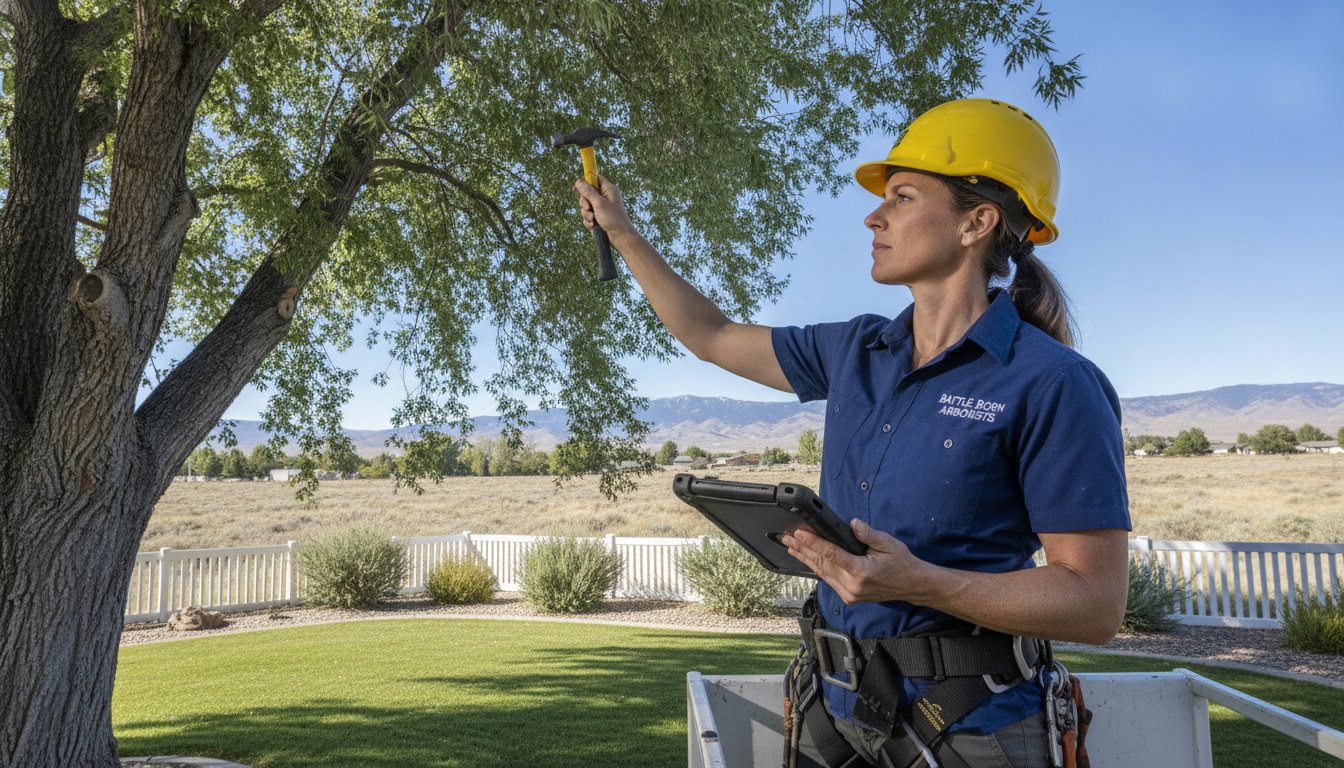
A certified professional is trained to identify “hazard trees” that pose a direct risk to your home or nearby power lines. They use specialized tools, such as soil probes to measure moisture depth and sounding mallets to detect hollow pockets within a trunk. A key part of their expertise is differentiating between abiotic stressors, like salt buildup from winter runoff, and biotic stressors, such as living insects or fungi. This distinction ensures that the treatment addresses the actual problem rather than just the symptoms.
Lab Testing and Advanced Diagnostics
While a visual inspection is often sufficient, some cases require deeper investigation. Soil sampling becomes necessary when we suspect high salinity or extreme pH imbalances that prevent nutrient uptake. Tissue sampling can also be used to confirm specific fungal blights that look similar to heat scorch. Most Reno assessments are completed visually without needing expensive lab work.
Common Reno Tree Pests and Diseases to Watch For
In our high-desert environment, pests don’t choose their targets at random. They are opportunistic survivors that wait for a tree’s natural defenses to falter due to drought or poor soil. A comprehensive tree health assessment reno nv often reveals that what looks like a sudden insect infestation is actually the final stage of a long-term environmental struggle. Recognizing these common local threats early can be the difference between a simple treatment and a total tree removal.
- The Pine Bark Beetle: These small but destructive insects are the primary threat to ponderosa and piñon pines across Washoe County. They specifically target drought-stressed trees that lack the sap pressure needed to push the beetles out of the bark. If you see small “pitch tubes” that look like popcorn on the trunk, the tree is already under heavy attack. Understanding your options for bark beetle treatment Reno homeowners can rely on is essential to stopping an infestation before it becomes fatal.
- Aphids and Scale: These sucking insects are common on our maples and aspens. You’ll likely notice a sticky substance called “honeydew” coating your patio furniture or car before you see the bugs themselves. This sugary waste doesn’t just damage the leaves; it attracts large numbers of ants and leads to the growth of black sooty mold.
- Fire Blight: This bacterial disease is a frequent visitor to Reno’s ornamental pear and apple trees. It causes branch tips to blacken and curl into a characteristic “shepherd’s crook” shape. Because it spreads rapidly during our wet spring months, immediate pruning is necessary to prevent it from reaching the main trunk.
- Cytospora Canker: Often the silent killer of local spruce and poplar trees, this fungal disease creates sunken areas on the bark. You might notice amber-colored sap oozing from the branches. It typically moves from the bottom of the tree upward, slowly killing one limb at a time.
The Link Between Pest Control and Tree Vigor
Battle Born Pest Control approaches tree care by identifying the specific insects that weaken your landscape’s natural defenses. Because Reno is famously windy, topical sprays often drift away before they can be effective. We prioritize systemic treatments that the tree absorbs through its roots or trunk, ensuring the medicine stays where it’s needed. We also consider the role of natural predators; a healthy yard should encourage beneficial insects like ladybugs that help manage aphid populations as part of a long-term health plan.
Identifying ‘Secondary’ Invaders
It’s vital to understand that many wood-boring beetles are secondary invaders. They usually attack trees that are already weakened by thirst or compacted soil. Simply spraying for bugs won’t save a tree that is dying of thirst; the underlying environmental stress must be addressed first. If you notice woodpeckers frequently visiting a specific tree, it’s often a clear sign of an underlying beetle infestation. The birds are tapping into the wood to find the larvae, signaling that a tree health assessment reno nv is needed to evaluate the tree’s internal condition.
Evaluating High Desert Soil and Environmental Stressors
Reno’s high-desert environment presents a unique set of chemical and physical challenges that differ significantly from the more temperate climates of Northern California or even Southern Nevada. In the Truckee Meadows, our soils are predominantly Aridisols, which are notorious for their low organic matter and high alkalinity. This “Alkaline Trap” often leads to iron chlorosis, a condition where trees cannot absorb essential nutrients despite them being present in the soil. If you notice your maple or oak leaves turning a pale yellow while the veins remain dark green, your tree is likely struggling with our local pH levels rather than a simple lack of water.
Physical soil structure is just as critical during a tree health assessment reno nv. Many Reno neighborhoods are built on heavy clay that compacts easily under the weight of lawn mowers or foot traffic. This compaction squeezes out oxygen pockets, effectively suffocating the root system. When roots can’t breathe, they can’t absorb the water you provide. This often leads to irrigation errors where homeowners see a wilting tree and add more surface water, which only runs off the hardened ground or evaporates in our low 10% humidity. Deep root soaking is the only way to penetrate the clay and reach the feeder roots that reside 12 to 18 inches below the surface.
Winter desiccation is another silent stressor in our region. Our dry Washoe Zephyr winds continue to pull moisture from evergreen needles even when the ground is frozen. Without supplemental winter watering during dry spells, pines and junipers can suffer “winter burn” that doesn’t become visible until the following spring. If you are worried about how these environmental factors are affecting your yard, you can schedule a tree health assessment to get a customized plan for your specific landscape.
Managing Reno’s Microclimates
The health of a tree can vary wildly depending on its specific location within the city. Trees in the North Valleys often face much higher wind speeds and lower temperatures than those in the more sheltered Southwest Reno neighborhoods. Proximity to asphalt and concrete also creates “heat islands” that can raise the local temperature by several degrees, causing trees to lose water faster than they can replace it. Professional tree health assessment reno nv services take these microclimates into account, often recommending specific pruning to reduce the “sail effect” and prevent structural failure during our intense windstorms.
Soil Remediation Techniques
Restoring health to a struggling tree often requires more than just water; it requires changing the soil’s physical state. Vertical mulching and air-spading are effective ways to break up compaction without damaging sensitive roots. It’s important to avoid generic “all-purpose” fertilizers, as adding more salts to our already alkaline soil can actually inhibit a tree’s ability to take up water. Hydrophobicity is a condition where Reno soils become so dry they actually repel water rather than absorbing it, which is a common issue after a long, hot summer.
Treatment vs. Removal: Making the Right Call for Your Property
Deciding whether to invest in a struggling tree or move forward with removal is often an emotional process for homeowners. A professional tree health assessment reno nv acts as an objective guide in these moments, providing a clear look at the tree’s biological potential and its structural safety. We often use the 50% rule as a baseline; if a tree has lost more than half of its living canopy to dieback or storm damage, it usually lacks the energy reserves to mount a full recovery. In these cases, the tree becomes a consumer of resources rather than an asset to your landscape.
Species value is another critical factor in this decision. Some trees, like the invasive Siberian Elm, are often considered “trash trees” in Northern Nevada because of their brittle wood and aggressive seeding habits. These species may not be worth a significant financial investment if they are already showing signs of decline. Conversely, a healthy, well-placed maple or a mature pine provides significant property value and shade. For these valuable assets, a cost-benefit analysis often favors long-term treatment over the high one-time cost of removal, especially when the tree’s structural integrity is still intact.
Safety and liability must always remain the top priority. If a tree is categorized as a “high risk” according to professional arborist standards, the potential for property damage or injury outweighs the aesthetic benefits of keeping it. This is especially true in our region, where high-wind events are a regular occurrence. A tree with a hollow trunk or significant lean toward a structure requires immediate attention to protect your home and family.
When to Invest in Tree Preservation
If the root system is healthy and the structural issues are manageable, preservation is a rewarding path. Systemic injections can deliver targeted nutrients or pest management directly into the tree’s vascular system, bypassing our difficult alkaline soils. For high-value historic trees with specific limb weaknesses, structural cabling and bracing can provide the support needed to survive heavy snow loads. Additionally, professional pruning can “reset” a tree’s growth pattern by removing deadwood and improving airflow throughout the canopy.
Safe Tree Removal in Reno and Sparks
There are times when removal is the only responsible option. If you see fungal brackets (conks) growing at the base of the trunk or notice that the trunk has become hollow, the tree is likely too far gone to save. Removing a large tree near a home or power lines is a complex task that requires specialized equipment and expertise. It’s essential to hire a licensed and insured professional to handle these removals to ensure the work is done safely and according to local regulations. Schedule your professional tree health assessment with Battle Born Pest Control today to get an honest evaluation of your landscape’s needs.
Securing the Future of Your Northern Nevada Landscape
Maintaining a healthy landscape in the Truckee Meadows requires a proactive approach that respects our unique high-desert environment. By recognizing the early signs of stress and understanding the complex relationship between soil pH and pest pressure, you can prevent minor issues from becoming costly hazards. A professional tree health assessment reno nv provides the scientific data needed to make informed decisions about preservation or removal; this ensures your property remains safe and beautiful for years to come.
As a locally owned and licensed business in Northern Nevada, we prioritize the well-being of our community. Our team includes ISA Certified Arborists who specialize in creating customized treatment plans that are mindful of your family and pets. We focus on long-term health rather than quick fixes, providing you with peace of mind during our intense windstorms and dry winters. You’ll find that an honest, expert evaluation is the best way to protect your home’s legacy.
Protect your landscape: Book a Certified Arborist Assessment
Your trees are a vital part of your yard’s character. With the right care and professional guidance, they’ll continue to thrive in our high-desert home.
Frequently Asked Questions
How much does a tree health assessment cost in Reno?
The cost of an evaluation depends on the size of your property and the number of trees that require a detailed inspection. While some basic visual checks are straightforward, more complex landscapes with mature specimens may require additional time for a thorough diagnostic review. It’s best to request a personalized quote to ensure the assessment covers the specific species and environmental conditions found in your yard.
Can a sick pine tree be saved if it’s losing needles?
A pine tree can often be saved if the needle loss is restricted to the interior of the branches, which is frequently a sign of manageable drought stress. This is a common occurrence in our high-desert climate, especially during long dry spells. However, if the discoloration reaches the tips of the branches or the tree stops producing new growth, the underlying issue may be more severe and require immediate professional intervention. Learning about proven bark beetle treatment Reno specialists recommend can help you determine whether an infestation is contributing to your pine’s decline.
What are the most common tree diseases in Northern Nevada?
Fire blight, cytospora canker, and various fungal leaf spots are the most frequent diseases we encounter in the Truckee Meadows. These pathogens often take advantage of trees weakened by our alkaline soil or erratic spring weather. Identifying these issues during a tree health assessment reno nv allows for a targeted management plan that can prevent the spread of infection to the rest of your landscape.
How often should I have my trees inspected by an arborist?
Most healthy trees in our region benefit from a professional inspection every two to three years to monitor for subtle changes in vigor. If you have older trees or large cottonwoods located near your home, an annual check is a safer approach to evaluate structural integrity before the heavy winter snow arrives. Regular inspections help you catch small problems before they turn into expensive safety hazards for your family.
Does Reno have specific rules about removing dead trees?
The City of Reno requires a tree work permit for removing or pruning any trees that are publicly owned or located within the public right-of-way. While rules for private property are generally more flexible, many local homeowners’ associations have their own requirements for maintaining or replacing dead trees. It’s important to verify your specific neighborhood regulations to stay in compliance with local codes and maintain your property’s value.
Can pests from my trees move into my house?
Most tree pests like aphids or bark beetles are host-specific and won’t survive inside a home environment. However, branches that touch your roof or siding can serve as a direct highway for ants, spiders, and rodents to enter your living space. Keeping your trees properly pruned and away from the structure is an effective way to maintain a clear boundary between your landscape and your home’s interior.
Is it better to water trees in the morning or evening in Reno?
Early morning is the best time to water trees in Reno to ensure the moisture reaches the root zone before the afternoon sun and wind arrive. Watering before 10:00 AM reduces evaporation and gives the tree the hydration it needs to withstand the heat of the day. Evening watering is less ideal because it can leave the foliage damp overnight, which sometimes encourages fungal growth during our cooler spring and fall seasons.
What is the difference between a tree health assessment and a risk assessment?
A tree health assessment reno nv focuses on the biological vitality and growth potential of the tree, while a risk assessment specifically looks at the structural safety and the likelihood of a failure. A health assessment is designed to help your trees thrive and live longer, whereas a risk assessment identifies branches or trunks that might pose a danger to your house or power lines. Both are important for a balanced landscape plan.